
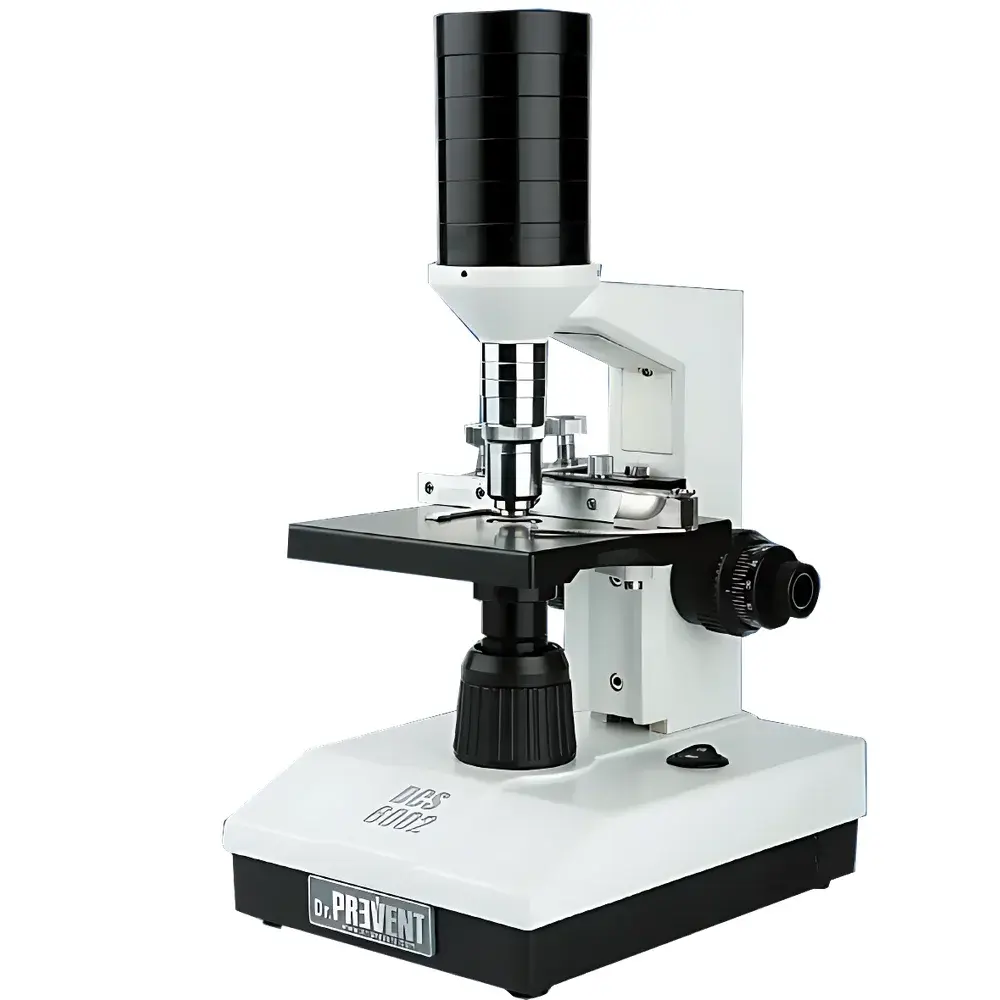
Product Intelligence & Creativity DSC6002 Phase Contrast Oral Microscope
| Brand | Product Intelligence & Creativity |
|---|---|
| Origin | Beijing, China |
| Model | DSC6002 |
| Total Magnification | 4200× |
| Objective Lens | 40× Phase Contrast |
| Auxiliary Lens | 1.25× |
| Camera Resolution | 410,000 pixels (Color CCD) |
| Focus Travel | 30 mm (Coarse/Fine), Fine Adjustment Graduation: 0.002 mm |
| Illuminator Vertical Adjustment | 20 mm |
| Interpupillary Distance Range | 55–75 mm |
| Mechanical Stage Dimensions | 190 × 145 mm, Travel Range: 75 × 50 mm, Vernier Scale: 0.1 mm |
| Dimensions (W×H×D) | 220 × 150 × 340 mm |
| Weight | 2.9 kg |
| Illumination | Adjustable High-Brightness LED (12 V, 50 W), Dual Filter Set (Yellow & Green, Ø43 mm) |
| Power Input | 110/220 V AC |
| Display | Integrated 17-inch LCD monitor (native resolution supports real-time bacterial motility visualization) |
Overview
The Product Intelligence & Creativity DSC6002 Phase Contrast Oral Microscope is a dedicated upright biological microscope engineered for non-invasive, label-free visualization of live oral microorganisms in clinical and educational settings. It operates on the principle of phase contrast optics—enhancing contrast in transparent, unstained biological specimens by converting phase shifts in light passing through varying refractive indices into amplitude differences visible to the human eye. This enables direct observation of motile bacteria, spirochetes, bacilli, cocci, and fusiform organisms in saliva, plaque scrapings, or gingival crevicular fluid without chemical fixation or staining—preserving native morphology and dynamic behavior. Designed specifically for dental clinics, periodontal practices, and oral hygiene education, the DSC6002 integrates an ergonomic optical path with real-time digital imaging, facilitating immediate patient engagement and evidence-based oral health counseling.
Key Features
- Phase contrast optical system with 40× phase objective and 1.25× auxiliary lens, delivering a total magnification of 4200× optimized for subcellular resolution of oral microbes.
- Integrated 17-inch high-contrast LCD display with native video output—enabling real-time visualization of bacterial motility, aggregation, and morphological heterogeneity.
- 410,000-pixel color CCD camera with USB 2.0 interface for seamless acquisition of still images and time-lapse video sequences directly to Windows- or macOS-based workstations.
- Adjustable high-intensity LED illumination (12 V, 50 W) with dual-band filter set (yellow and green, Ø43 mm) to enhance contrast for specific microbial morphotypes while minimizing phototoxicity and thermal load.
- Precision mechanical stage (190 × 145 mm) with 75 × 50 mm travel range and 0.1 mm vernier scale—supporting reproducible positioning during longitudinal monitoring of biofilm formation or treatment response.
- Fine focus mechanism with 0.002 mm graduation and 30 mm total travel—ensuring stable Z-axis control for multiplane assessment of layered oral specimens.
- Compact footprint (220 × 150 × 340 mm) and lightweight chassis (2.9 kg)—designed for benchtop deployment in operatory rooms, mobile dental units, or teaching laboratories.
Sample Compatibility & Compliance
The DSC6002 accommodates standard glass slides, Petri dishes (up to 100 mm diameter), and custom oral sampling carriers—including sterile swab smears, saliva sedimentation preparations, and gingival fluid droplets mounted under coverslips. Its phase contrast configuration eliminates the need for Gram staining or fluorescent labeling, aligning with CLSI M22-A3 and ISO 15189 pre-analytical guidelines for minimally manipulated specimen assessment. While not intended for diagnostic reporting per FDA 21 CFR Part 866.2900 or IVD CE marking, the system supports GLP-aligned documentation workflows when paired with validated image capture software. All optical components comply with ISO 8578 (microscope mechanical tube length standards) and IEC 61000-6-3 (EMC emission limits).
Software & Data Management
The microscope interfaces natively via USB with cross-platform imaging software supporting TIFF, JPEG, and AVI export formats. Metadata embedding includes timestamp, magnification, illumination intensity, and operator ID—enabling audit-ready traceability for clinical education records or internal QA reviews. Image annotation tools permit measurement calibration (µm/pixel), region-of-interest tagging, and side-by-side comparison of pre- and post-intervention samples. Exported datasets integrate with PACS-compatible viewers and electronic dental record (EDR) systems compliant with HL7 FHIR Imaging Document Resource standards. No cloud storage or proprietary SaaS subscription is required; all processing occurs locally to maintain HIPAA-compliant data sovereignty.
Applications
- Visual identification and qualitative monitoring of Treponema denticola, Fusobacterium nucleatum, and Porphyromonas gingivalis in untreated plaque samples.
- Educational demonstration of bacterial motility patterns—e.g., spirochetal corkscrew motion versus bacillary tumbling—to reinforce oral microbiome literacy among patients and students.
- Pre- and post-scaling evaluation of supragingival biofilm architecture and residual motile flora.
- Supporting preventive dentistry protocols by illustrating microbial load reduction following chlorhexidine rinses or probiotic interventions.
- Longitudinal tracking of microbial community shifts in elderly patients with xerostomia or denture-related stomatitis.
- Integration into dental school curricula for hands-on instruction in oral microbial ecology and evidence-based patient communication strategies.
FAQ
Is the DSC6002 suitable for quantitative bacterial enumeration?
No—it is designed for qualitative morphological and behavioral assessment, not colony-forming unit (CFU) quantification. For enumeration, culture-based or qPCR methods remain standard.
Can the system be calibrated to ISO/IEC 17025 requirements?
Yes—when used with NIST-traceable stage micrometers and documented SOPs for focus validation, it supports metrological traceability for internal competency assessments.
Does the microscope meet regulatory requirements for clinical use in the EU or USA?
It is classified as a general-purpose laboratory microscope under EU Directive 98/79/EC Annex II List B and FDA 21 CFR §866.2900 as a non-diagnostic aid; formal IVD certification is not claimed.
What is the expected service life of the LED illumination module?
Rated for ≥20,000 hours at nominal brightness—equivalent to >10 years of daily 6-hour clinical operation without spectral drift or intensity decay.
Is third-party software integration supported for AI-assisted morphology classification?
Yes—the USB video stream conforms to UVC 1.1 protocol, enabling compatibility with open-source platforms such as QuPath or commercial AI tools trained on oral microbiota image datasets.





