
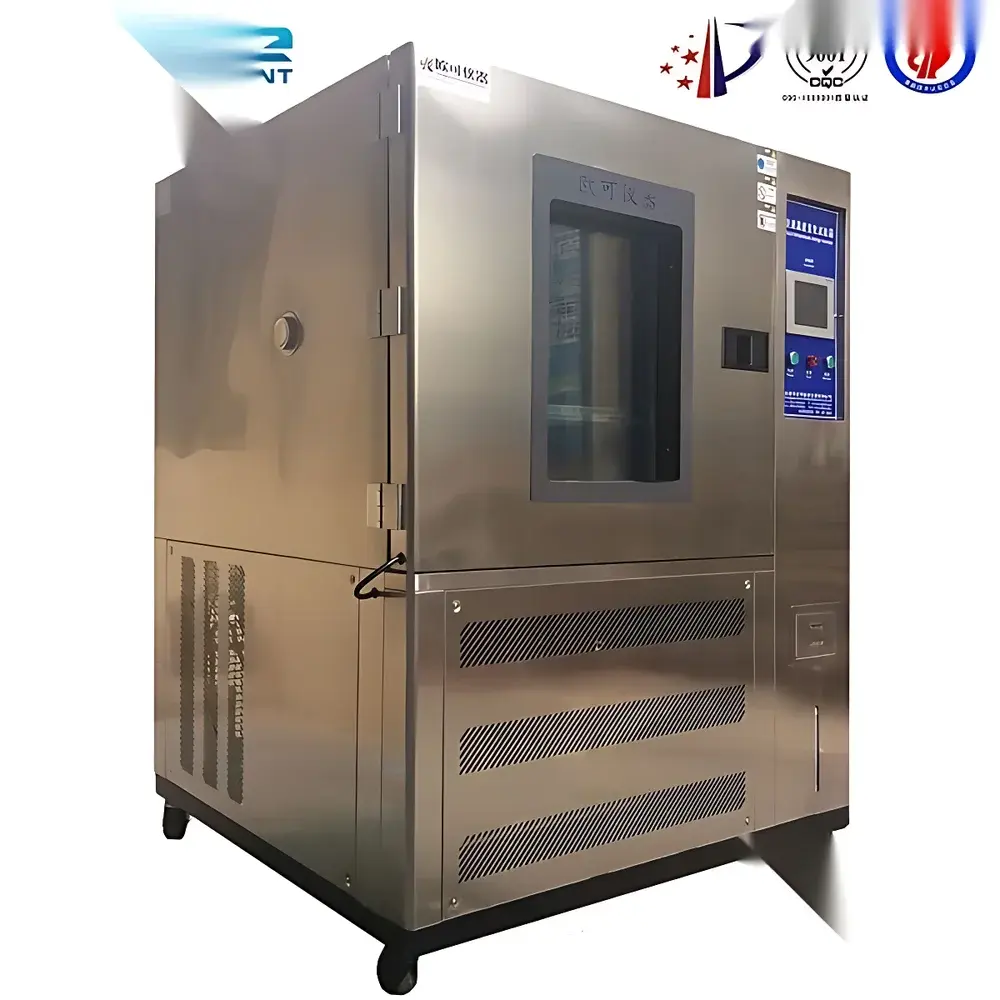
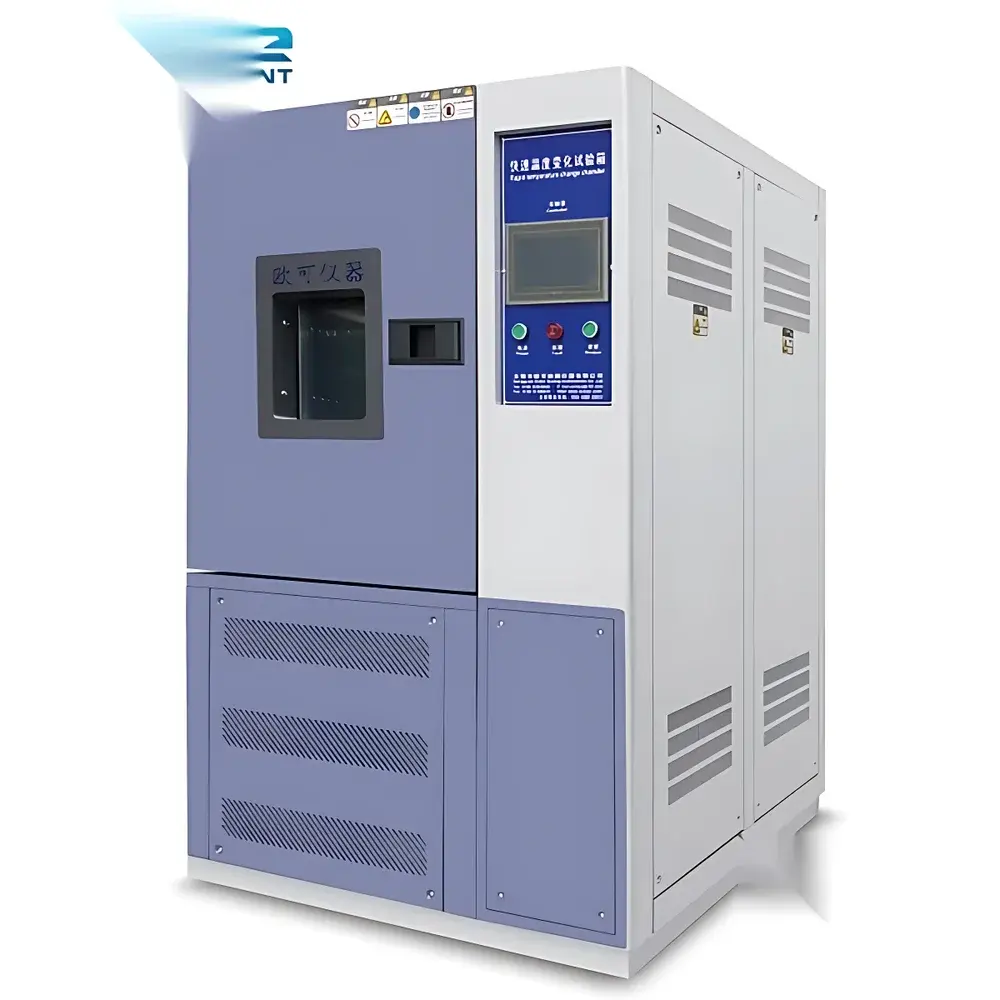
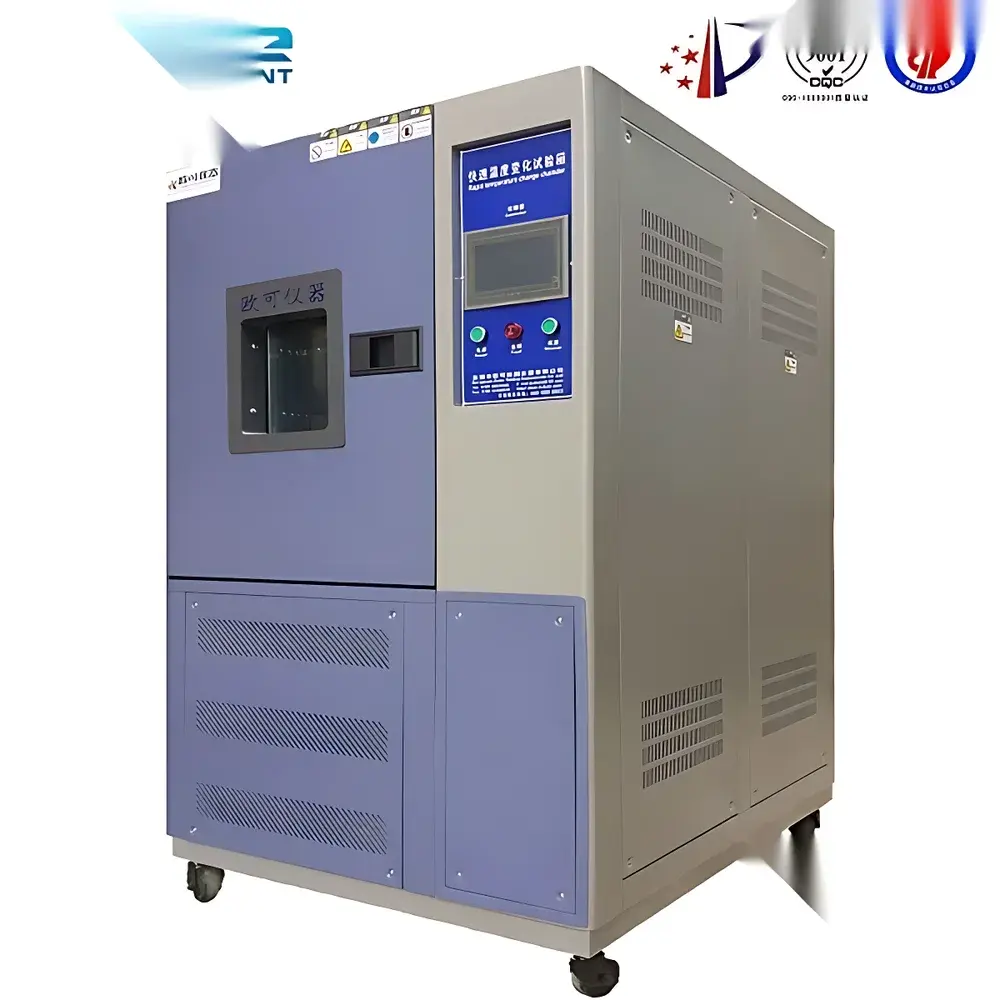
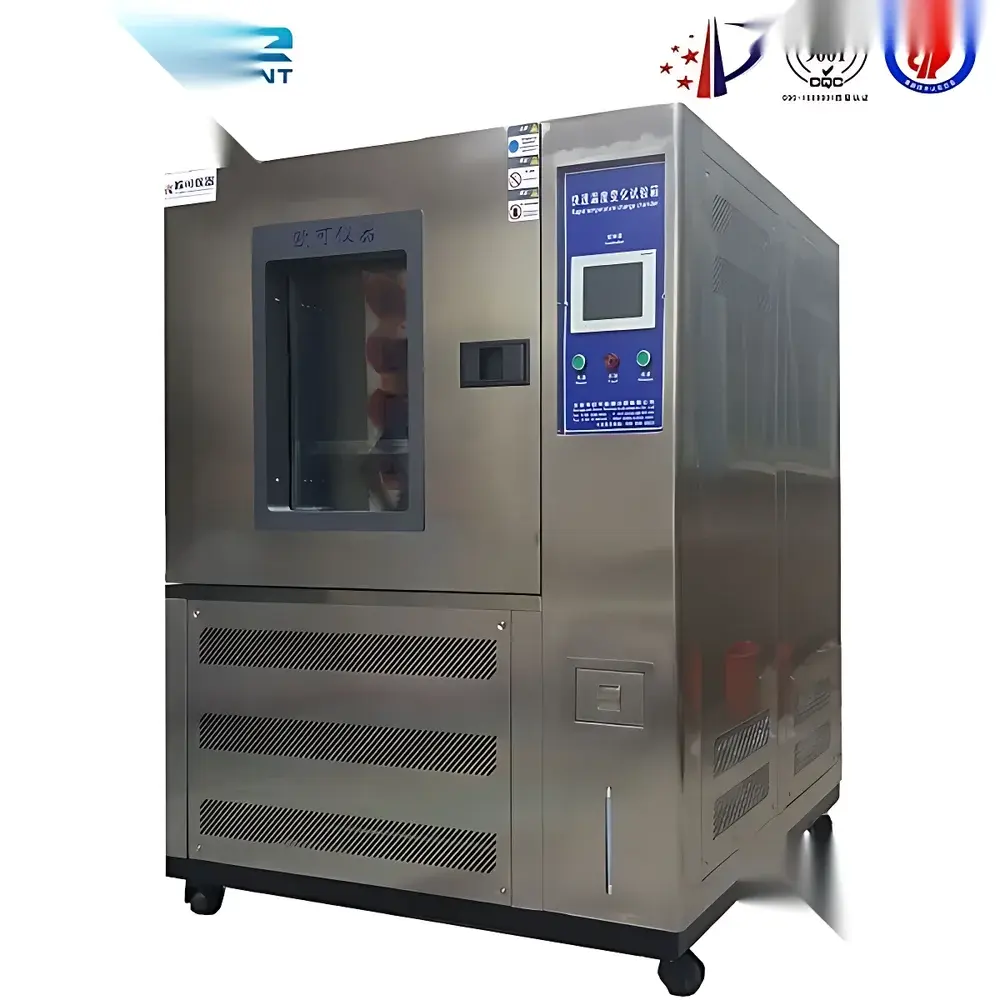
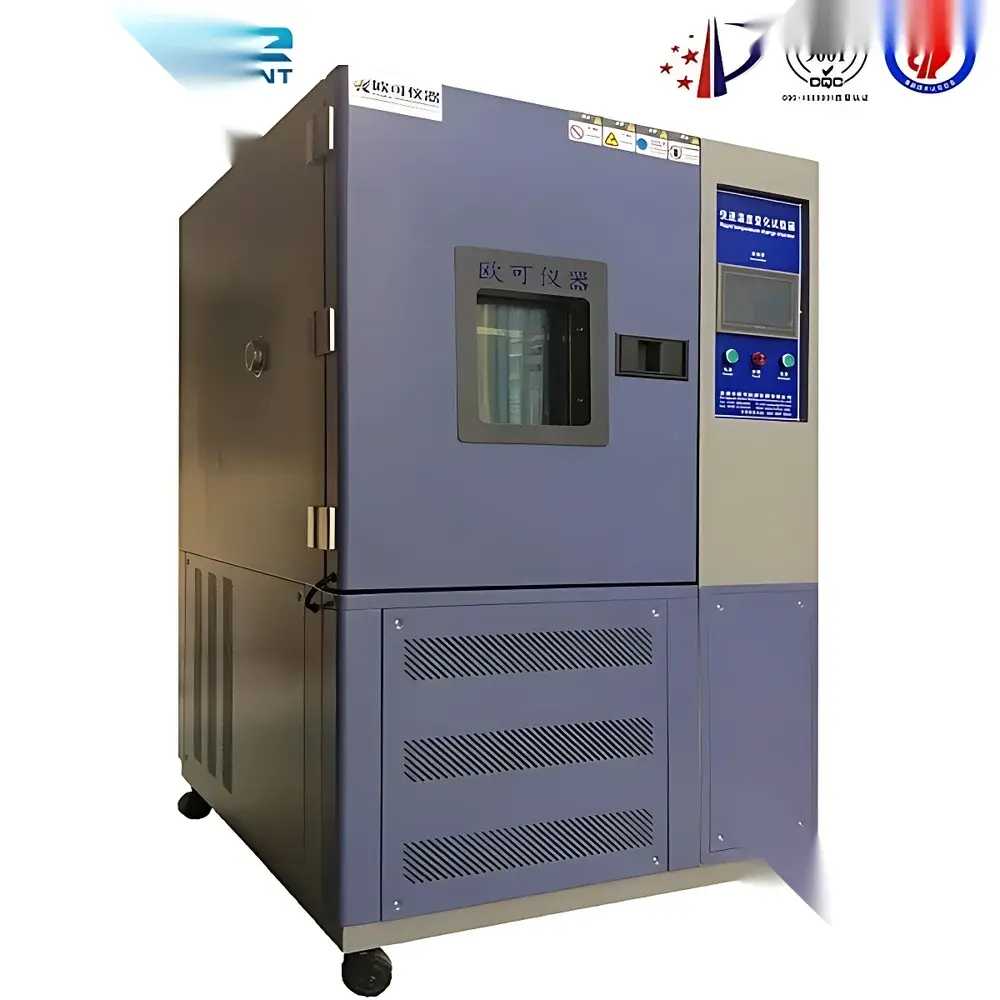
Programmable Rapid Temperature Change Test Chamber
| Brand | Custom OEM |
|---|---|
| Origin | Imported |
| Manufacturer Type | Authorized Distributor |
| Price | USD 14,500 (FOB) |
| Temperature Range | −70 °C to +150 °C |
| Humidity Range | 20–98% RH (optional: 5–98% RH) |
| Ramp Rates | 5–25 °C/min (selectable) |
| Temp Uniformity | ±2 °C |
| Humidity Uniformity | ±3.0% RH (≥75% RH) |
| Temp Stability | ±0.5 °C |
| Humidity Stability | ±2.5% RH |
| Internal Volume | 225–1000 L (customizable) |
| Construction | SUS 304 stainless steel |
| Refrigerant | R507/R23 (zero ODP, low GWP) |
| Control Interface | 7″ color LCD touch HMI with bilingual (EN/CN) support |
| Compliance | GB/T 2423.1, GB/T 2423.2, GB/T 2423.22, GJB 150.3, GJB 150.4, GB/T 10589, GB/T 11158, GB/T 10592 |
Overview
The Programmable Rapid Temperature Change Test Chamber is an engineered environmental simulation system designed for accelerated thermal stress testing of electronic components, automotive modules, aerospace subsystems, and high-reliability materials. It operates on a dual-stage cascade refrigeration architecture—integrating primary and secondary low-temperature circuits—to achieve precise, repeatable, and high-speed temperature transitions across a broad operational envelope (−70 °C to +150 °C). Unlike conventional thermal chambers, this unit delivers controlled ramp rates up to 25 °C/min between extreme setpoints, enabling rigorous evaluation of thermal shock resistance, solder joint integrity, seal performance, and material dimensional stability under dynamic thermal loads. Its design adheres to the physical principles of convective heat transfer optimization, employing a scientifically validated air circulation layout with axial-flow impellers and multi-directional ducting to eliminate thermal stratification and ensure uniform exposure across the entire test volume.
Key Features
- High-fidelity programmable controller with 7-inch full-color TFT-LCD touchscreen interface, supporting real-time curve visualization, multi-segment profile editing (up to 96 independent test standards), and bilingual (English/Chinese) operation—fully compliant with ISO/IEC 17025 documentation requirements.
- Cascade refrigeration system utilizing hermetically sealed, low-noise compressors from leading European and North American manufacturers, charged exclusively with environmentally certified refrigerants R507 and R23—zero ozone depletion potential (ODP = 0), low global warming potential (GWP < 3,500).
- Robust chamber construction using electropolished SUS 304 stainless steel interior and insulated double-wall housing with high-density polyurethane foam (thermal conductivity ≤ 0.022 W/m·K) for minimal energy loss and long-term structural integrity.
- Integrated safety architecture featuring redundant protection layers: overcurrent and earth-leakage circuit breakers, compressor discharge temperature monitoring, phase-loss detection, real-time ground-fault sensing, and dual-limit over-temperature cutoff with audible/visual alarm escalation.
- Standard 50 mm diameter access port (left-side mounted, sealed with silicone gasket) for external signal routing, power feedthrough, or sensor integration—compatible with MIL-STD-202 and IPC-9701 wiring protocols.
- Automated cycle management: programmable start/stop scheduling, unlimited loop count (1–999 cycles), dwell time control (1 min to 999 h 59 min), and auto-recovery after power interruption per IEC 61000-4-11 immunity specifications.
Sample Compatibility & Compliance
This chamber accommodates a wide range of sample configurations—from PCB assemblies and battery packs to optical enclosures and polymer housings—within customizable internal volumes (225 L to 1000 L). The uniform temperature distribution (±2 °C) and humidity homogeneity (±3.0% RH above 75% RH) meet stringent requirements for qualification testing under multiple international and defense standards. It is fully validated for conformance to GB/T 2423.1 (cold), GB/T 2423.2 (dry heat), GB/T 2423.22 (temperature change), GJB 150.3 (high-temp), GJB 150.4 (low-temp), and GB/T 10592 (general performance criteria). Optional humidity control extends applicability to combined environmental stress screening (CESS) per JEDEC JESD22-A104 and MIL-STD-810H Method 502.7. All control logic and data logging comply with GLP/GMP audit trail requirements, including user authentication, parameter change history, and timestamped event logs traceable to UTC.
Software & Data Management
The embedded controller firmware supports export of time-stamped CSV datasets (temperature, humidity, setpoint, alarm status) via USB or optional Ethernet interface. Data files are structured for direct import into MATLAB, Python pandas, or statistical process control (SPC) platforms such as Minitab or JMP. Firmware versioning, calibration certificate tracking, and password-protected administrator mode align with FDA 21 CFR Part 11 electronic record/electronic signature (ER/ES) readiness—enabling secure audit trails, role-based access control, and electronic signature capture for validation documentation. Remote monitoring and basic parameter adjustment are available via optional web-server module (HTTPS encrypted), compatible with enterprise SCADA environments using Modbus TCP protocol.
Applications
- Thermal cycling reliability assessment of semiconductors, connectors, and flex-rigid PCBs per IPC-9701 and AEC-Q200.
- Qualification of electric vehicle battery modules under rapid charge/discharge thermal transients.
- Validation of adhesive bond strength and encapsulant delamination behavior in optoelectronic packaging.
- Environmental stress screening (ESS) for avionics hardware prior to HALT/HASS campaigns.
- Material coefficient of thermal expansion (CTE) characterization via dimensional metrology under controlled ramp profiles.
- Accelerated aging studies of elastomeric seals, gaskets, and conformal coatings per ASTM D395 and ISO 188.
FAQ
What is the maximum achievable temperature ramp rate, and how is it verified?
The chamber achieves up to 25 °C/min between −45 °C and +85 °C, measured using NIST-traceable Class A PT100 sensors at nine standardized spatial locations per IEC 60068-3-5. Verification reports include uncertainty budgets and repeatability data (n ≥ 3 runs).
Can the system be integrated into an existing factory MES or LabVantage environment?
Yes—via optional Modbus TCP or OPC UA gateway modules. Full tag mapping, alarm forwarding, and historical data polling are supported without custom driver development.
Is humidity control mandatory, or can dry thermal cycling be performed without it?
Humidity functionality is modular: standard configuration supports dry thermal cycling only; humidity capability (20–98% RH) is factory-installed as a configurable option. No performance compromise occurs when operating in dry mode.
Does the controller support automated compliance reporting for ISO/IEC 17025 audits?
Yes—the system generates PDF-formatted test reports with embedded digital signatures, calibration metadata, environmental deviation flags, and operator ID logs—all compliant with ILAC P14:2019 requirements for accredited laboratories.



