
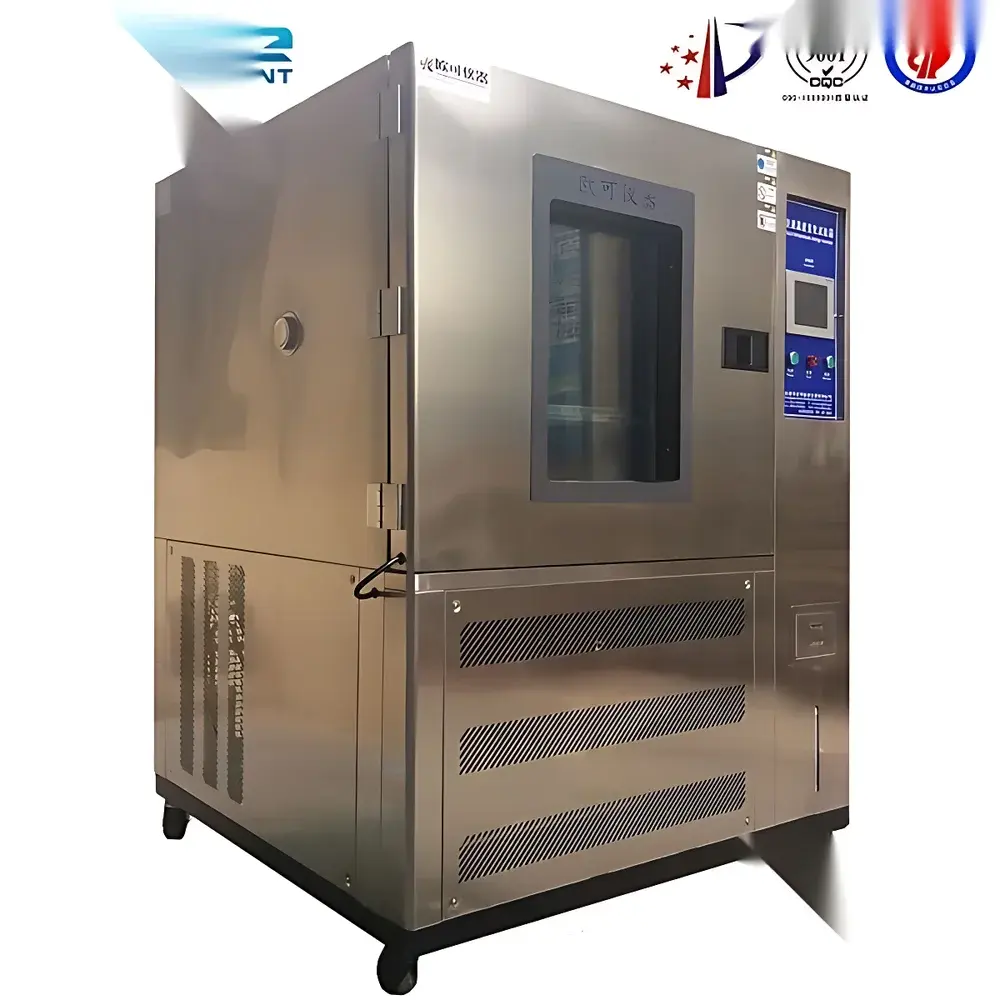
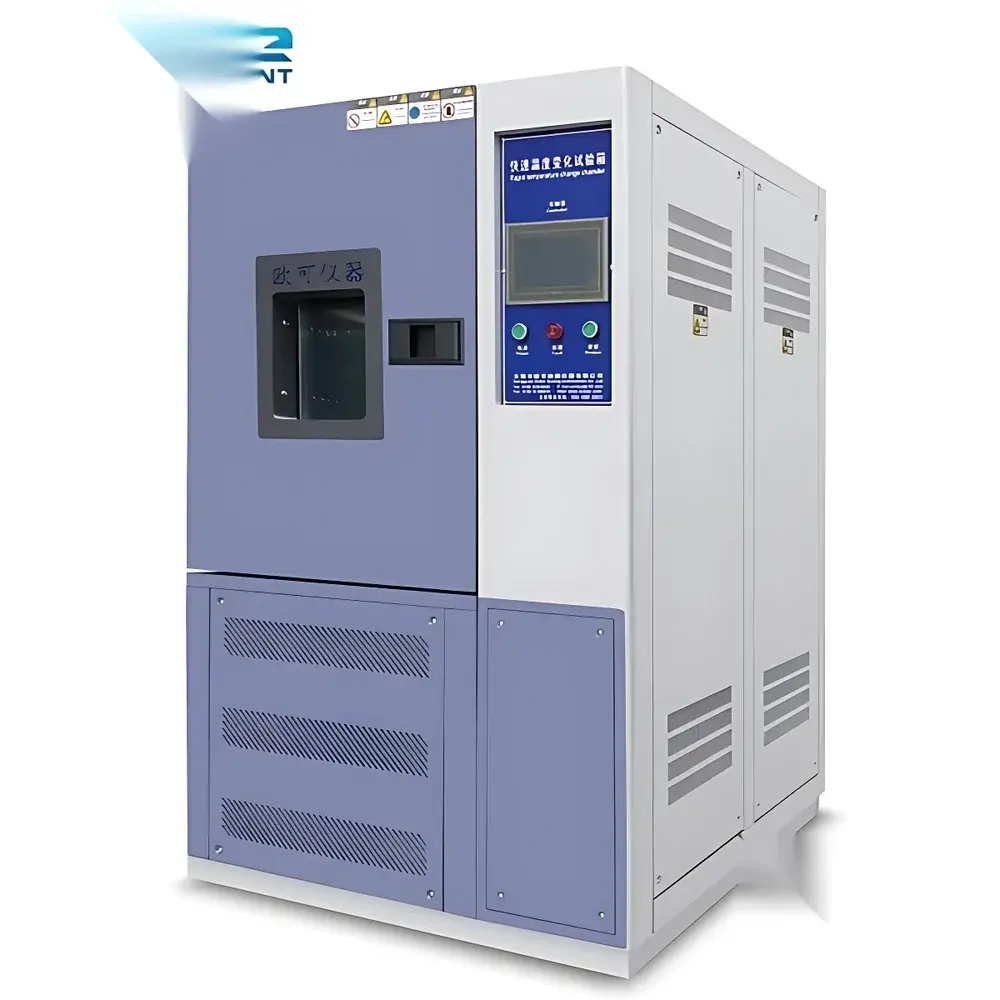
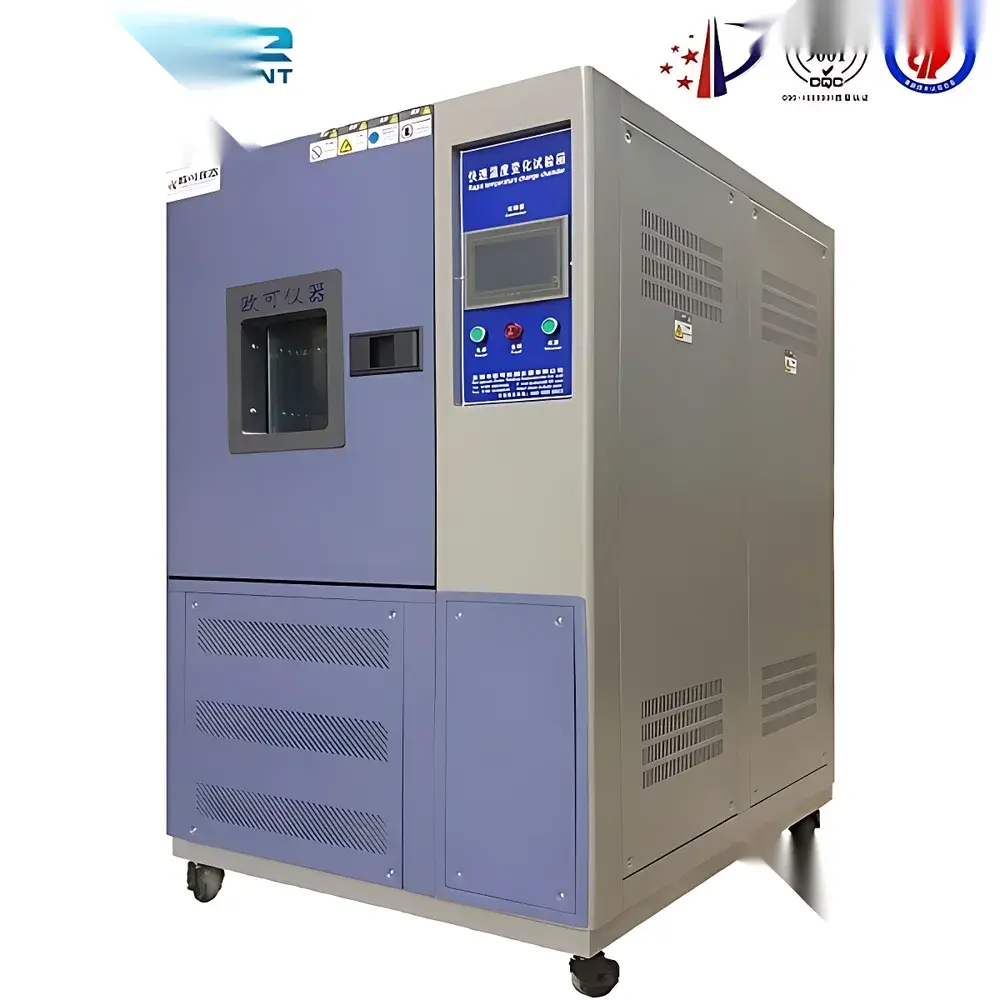
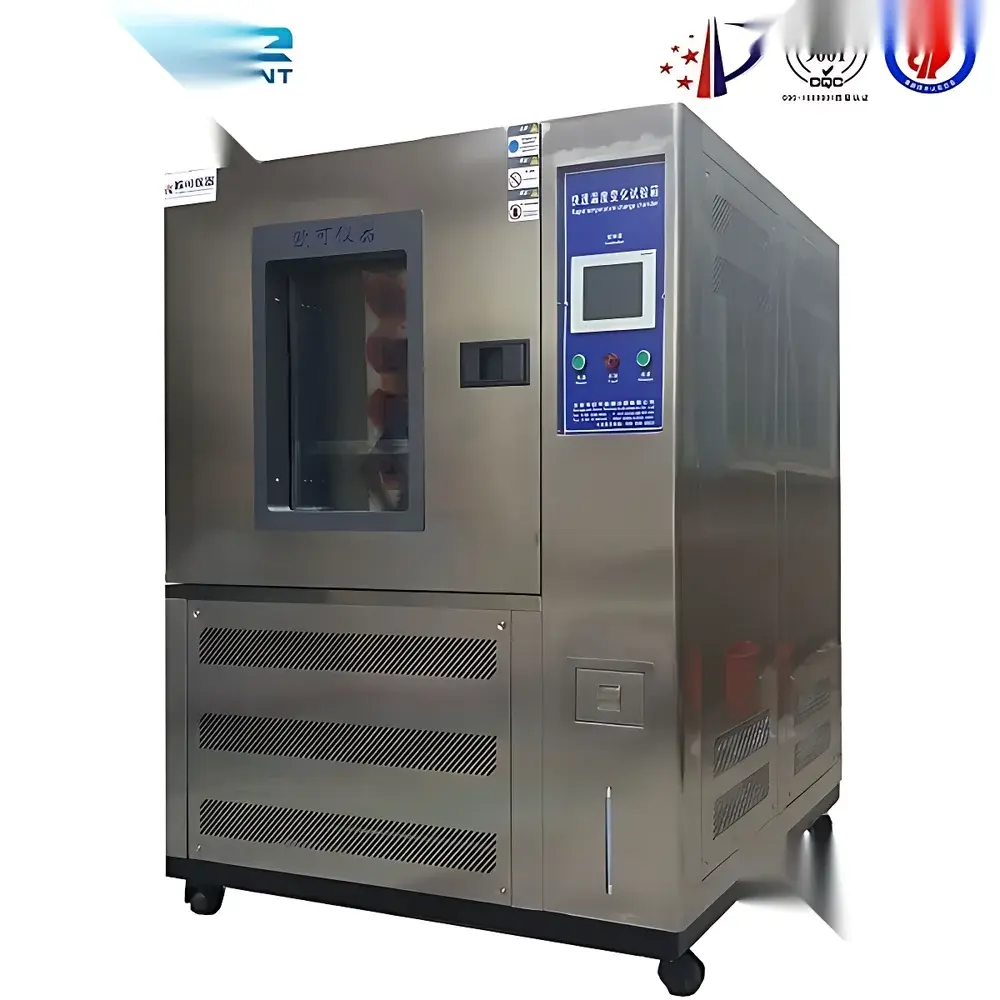
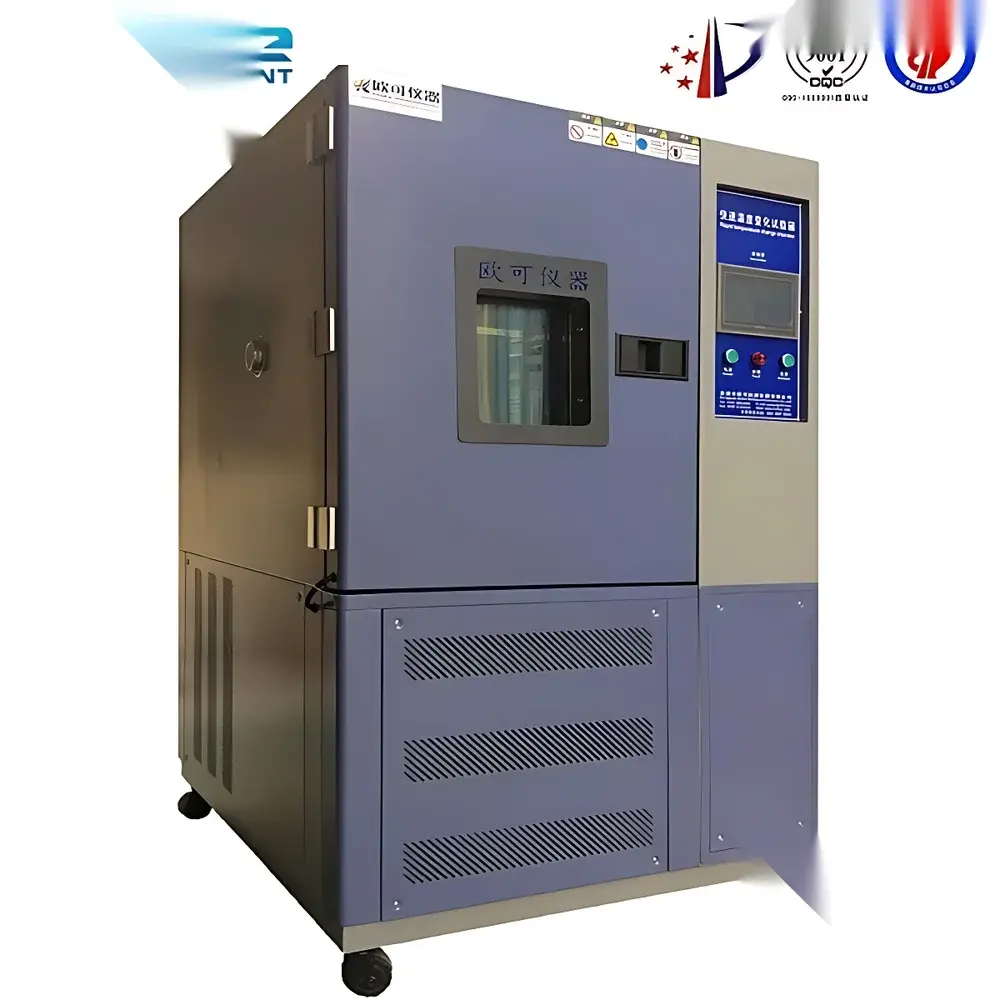
Programmable Rapid Temperature Change Test Chamber
| Brand | Custom OEM / Other Industrial Brands |
|---|---|
| Origin | Imported |
| Manufacturer Type | Authorized Distributor |
| Price | USD 14,000–18,000 (FOB) |
| Temperature Range | −70 °C to +150 °C |
| Humidity Range | 20–98% RH (optional: 5–98% RH) |
| Ramp Rates | 5–25 °C/min (selectable) |
| Temp. Uniformity | ±2 °C |
| Temp. Stability | ±0.5 °C |
| Humidity Uniformity | ±3.0% RH (≥75% RH) |
| Humidity Stability | ±2.5% RH |
| Internal Volume | 225–1000 L (KS-TH-225 to KS-TH-1000 series) |
| Test Port | Ø50 mm (left-side, sealed feedthrough) |
| Control Interface | 7-inch color LCD touch panel, bilingual (EN/CN), 96 programmable test profiles |
| Safety Compliance | Over-temperature, over-current, leakage, ground fault, compressor high-pressure/low-pressure, phase failure, and emergency power-off protection |
| Refrigerant | R507/R23 (zero ODP, low GWP HFC blend) |
| Structural Material | SUS304 stainless steel interior & chamber frame |
| Airflow Design | Optimized vertical/horizontal recirculation with PID-controlled damper actuation (≤10 s switching time) |
| Recovery Time | ≤5 min after thermal shock transition |
| Standards Compliance | GB/T 2423.1, GB/T 2423.2, GB/T 2423.22, GJB 150.3–150.5, GB 10589, GB 11158, GB 10592 |
Overview
The Programmable Rapid Temperature Change Test Chamber is an industrial-grade environmental simulation system engineered for precise, repeatable, and accelerated thermal stress testing of electronic components, automotive modules, aerospace hardware, and advanced materials. It operates on a dual- or triple-chamber thermal shock architecture—comprising independent high-temperature, low-temperature, and test zones—enabling rapid transitions between extreme thermal states without subjecting the DUT (Device Under Test) to mechanical movement. Thermal energy is stored in dedicated hot/cold reservoirs and transferred via high-efficiency air ducts and pneumatically actuated dampers, minimizing thermal inertia and ensuring sub-5-minute temperature recovery per ISO 16750-4 and MIL-STD-810H Section 503.4 requirements. The chamber’s core function is to replicate real-world thermal cycling conditions—including sudden ambient shifts, power-on/off transients, and seasonal extremes—to evaluate solder joint integrity, polymer dimensional stability, sealant adhesion, and long-term reliability under accelerated aging protocols.
Key Features
- Triple-zone configuration (hot chamber / cold chamber / test chamber) with vacuum-insulated partition walls and high-density polyurethane foam (≥150 mm thickness) for minimal thermal bridging and superior energy retention
- High-speed thermal ramp capability: selectable rates from 5 °C/min up to 25 °C/min across the full operating range (−70 °C to +150 °C), verified per IEC 60068-2-14 change-rate calibration methodology
- 7-inch industrial-grade TFT-LCD touchscreen controller with real-time graphical curve display, multi-language UI (English/Chinese), and 96 user-defined test profiles supporting nested loops, conditional branching, and hold-soak-ramp sequences
- PLC-integrated safety architecture with redundant monitoring: dual thermocouple inputs per zone, pressure transducers on refrigerant circuits, and automatic lockout on any deviation exceeding preset tolerance bands
- Environmentally compliant refrigeration: cascade two-stage system using R507 (high-temp stage) and R23 (low-temp stage), both zero-ozone-depletion-potential (ODP = 0) HFC refrigerants meeting EU F-Gas Regulation (EU) No 517/2014
- Robust mechanical design: SUS304 stainless steel inner chamber, reinforced structural frame, and vibration-damped compressor mounts to ensure long-term dimensional stability and acoustic performance (<72 dB(A) at 1 m)
Sample Compatibility & Compliance
This chamber accommodates static DUTs up to 1000 L internal volume (KS-TH-1000 model), with standardized Ø50 mm left-side port for external cabling, sensor leads, or pneumatic/hydraulic feedthroughs—sealed with silicone gaskets rated to −70 °C. All models comply with national and international environmental test standards including GB/T 2423.1 (cold), GB/T 2423.2 (dry heat), GB/T 2423.22 (temperature change), GJB 150.3–150.5 (military environmental engineering), and harmonized EN 60068-2 series. The control system supports audit-ready data logging with timestamped event records, aligning with GLP and GMP documentation requirements. Optional validation packages include IQ/OQ documentation, NIST-traceable sensor calibration certificates, and 21 CFR Part 11-compliant electronic signature support for regulated industries.
Software & Data Management
The embedded controller firmware provides deterministic real-time scheduling with millisecond-level command execution and synchronized multi-zone PID regulation (auto-tuned per ASTM E2655). Data is logged at user-selectable intervals (1 s to 60 min) to internal flash memory (≥16 GB) and exportable via USB 2.0 or Ethernet (Modbus TCP/RTU). Optional PC-based software enables remote monitoring, statistical process control (SPC) charting, failure mode correlation, and automated report generation (PDF/CSV). All operational logs—including alarm history, setpoint changes, door openings, and refrigerant pressure trends—are time-stamped with UTC synchronization and protected against unauthorized modification, satisfying FDA 21 CFR Part 11 Annex 11 traceability mandates.
Applications
- Qualification testing of PCBAs, IC packages, and MEMS sensors per AEC-Q200 and JEDEC JESD22-A104
- Thermal shock validation of battery packs (Li-ion, solid-state) under UN 38.3 Clause 50
- Material compatibility assessment for aerospace composites (e.g., carbon fiber/epoxy) under RTCA DO-160 Section 4
- Accelerated life testing of medical device enclosures per ISO 14971 risk management framework
- Reliability screening of automotive ECUs per ISO 16750-4 and LV-124 specification
- Humidity-temperature combined stress testing for conformal coating performance evaluation
FAQ
What is the difference between two-zone and three-zone thermal shock configurations?
Two-zone systems alternate airflow between hot and cold reservoirs into a single test chamber; three-zone systems maintain constant hot/cold reservoir temperatures while shuttling the DUT between them—offering faster transitions and tighter temperature stability during dwell phases.
Can the chamber perform humidity-controlled thermal cycling?
Yes—models equipped with optional humidification (5–98% RH range) integrate steam generators and dehumidification coils with dew-point control logic, enabling combined temp/humidity stress profiles per IEC 60068-2-30.
Is remote monitoring and control supported?
Standard Ethernet interface supports Modbus TCP for SCADA integration; optional cloud gateway enables secure HTTPS-based remote access with role-based authentication and encrypted data transmission.
How is temperature uniformity validated?
Uniformity is verified per GB/T 10589 using a 9-point sensor array (center + 8 corners) during steady-state operation at −40 °C, +25 °C, and +85 °C, with results documented in factory acceptance test (FAT) reports.
What maintenance intervals are recommended for the refrigeration system?
Compressor oil analysis and filter-drier replacement every 24 months; annual verification of refrigerant charge balance and pressure switch calibration per manufacturer service bulletin SB-KS-2023-01.



