
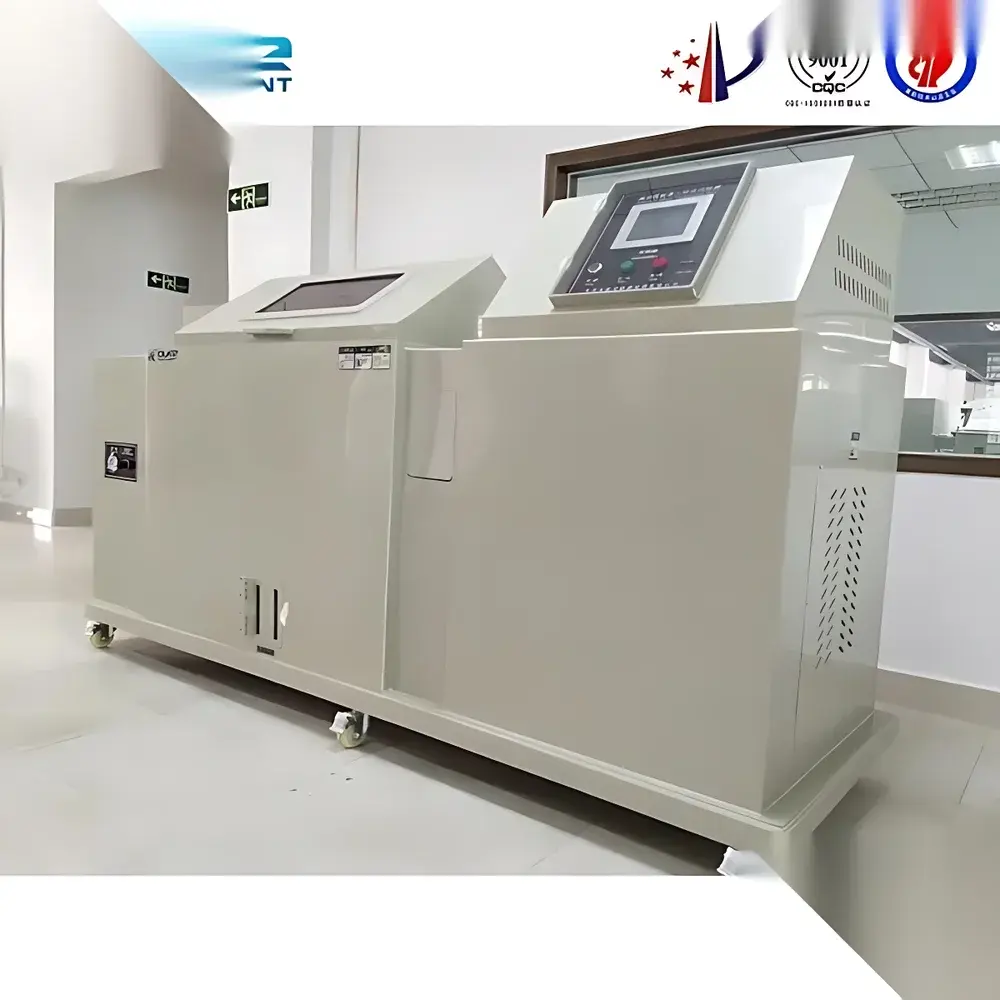
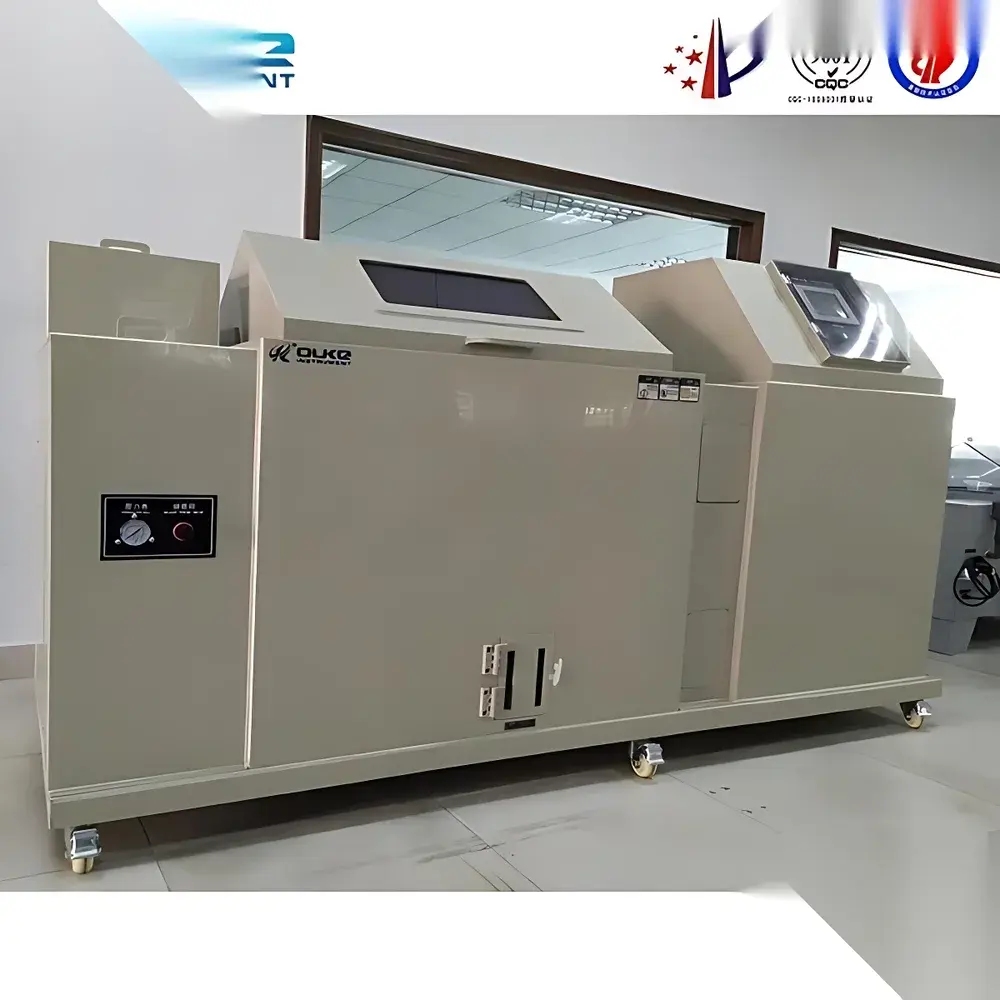
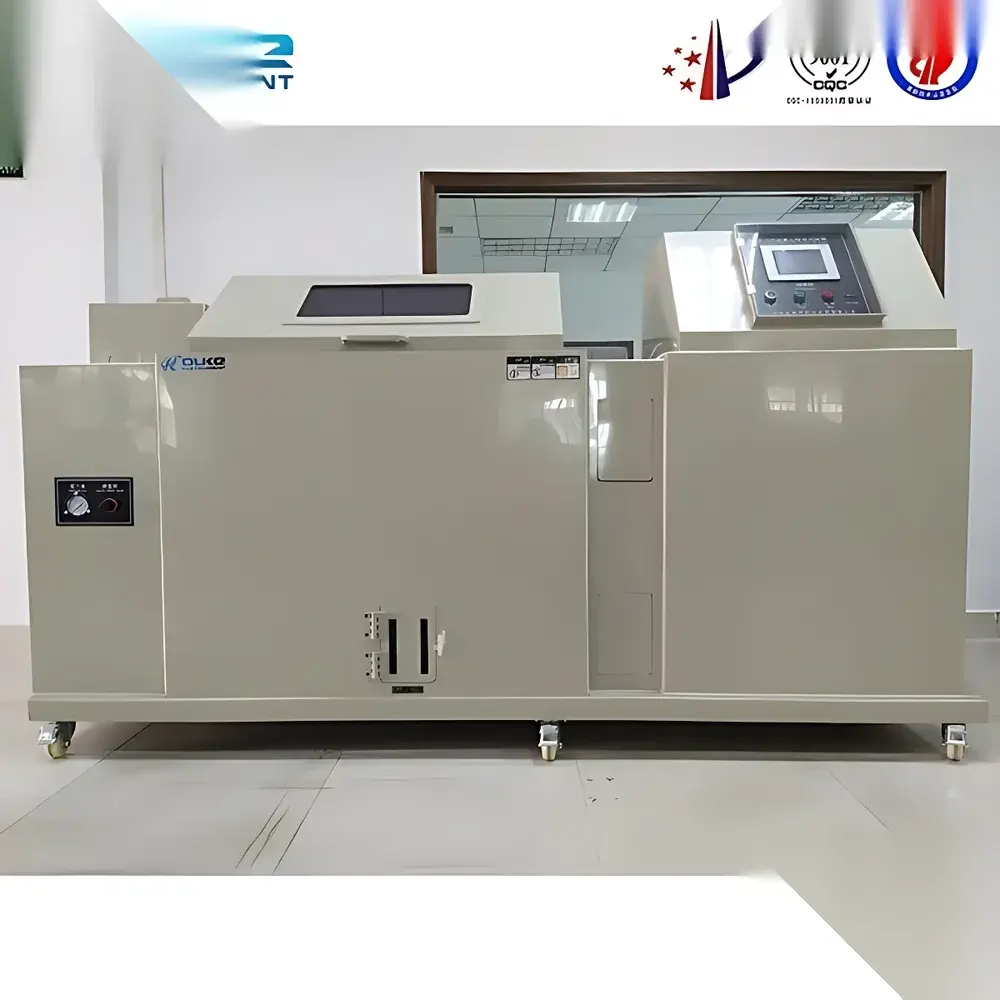
Programmable Salt Spray Corrosion Test Chamber
| Brand | Other Brands |
|---|---|
| Origin | Imported |
| Manufacturer Type | General Distributor |
| Price | USD 12,500 (FOB) |
| Temperature Control Accuracy | ±0.5 °C |
| NSS Test Condition | 35 °C ±1 °C (Chamber), 47 °C ±1 °C (Saturated Air Tank) |
| CASS Test Condition | 50 °C ±1 °C (Chamber), 63 °C ±1 °C (Saturated Air Tank) |
| Spray Angle Adjustment | 15° or 30° (planar indexing sample rack) |
| Air Pressure Regulation | Two-stage precision control (coarse: up to 2 kgf/cm² |
| fine | stable 1 kgf/cm² with digital pressure gauge) |
| Chamber Material | Welded PVC board (light gray, high-temp resistant) |
| Lid Material | Reinforced acrylic (impact-resistant, dual-layer edge design) |
| Humidification System | Direct steam heating with pure titanium heating elements |
| Compliance Standards | ASTM B117, ISO 9227, JIS Z2371, CNS 12289, GB/T 2423.17 |
Overview
The Programmable Salt Spray Corrosion Test Chamber is an engineered environmental test system designed for accelerated corrosion evaluation of metallic and coated materials under standardized saline aerosol exposure conditions. It operates on the principle of continuous or cyclic salt fog generation—where a precisely atomized sodium chloride (NaCl) solution is introduced into a temperature-controlled chamber via compressed air-driven nozzles—to simulate aggressive marine, industrial, or de-icing environments. Unlike basic static chambers, this unit integrates programmable logic control (Siemens PLC-based architecture), dual-stage air pressure regulation, and PID-driven thermal management to ensure strict adherence to international test protocols including ASTM B117 (Neutral Salt Spray), ISO 9227 (NSS/CASS/ASS), JIS Z2371, and GB/T 2423.17. Its fully automated operation mode enforces preconditioning validation—e.g., chamber temperature and saturated air tank temperature must reach setpoints before spray initiation—thereby eliminating false starts and enhancing inter-laboratory reproducibility.
Key Features
- Direct steam heating system with pure titanium immersion heaters—chemically inert to acidic/alkaline salt solutions, ensuring long-term stability and minimal power consumption.
- Planar indexing sample rack with adjustable inclination angles (15° or 30°) for uniform four-directional fog distribution and optimized specimen exposure geometry.
- Dual-stage air pressure regulation: coarse adjustment (up to 2 kgf/cm²) with integrated imported air filter and auto-drain function; fine-tuned final delivery at precisely 1 kgf/cm², monitored by calibrated analog/digital pressure gauge.
- Robust chamber construction using welded light-gray PVC board—resistant to thermal deformation and chemical attack at elevated operating temperatures.
- Reinforced transparent acrylic lid with double-thickened edges prevents warping during prolonged high-temperature operation and enables real-time visual inspection without opening.
- Integrated mist elimination system activates post-test to clear chamber visibility—critical for post-exposure assessment without manual venting delays.
- Dual-channel PID temperature control (±0.5 °C accuracy) with independent regulation of chamber and saturated air tank—facilitating traceable calibration and metrological compliance.
- Fail-safe protection suite: dual overtemperature cutoffs, low-water-level detection with automatic refill (using low-voltage DC sensor circuitry), and audible/visual alarm indicators.
Sample Compatibility & Compliance
This chamber accommodates flat, angular, or irregularly shaped specimens—including electroplated parts, automotive fasteners, aerospace alloys, painted panels, and galvanized steel components—on its modular, corrosion-resistant rack system. The 15°/30° tilt configuration ensures consistent droplet impingement across heterogeneous surfaces while maximizing rack capacity per cycle. All operational parameters align with regulatory requirements for quality assurance in industries governed by ISO/IEC 17025-accredited laboratories. It supports full audit readiness for GLP and GMP environments through programmable test sequencing, time-stamped event logging (start/end times, temperature deviations, spray status), and optional data export compatible with LIMS integration. The system meets mechanical and electrical safety standards per IEC 61000-6-2/6-4 and complies with CE marking directives for laboratory equipment.
Software & Data Management
The embedded human-machine interface features a high-contrast LCD display with intuitive menu navigation—enabling direct parameter entry, real-time monitoring of chamber temperature, saturated air tank temperature, elapsed time, and spray status. Test programs can be defined with up to 999,999 hours of duration (adjustable in seconds, minutes, or hours), including pause/resume functionality and power-loss recovery memory. While the base configuration uses Siemens S7-1200 PLC firmware (32-bit automotive-grade processor), optional RS-485/Modbus RTU or Ethernet/IP connectivity allows remote supervision and centralized data aggregation via SCADA or MES platforms. All critical events—including temperature excursions, water level warnings, and door-open interruptions—are timestamped and stored locally for ≥30 days, satisfying FDA 21 CFR Part 11 requirements when paired with user-access controls and electronic signature modules.
Applications
This test chamber serves as a core tool in corrosion R&D, supplier qualification, and incoming QC for sectors where material longevity under chloride exposure is mission-critical. Typical use cases include evaluating zinc-nickel plating performance on automotive brake calipers; assessing passivation integrity of stainless steel surgical instruments per ASTM F2519; validating anti-corrosion coatings on offshore wind turbine hubs; benchmarking aluminum alloy anodizing processes per MIL-A-8625; and verifying rust-inhibiting pretreatments for railway rolling stock components. Its programmability also supports modified test profiles—such as intermittent salt fog combined with dry/humidity phases—for simulating realistic service cycles beyond standard NSS/CASS protocols.
FAQ
What standards does this chamber support out-of-the-box?
ASTM B117, ISO 9227 (NSS, CASS, ASS), JIS Z2371, CNS 12289, and GB/T 2423.17—all configurable via front-panel programming without firmware modification.
Can the spray angle be customized beyond 15° and 30°?
No—the planar indexing mechanism is mechanically fixed at those two certified angles to maintain fog uniformity per ISO 9227 Annex B requirements.
Is the chamber suitable for testing non-metallic materials like plastics or elastomers?
Yes, though extended exposure may require validation against ISO 4611 or ASTM D4329 for polymer-specific degradation mechanisms; the chamber itself imposes no material restrictions.
Does the system include calibration documentation?
A factory calibration certificate (traceable to NIST or equivalent national metrology institute) is provided with shipment, covering temperature sensors and pressure transducers.
What maintenance intervals are recommended?
Daily: inspect nozzle cleanliness and water level; weekly: clean air filter and drain separator; quarterly: verify PID tuning and recalibrate temperature sensors using certified reference probes.



