
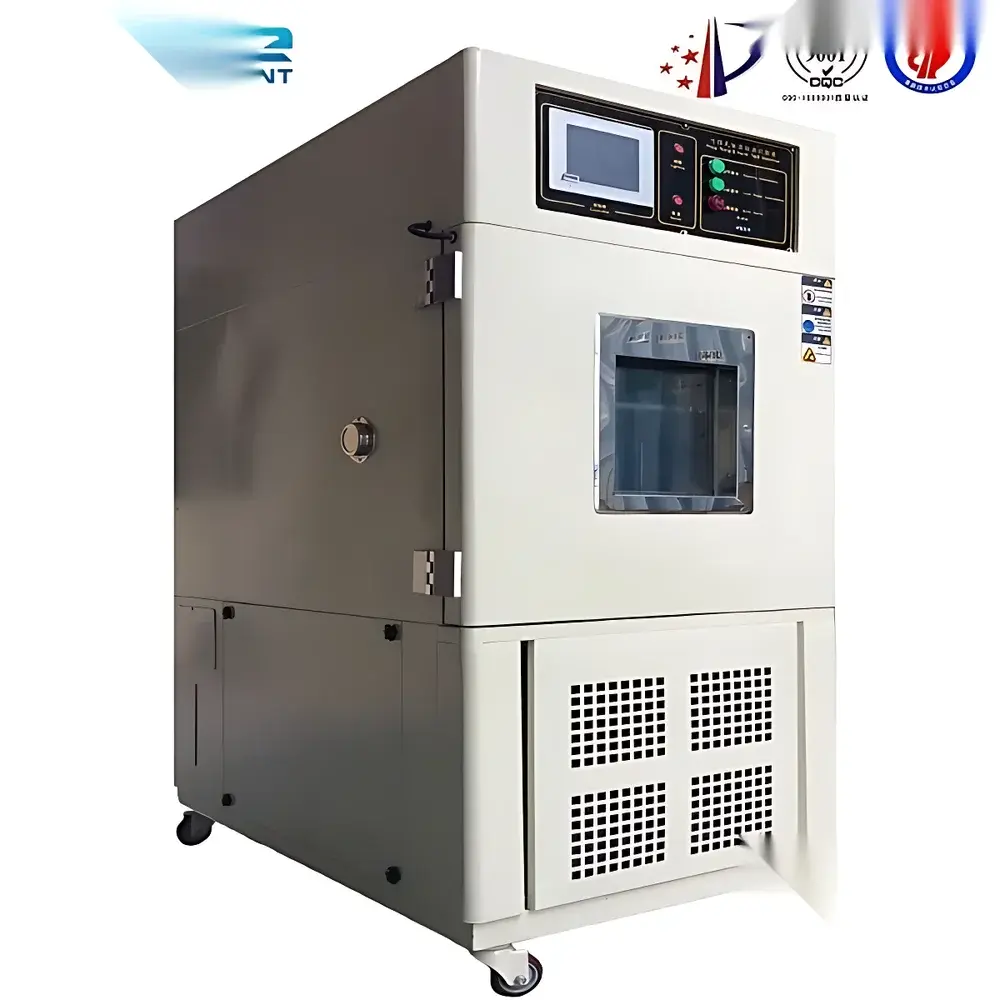
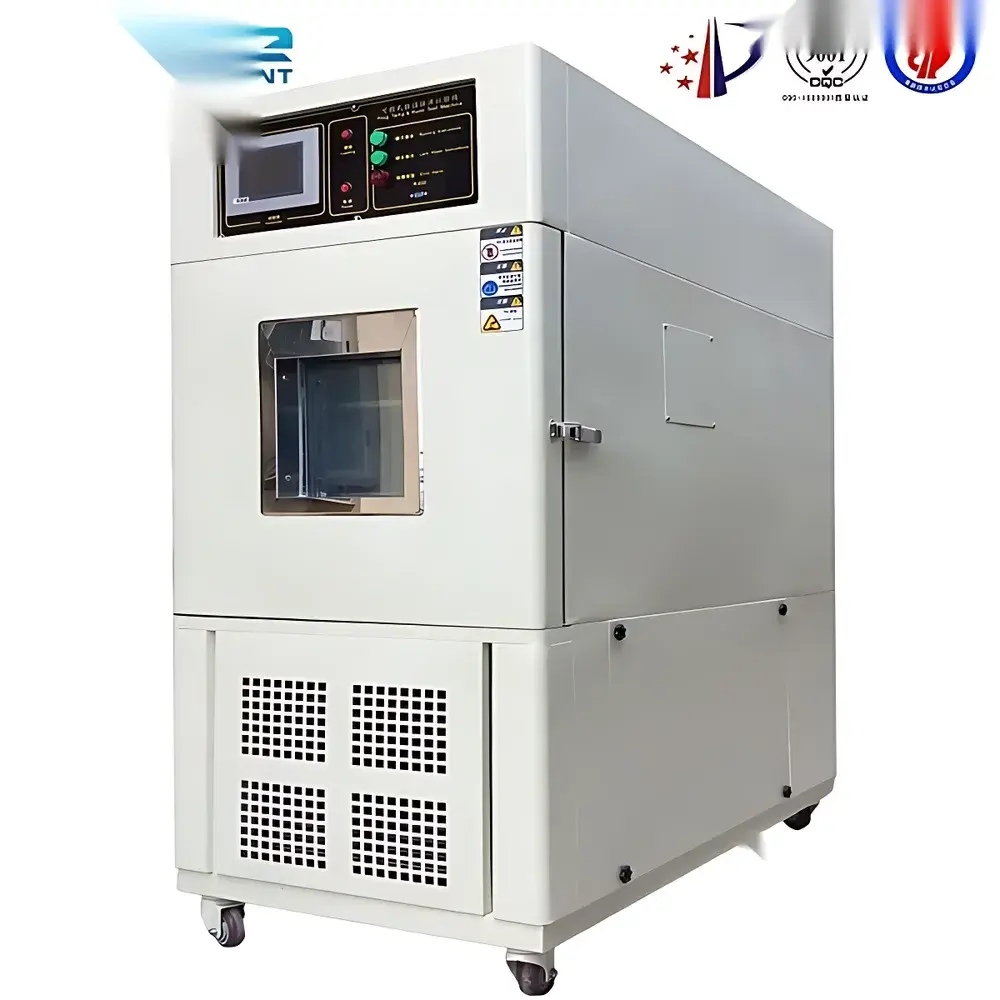
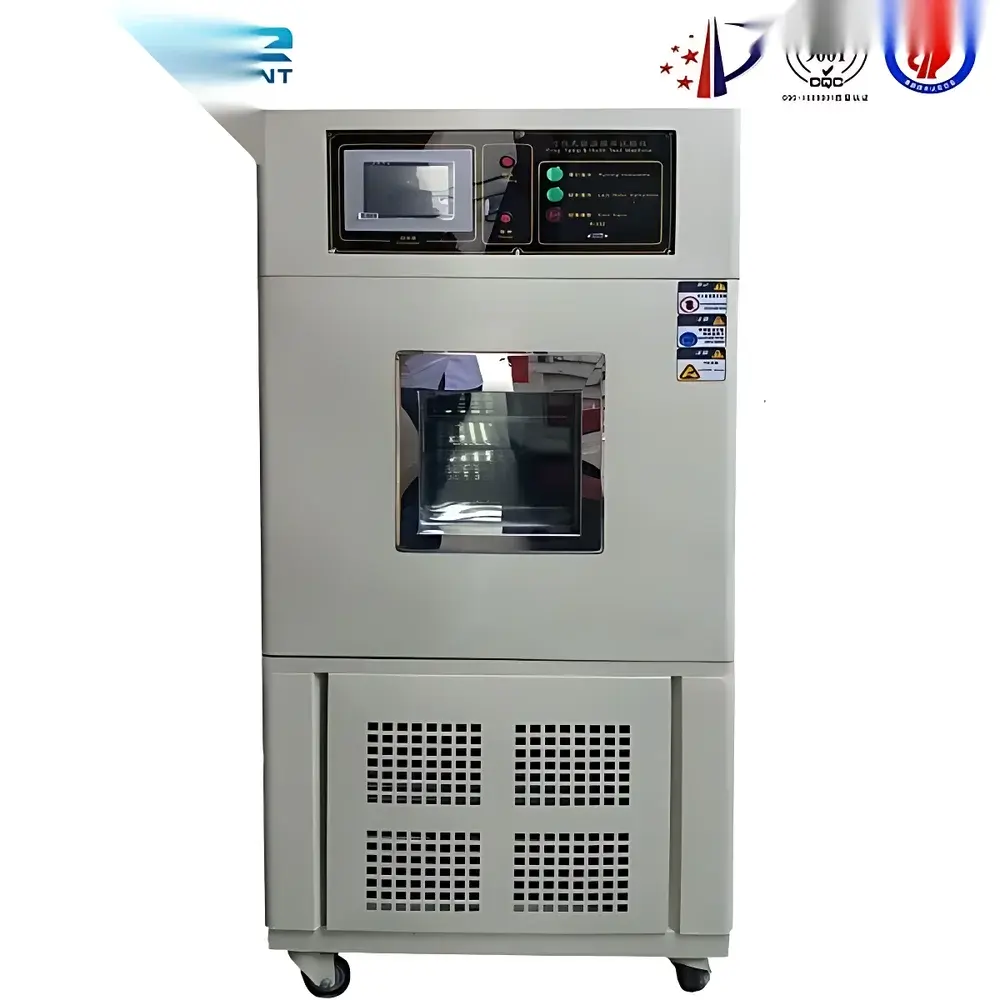
Programmable Temperature and Humidity Environmental Test Chamber – OEM/ODM Manufacturer
| [Brand | Other Brands |
|---|---|
| Origin | Imported |
| Manufacturer Type | Authorized Distributor |
| Price | USD 2,800 (approx.) |
| Compliance | GB10589-89, GB10592-89, GB11158-89, GB/T5170.2-1996, GB/T5170.5-1996, GB2423.1-89, GB2423.2-89, GB2423.22-87, GB2424.1-89 |
| Operating Ambient | 25°C ±6°C, Unloaded |
| Cooling Water Supply | 10–28°C, 0.1–0.3 MPa |
| Temperature Range | −70°C to +150°C (configurable) |
| Humidity Range | 20–98% RH |
| Ramp Rate | Air-average, not product-specific, dependent on load and configuration] |
Overview
The Programmable Temperature and Humidity Environmental Test Chamber is an industrial-grade climatic simulation system engineered for precision thermal and hygrothermal stress testing of electronic components, automotive modules, aerospace hardware, medical devices, and materials under controlled, repeatable conditions. It operates on a dual-loop balanced temperature and humidity control (BTHC) architecture—integrating independent refrigeration, heating, humidification, and dehumidification subsystems—to maintain stable setpoints across wide operational ranges. Unlike single-loop systems, BTHC employs proportional-integral-derivative (PID) control via solid-state relays (SSR), dynamically matching thermal/humidification output to real-time chamber losses. This ensures long-term stability, minimal overshoot, and compliance with international environmental test standards including IEC 60068-2, MIL-STD-810, and ISO 16750-4—while also meeting the full scope of referenced Chinese national standards (GB series) for verification and calibration traceability.
Key Features
- Full-range programmable operation from −70°C to +150°C and 20–98% RH, with customizable low-temperature configurations (e.g., −60°C, −50°C variants) based on compressor cascade or LN₂-assisted cooling options;
- Advanced touch-screen controller with multi-segment ramp-soak profiles, real-time trend logging, and password-protected parameter lockdown for GLP/GMP-aligned operation;
- Optimized air circulation design featuring centrifugal blower and laminar airflow ducting to ensure uniform temperature distribution (±0.5°C) and humidity homogeneity (±2% RH) per GB/T5170.2 and GB/T5170.5;
- High-efficiency refrigeration circuit utilizing all-copper capillary tube expansion technology—eliminating mechanical expansion valves for enhanced reliability, reduced maintenance, and improved transient response during rapid thermal transitions;
- Ergonomic chamber construction with seamless arc-welded stainless steel interior, double-wall insulation (polyurethane foam, ≥100 mm), and non-reflective, corrosion-resistant exterior finish;
- Integrated safety interlocks: over-temperature cut-off, high-humidity shutoff, refrigerant pressure monitoring, door switch override, and water flow sensor for chiller-cooling circuits.
Sample Compatibility & Compliance
This chamber accommodates diverse sample types—including PCB assemblies, battery packs, polymer composites, packaging materials, and sealed enclosures—without compromising environmental fidelity. Internal dimensions are fully customizable (including walk-in configurations), and optional accessories include stainless steel shelves, cable ports (with silicone grommets), data acquisition interfaces (RS485/Modbus, Ethernet), and internal lighting with UV shielding. All units undergo factory calibration per GB/T5170.2 (temperature) and GB/T5170.5 (humidity), with documented as-found/as-left reports. The system supports audit-ready documentation workflows compatible with FDA 21 CFR Part 11 requirements when paired with validated software packages.
Software & Data Management
Standard controller firmware enables up to 100 programmable test cycles, each with 99 segments (ramp, soak, step), event-triggered alarms, and onboard storage for ≥30 days of 1-second interval data. Optional PC-based software provides remote monitoring, automated report generation (PDF/CSV), statistical process control (SPC) overlays, and electronic signature support. Raw data export adheres to ASTM E2918 and ISO/IEC 17025 metadata conventions—including timestamps, operator ID, chamber ID, and calibration certificate references—ensuring full traceability in regulated QA/QC environments.
Applications
- Accelerated life testing of lithium-ion batteries under combined thermal cycling and humidity exposure;
- Qualification of avionics enclosures per DO-160 Section 4 (temperature) and Section 7 (humidity);
- Validation of adhesive bond integrity in automotive trim components across −40°C to +85°C/85% RH;
- Stability assessment of pharmaceutical primary packaging per ICH Q1A(R2) long-term and accelerated conditions;
- Environmental stress screening (ESS) of military-grade connectors and conformally coated circuit boards;
- Material coefficient of thermal expansion (CTE) characterization via dimensional metrology integration.
FAQ
What is the difference between “air-average ramp rate” and “product temperature transition rate”?
Air-average ramp rate refers to the mean change in chamber air temperature over time—not the actual thermal response of the test specimen. Product-specific rates depend on mass, thermal conductivity, mounting method, and internal airflow obstruction, and must be verified separately using calibrated thermocouples.
Is this chamber suitable for continuous operation at extreme low temperatures (e.g., −70°C)?
Yes—units configured with two-stage cascade refrigeration or liquid nitrogen assist support uninterrupted operation at −70°C, provided ambient cooling water remains within 10–28°C and system condensate drainage is maintained per installation manual.
Can the controller be validated for 21 CFR Part 11 compliance?
The base controller supports user access levels and audit trail logs; full Part 11 compliance requires deployment of the optional validated software suite with electronic signatures, role-based permissions, and immutable data archiving.
Does the chamber meet international standards beyond GB specifications?
Yes—its thermal and humidity performance aligns with IEC 60068-2-1 (cold), IEC 60068-2-2 (dry heat), IEC 60068-2-30 (damp heat, cyclic), and ISO 16750-4 (road vehicles), enabling global test acceptance without requalification.
What maintenance intervals are recommended for long-term reliability?
Compressor oil and filter replacement every 24 months; capillary tube inspection and refrigerant purity analysis annually; humidity sensor recalibration every 6 months or after 500 operational hours—per ISO/IEC 17025 preventive maintenance guidelines.



