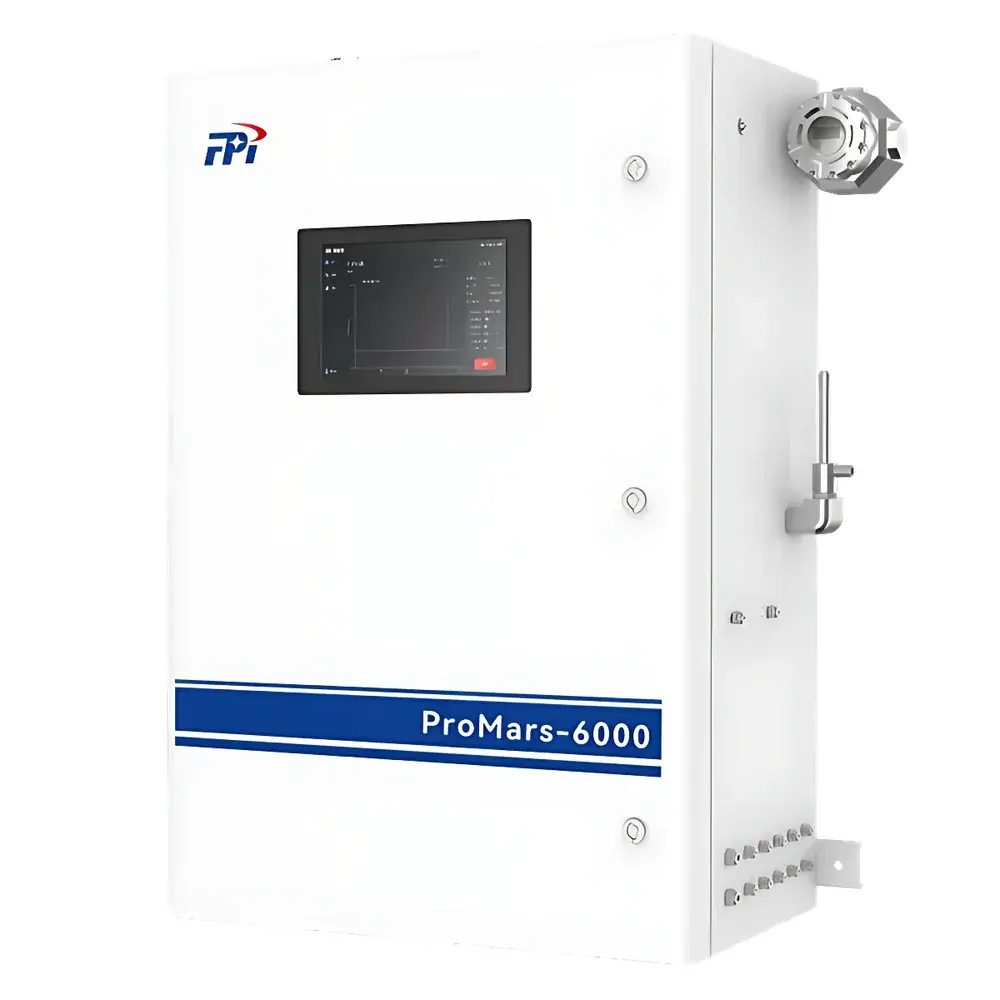
ProMars-6000 Online Mass Spectrometer by FPI
| Brand | FPI |
|---|---|
| Origin | Zhejiang, China |
| Manufacturer Type | Original Equipment Manufacturer (OEM) |
| Country of Origin | China |
| Model | ProMars-6000 |
| Pricing | Available upon Request |
Overview
The ProMars-6000 Online Mass Spectrometer is an industrial-grade quadrupole mass spectrometry system engineered for real-time, continuous gas-phase compositional analysis in demanding process environments. Operating on the principle of electron ionization (EI) coupled with quadrupole mass filtering, the instrument separates and detects gaseous species based on their mass-to-charge ratio (m/z) with high specificity and temporal resolution. Designed for integration into distributed control systems (DCS) and programmable logic controllers (PLC), it delivers sub-second analytical response—enabling closed-loop process monitoring, rapid fault detection, and dynamic optimization in continuous manufacturing operations. Its robust architecture supports unattended 24/7 operation under fluctuating temperature, pressure, and humidity conditions typical of plant-floor installations.
Key Features
- High-speed scanning capability: Single-component analysis completed in <0.5 seconds, supporting up to 10 Hz full-spectrum acquisition for time-resolved process dynamics.
- Mass range: 1–200 amu, covering common process gases (e.g., H₂, O₂, N₂, CO, CO₂, CH₄, C₂H₄, NH₃, H₂S) and volatile organic compounds (VOCs) relevant to chemical and metallurgical processes.
- Quadrupole mass analyzer with high mass stability and resolution (unit mass resolution at 10% valley definition), calibrated to NIST-traceable standards.
- Dual-detector configuration: Faraday cup for high-concentration measurement (linear dynamic range up to 10⁶) and electron multiplier (EM) for trace-level detection (sub-ppb LOD for selected analytes), with automatic gain switching and cross-calibration.
- Ion source with dual filament design, overcurrent protection, and inertized surface coating (e.g., gold or ceramic) to minimize adsorption, memory effects, and carbon deposition during long-term exposure to reactive or condensable process streams.
- Automated sensitivity calibration using internal reference gas pulses (e.g., Ar or Ne), scheduled per user-defined intervals (e.g., every 4–24 hours) to maintain quantitative accuracy without manual intervention.
- One-touch startup sequence with preloaded method templates, reducing operator dependency and minimizing warm-up and tuning time prior to routine analysis.
Sample Compatibility & Compliance
The ProMars-6000 interfaces with standard 1/4″ or 3/8″ stainless-steel sample lines and accepts gas streams conditioned via heated sampling probes, particulate filters, moisture traps, and pressure regulators (0.1–1.5 bar absolute inlet pressure, 30–150 °C sample temperature). It complies with IEC 61000-6-2 (immunity) and IEC 61000-6-4 (emissions) for industrial electromagnetic compatibility. While not intrinsically safe certified out-of-the-box, it is compatible with ATEX/IECEx Zone 2 or Class I Div 2 safety enclosures when deployed in hazardous areas. Data integrity features align with FDA 21 CFR Part 11 requirements—including electronic signatures, audit trails, and method locking—supporting GLP and GMP-aligned validation protocols in regulated industries.
Software & Data Management
The proprietary ProcessMS software suite provides a Windows-based interface for instrument control, spectral visualization, quantitative calibration, and method development. Key modules include real-time mass chromatogram display, peak deconvolution for overlapping signals, multi-point calibration curve generation (linear, quadratic, or polynomial), and automated drift correction using internal standards. Raw data are stored in HDF5 format with embedded metadata (timestamp, instrument parameters, calibration status), enabling seamless export to LIMS, MES, or PI System via OPC UA or Modbus TCP. Software supports IQ/OQ documentation packages and includes built-in tools for performance verification tests (e.g., mass axis accuracy, sensitivity stability, repeatability assessment).
Applications
- Steelmaking & ferroalloy production: Real-time monitoring of blast furnace top gas, coke oven gas, and converter off-gas for CO/CO₂ ratio control, energy recovery optimization, and emission compliance reporting.
- Coal gasification: In-situ analysis of syngas composition (H₂/CO/CH₄/CO₂) to adjust oxygen-to-coal ratio and optimize gasifier thermal efficiency.
- Ethylene cracking units: Rapid detection of key裂解 products (C₂H₄, C₃H₆, C₄ hydrocarbons) and impurities (e.g., Cl⁻, S-compounds) to guide fractionation column setpoints and catalyst health assessment.
- Industrial bioreactors: Online tracking of dissolved O₂, CO₂ evolution rate (CER), and off-gas metabolites (e.g., ethanol, acetate) for metabolic flux analysis and fed-batch control.
- Hydrogen production & purification: Quantitative measurement of H₂ purity, residual N₂/O₂, and trace contaminants (e.g., H₂O, CO) in PEM electrolyzer or PSA tail gas streams.
FAQ
What sample introduction options are supported?
Standard configurations include heated capillary inlet (up to 150 °C), with optional integration of gas chromatography (GC) pre-separation modules for complex mixtures.
Is the system compatible with existing DCS platforms?
Yes—native support for Modbus TCP, OPC UA, and analog 4–20 mA outputs enables direct integration with Emerson DeltaV, Honeywell Experion, and Siemens PCS7 systems.
How often does the instrument require maintenance?
Routine maintenance intervals are typically 6–12 months; filament replacement and quadrupole cleaning are recommended annually under continuous operation.
Can the ProMars-6000 be validated for regulated pharmaceutical applications?
Yes—the hardware and software architecture support full 21 CFR Part 11 compliance, including role-based access control, electronic signatures, and audit trail generation required for FDA-submitted validation reports.
What is the typical installation footprint and power requirement?
The main analyzer unit occupies 600 × 500 × 300 mm (W × D × H) and operates on single-phase 220 V AC, 50/60 Hz, with total power consumption ≤1.2 kW including vacuum pumps and electronics.