
Protea Solus HCl Hydrogen Chloride Gas Analyzer
| Brand | Protea |
|---|---|
| Origin | United Kingdom |
| Manufacturer Type | Authorized Distributor |
| Origin Category | Imported |
| Model | Solus HCl |
| Pricing | Upon Request |
Overview
The Protea Solus HCl Gas Analyzer is a compact, extractive laser-based gas measurement system engineered for continuous, real-time quantification of hydrogen chloride (HCl) in demanding industrial emission streams. It employs Tunable Diode Laser Absorption Spectroscopy (TDLAS) in the near-infrared (NIR) spectral region — specifically targeting a narrow, isolated absorption line of HCl at ~1.7 µm — to deliver high selectivity and immunity to cross-interference from CO₂, SO₂, NOₓ, and other common flue gas constituents. Unlike broadband NDIR or electrochemical sensors, TDLAS enables direct, calibration-free concentration determination based on fundamental Beer–Lambert law physics, with no reliance on reference gases or frequent span adjustments. The analyzer is thermally stabilized to 190 °C throughout the optical measurement cell to prevent HCl condensation and wall adsorption, ensuring quantitative recovery of low-concentration (sub-ppm) HCl even in wet, corrosive, and particulate-laden exhausts typical of waste incineration (WID-compliant plants), cement kilns, and medical waste treatment facilities.
Key Features
- Extractive, heated sampling architecture with integrated 190 °C measurement cell and heated sample line interface
- NIR-TDLAS platform with 0.1 nm spectral resolution and 2–2.5 nm tunable wavelength range for multi-gas flexibility (HCl, NH₃, H₂O)
- Zinc selenide (ZnSe) optical windows and photodiode detector optimized for robust NIR transmission and signal stability
- Patented carbon-fiber enclosure: lightweight (10 kg), vibration-damped, corrosion-resistant, and rack-mountable (46 cm × ? cm × 4U, 19″ standard)
- Onboard sample conditioning: heated inlet filter, mass-flow-controlled sampling (3 L·min⁻¹), automated N₂ purge valve, and optional flow-regulated dilution module — eliminating need for external wet/dry scrubbers or chiller-based conditioning
- Zero-calibration operation: no daily span gas required; inherent stability validated per ISO 14956 and EN 15267-3 protocols
Sample Compatibility & Compliance
The Solus HCl analyzer is certified for use in continuous emissions monitoring systems (CEMS) compliant with EU Waste Incineration Directive (2000/76/EC, updated under 2010/75/EU IED), US EPA Methods 26A and 320, and EN 14181 QAL1/QAL2 requirements. Its heated, corrosion-resistant path accommodates sample matrices containing up to 40% H₂O(v), ≤100 mg/m³ particulates (with filtration), and acid dew points exceeding 150 °C. When paired with an optional zirconia-based O₂ sensor, the system delivers simultaneous, time-synchronized reporting of HCl, H₂O, and O₂ — enabling stoichiometric correction, dilution calculation, and compliance with regulatory reporting formats (e.g., mg/Nm³ @ 11% O₂). All firmware and data logging functions adhere to GLP/GMP traceability principles, with audit-ready event logs and timestamped configuration changes.
Software & Data Management
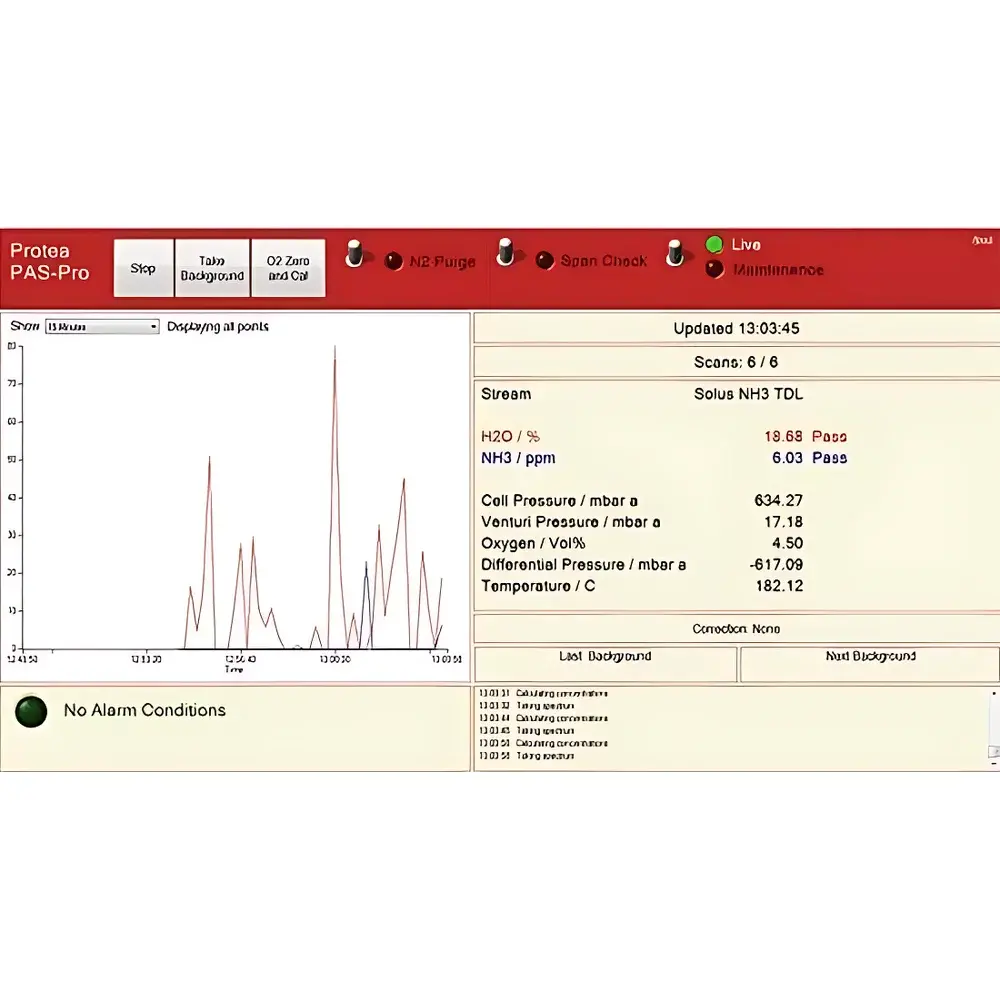
The embedded Linux-based controller supports Modbus TCP/RTU, RS-485, and 4–20 mA analog outputs (isolated, NIST-traceable). The Protea GasWorks™ desktop software provides full remote configuration, spectral diagnostics, trend visualization, and report generation (PDF/CSV) aligned with EN 14181 Part 3 QA documentation. Raw absorbance spectra, peak-fit residuals, and signal-to-noise ratios are logged at 1 Hz for root-cause analysis. Data integrity complies with FDA 21 CFR Part 11 via user-role access control, electronic signatures, and immutable audit trails — supporting regulated environments including pharmaceutical thermal processing and hazardous waste treatment QA/QC labs.
Applications
- Continuous HCl monitoring in municipal solid waste (MSW) and clinical waste incinerators
- Process gas analysis in cement clinker production and metallurgical off-gas streams
- Regulatory CEMS validation and QA/QC support for stack testing laboratories
- Research-grade HCl kinetics studies in pilot-scale thermal decomposition reactors
- Multi-gas verification (HCl + NH₃ + H₂O) during selective non-catalytic reduction (SNCR) optimization
FAQ
Does the Solus HCl require daily calibration gas?
No — it operates on first-principles TDLAS spectroscopy and does not require zero/span gases for routine operation. Periodic verification using certified HCl permeation tubes is recommended per EN 14181 QAL3 every 3 months.
Can the same instrument measure both HCl and NH₃?
Yes — the tunable laser allows reconfiguration to target distinct NIR absorption lines; switching between HCl and NH₃ requires only firmware update and optical alignment verification, not hardware modification.
Is the analyzer suitable for high-humidity flue gas?
Yes — the 190 °C heated measurement cell and ZnSe optics prevent condensation and water film formation, enabling stable sub-ppm detection in streams with >30% water vapor content.
What maintenance intervals are recommended?
Filter replacement every 3 months; annual inspection of laser diode output power and detector responsivity; no optical cleaning required under normal operation due to inert gas purge and heated path design.







