
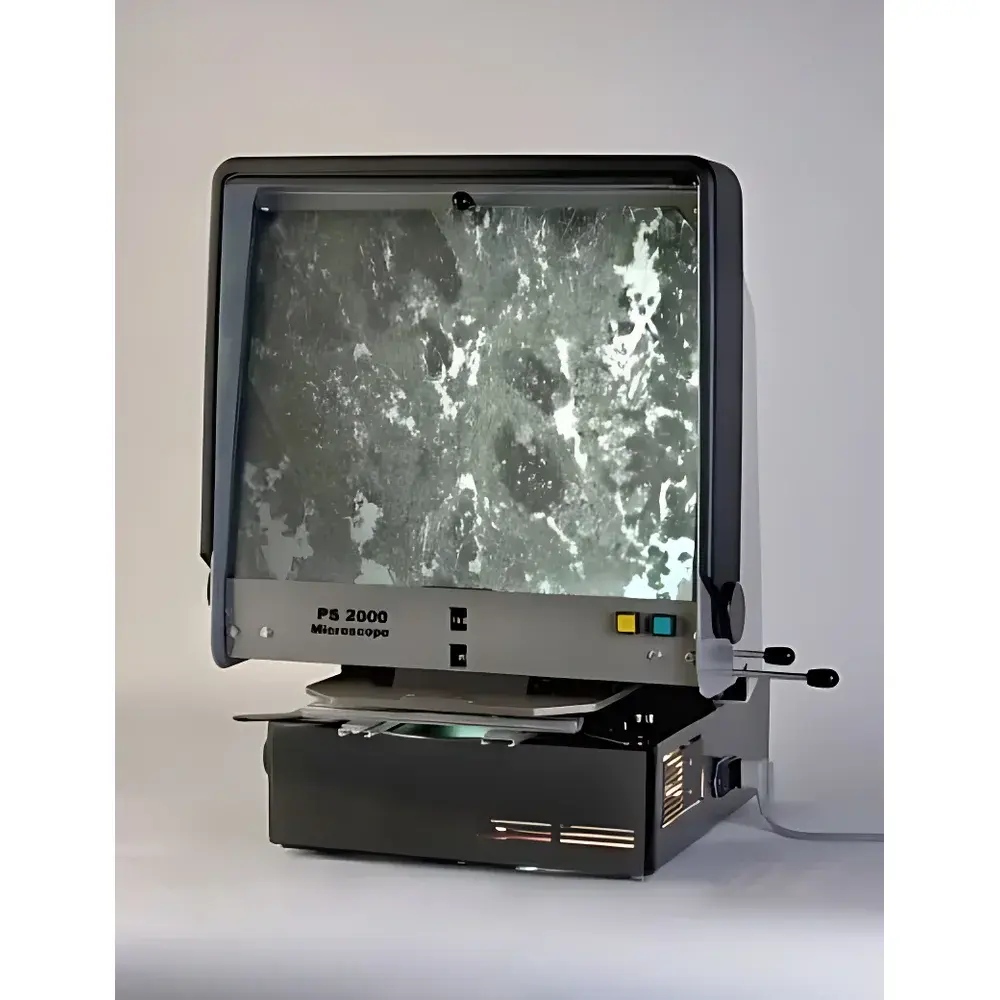
PS2000 Polarized Light Microscope System
| Origin | Germany |
|---|---|
| Manufacturer Type | Authorized Distributor |
| Origin Category | Imported Instrument |
| Model | PS2000 |
| Pricing | Available Upon Request |
Overview
The PS2000 Polarized Light Microscope System is a high-precision, research-grade optical instrument engineered for quantitative petrographic and materials science analysis. Designed around the principles of transmitted polarized light microscopy (PLM), it enables rigorous characterization of birefringent anisotropic materials—including geological thin sections, polymers, liquid crystals, and pharmaceutical crystalline forms. Its core optical architecture incorporates strain-free optics, precision-aligned polarizers and analyzers, and motorized switching between brightfield, crossed-polarized, and conoscopic illumination modes—ensuring compliance with ASTM D4125, ISO 10477, and USP standards for optical mineralogy and crystallographic evaluation.
Key Features
- Motorized polarization state control: Fully automated switching between plane-polarized light (PPL), crossed-polarized light (XPL), and accessory plate insertion (e.g., λ-plate, quartz wedge) via integrated stepper-driven filter turrets—eliminating manual alignment drift and enabling repeatable, time-stamped configuration logging.
- Dedicated thin-section observation platform: Rotating mechanical stage with 360° vernier scale (±0.1° resolution) and coaxial coarse/fine focus controls optimized for 30 × 24 mm standard petrographic slides; stage travel range: 75 × 50 mm with calibrated X/Y digital readout optional.
- Modular objective turret: Fixed-position nosepiece accommodating three objectives—standard 14.8× wide-field objective (effective field number ≥26.5 mm) for full-thin-section imaging at 1:1 scale on compatible display monitors; two vacant RMS-threaded mounts (M25 × 0.75) for user-installed objectives (e.g., 2.5×, 5×, 40× strain-free achromats).
- High-stability illumination system: Dual-source halogen-xenon lamp (250 W, 24 V DC) with continuous spectral output from 380–900 nm; intensity regulated via linear feedback-controlled dimmer (0–100% brightness, 0.5% step resolution); lamp lifetime rated at ≥250 h at nominal output.
- Universal power management: Integrated toroidal transformer supporting global input voltages (110–220–240 V AC, 50/60 Hz), delivering stable 24 V DC to lamp and motor subsystems with EMI filtering compliant with IEC 61000-4-3.
Sample Compatibility & Compliance
The PS2000 accommodates standard 30 × 24 mm glass-mounted thin sections (thickness: 30 ± 5 µm), as well as polished blocks, fiber mounts, and polymer films up to 1.5 mm thickness using optional long-working-distance condenser modules. All optical components meet DIN 58882 requirements for strain-free construction. The system supports GLP/GMP documentation workflows: motorized component positions, lamp intensity settings, and polarization states are timestamped and exportable in CSV format. Optional software integration enables 21 CFR Part 11-compliant electronic signatures and audit trails when paired with validated acquisition platforms.
Software & Data Management
While the PS2000 operates as a standalone optical platform, it is fully compatible with third-party digital imaging systems (e.g., USB 3.0 CMOS cameras, HDMI capture devices). Firmware-level serial communication (RS-232/USB virtual COM) permits remote control of lamp intensity, stage rotation, and polarization mode via LabVIEW, Python (PySerial), or MATLAB. Image metadata—including magnification, polarization state, exposure time, and lamp voltage—is embedded in TIFF/RAW headers. Optional PS2000 Control Suite (v3.2+) provides calibration-assisted grain size measurement (per ASTM E112), retardation quantification (using Michel-Lévy chart interpolation), and multi-frame polarization series acquisition for birefringence mapping.
Applications
- Petrography: Identification and modal analysis of igneous, metamorphic, and sedimentary minerals; determination of extinction angles, twinning patterns, and optic sign via convergent beam electron diffraction (CBED)-correlated optical methods.
- Materials Science: Assessment of polymer phase separation, liquid crystal domain orientation, and stress-induced birefringence in composites and coatings.
- Pharmaceutical Development: Polymorph screening, crystallinity verification, and hydrate/anhydrate differentiation per ICH Q5A and USP .
- Forensics & Failure Analysis: Fiber identification (natural/synthetic), paint layer stratigraphy, and inclusion analysis in metallurgical samples.
FAQ
Is the PS2000 suitable for quantitative birefringence measurement?
Yes—when used with calibrated retardation standards and optional digital image analysis software, it supports semi-quantitative retardation estimation (0.01–5,600 nm range) based on interference color matching per the Michel-Lévy chart.
Can third-party objectives be mounted without modification?
Yes—the two vacant RMS-threaded objective mounts accept industry-standard 25 mm thread pitch objectives; mechanical and optical parfocality must be verified during installation.
Does the system include documentation for regulatory audits?
The base unit includes traceable calibration certificates for stage rotation accuracy and lamp spectral output; full 21 CFR Part 11 compliance requires optional software licensing and IQ/OQ protocol execution.
What is the recommended maintenance interval for the 250 W lamp?
Lamp replacement is advised after 250 hours of cumulative operation or upon observed color temperature shift (>100 K deviation from 3200 K nominal); spare lamps are supplied with individual spectral calibration reports.





