
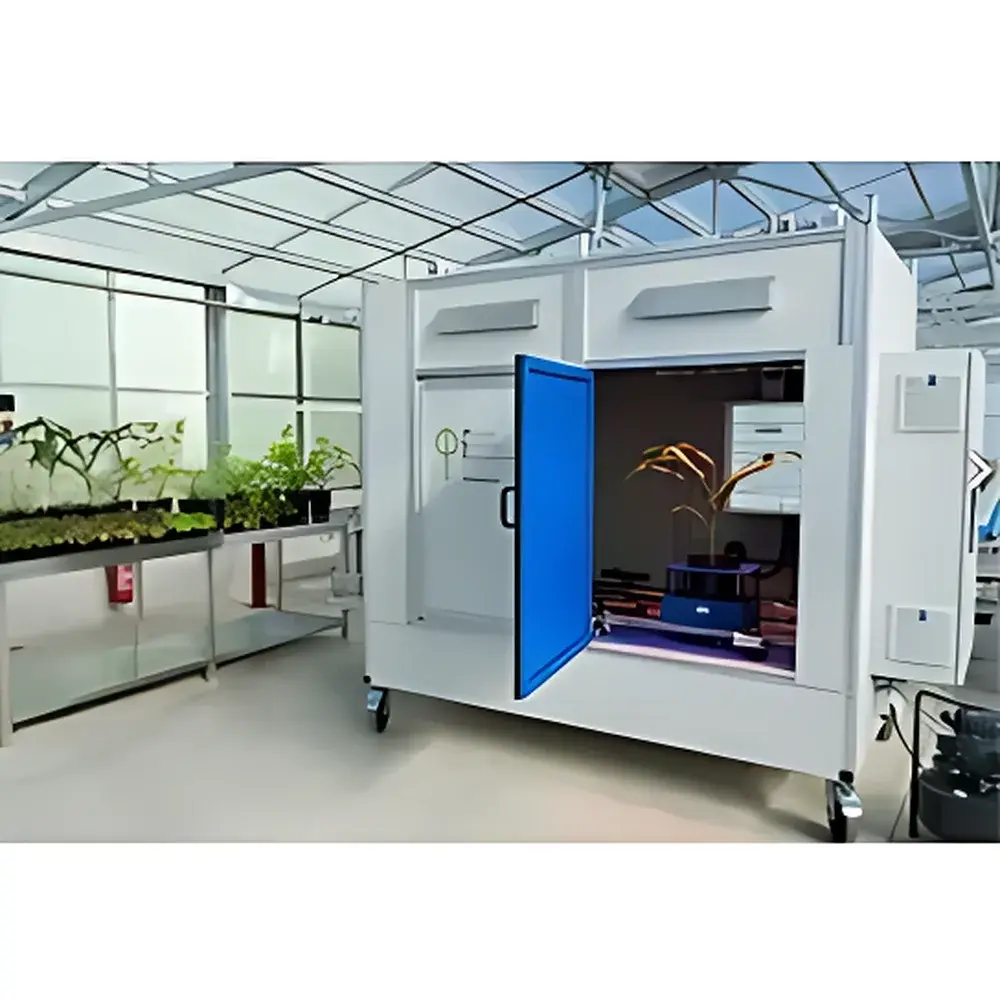
PSI PlantScreen SC Mobile Plant Phenotyping Imaging System
| Brand | PSI (Czech Republic) |
|---|---|
| Origin | Czech Republic |
| Model | PlantScreen SC |
| Mobility | Integrated casters for intra-greenhouse repositioning |
| Standard Plant Capacity | Up to 70 cm height, 50 cm canopy diameter |
| Core Imaging Modules | FluorCam chlorophyll fluorescence imaging + RGB 3D morphometric imaging |
| Optional Modules | 3D laser triangulation scanning, hyperspectral imaging (400–1000 nm), thermal infrared imaging (7.5–14 µm), NIR imaging |
| Sample Handling | Barcode-scanned standardized trays (5×4, 2×2, 1×2, 1×1 configurations |
| Environmental Monitoring | Integrated temperature & relative humidity sensors with time-synchronized logging |
| Software Suite | PSI PlantScreen Control & Analysis Suite (includes experiment scheduling, automated acquisition, batch processing, relational database management, GLP-compliant audit trail) |
Overview
The PSI PlantScreen SC Mobile Plant Phenotyping Imaging System is an integrated, compact, and relocatable platform engineered for high-throughput, non-invasive phenotypic characterization of plants under controlled greenhouse or growth chamber conditions. Built upon a robust modular architecture, the system combines synchronized optical imaging, precise sample handling, and environmental monitoring within a single wheeled enclosure—enabling flexible deployment across multiple greenhouse zones without permanent infrastructure modification. Its core measurement principle relies on multi-modal, spatially resolved optical sensing: chlorophyll fluorescence imaging quantifies photosynthetic efficiency (Fv/Fm, ΦPSII, NPQ) via pulse-amplitude-modulated (PAM) excitation, while multi-angle RGB 3D imaging captures morphometric parameters—including projected canopy area, plant height, width, convex hull volume, and color-based stress indicators—through structured-light-assisted stereo reconstruction and photogrammetric analysis. All measurements are performed in a light-controlled imaging chamber, ensuring repeatability and minimizing ambient interference. The system operates under fully automated workflow logic: barcode-identified trays enter the chamber, undergo sequential imaging, and exit—enabling unattended overnight or multi-day time-series experiments.
Key Features
- Integrated mobile chassis with industrial-grade casters for smooth relocation within greenhouses or growth facilities
- Automated conveyor-based sample handling with QR-code recognition for traceable, high-throughput sample registration
- Dual-core imaging modules: FluorCam PAM fluorimeter (625 nm actinic light, 740 nm detection, 12-bit dynamic range) and calibrated multi-view RGB 3D camera array (top + dual lateral views)
- Modular expansion interface supporting optional imaging units: 3D laser triangulation scanner (±0.1 mm Z-resolution), push-broom hyperspectral imager (400–1000 nm, 3 nm spectral sampling), microbolometer-based thermal IR camera (7.5–14 µm, NETD < 50 mK), and NIR reflectance module (850–1050 nm)
- Onboard environmental monitoring: PT100 temperature sensor (±0.2 °C accuracy) and capacitive RH sensor (±2% RH, 10–90% range), time-stamped and synchronized with image metadata
- Pre-installed server-grade control PC running real-time Linux-based acquisition firmware and Windows-based PSI PlantScreen Software Suite
Sample Compatibility & Compliance
The PlantScreen SC accommodates standardized plant growth trays compatible with widely adopted horticultural and research protocols—including Arabidopsis thaliana, tobacco, strawberry, turfgrass, soybean, and maize seedlings. Four tray formats are supported: 5×4 (250 mL pots), 2×2 (1 L), 1×2 (3 L), and 1×1 (5 L), enabling scalable throughput from model species to crop-sized specimens. All imaging workflows comply with ISO 20675:2019 (Plant phenotyping—Requirements for imaging-based trait measurement) and support GLP/GMP-aligned experimental documentation through embedded audit trails, user access controls, and immutable data logging. Environmental sensor outputs adhere to ASTM E1545-18 (Standard Test Method for Determining Relative Humidity) and IEC 60751 (Industrial platinum resistance thermometers). Data export formats include TIFF (raw images), CSV (trait tables), HDF5 (multi-dimensional datasets), and MIAME-compliant XML metadata.
Software & Data Management
The PSI PlantScreen Software Suite provides end-to-end experimental lifecycle management—from protocol definition and schedule automation to batch image processing and relational database curation. The software implements a hierarchical data model linking raw images, derived morphometric/physiological traits, environmental logs, and sample metadata via unique tray barcodes. Fluorescence analysis employs pixel-wise kinetic modeling (OJIP transients, relaxation kinetics) and spatial heterogeneity mapping; RGB 3D analysis applies machine learning–enhanced segmentation (U-Net backbone) for organ-level feature extraction. All analytical pipelines are scriptable via Python API (PyPlantScreen), enabling integration with Jupyter-based reproducible research workflows. Audit trails record operator ID, timestamp, parameter changes, and processing history per dataset—meeting FDA 21 CFR Part 11 requirements for electronic records and signatures when configured with digital certificate authentication.
Applications
- High-throughput screening of abiotic stress responses (drought, heat, salinity, nutrient deficiency) via combined fluorescence quenching dynamics and canopy shrinkage metrics
- Phenotypic validation of gene-editing outcomes in CRISPR-Cas9 lines, correlating morphological divergence with photosynthetic performance
- Time-lapse developmental phenotyping—from germination to reproductive stage—with daily 3D volumetric growth curves
- Chemical phenomics: dose–response profiling of biostimulants, biopesticides, or soil amendments using multivariate trait signatures
- Calibration and ground-truthing of UAV- or field-sensor-derived vegetation indices (e.g., NDVI, PRI, Fv/Fm proxies)
- Support for breeding programs requiring heritability estimation of architectural traits (e.g., tiller angle, leaf inclination) under controlled-environment replication
FAQ
What is the maximum plant height supported by the standard PlantScreen SC configuration?
The standard configuration accommodates plants up to 70 cm in height and 50 cm in canopy diameter. Custom-height enclosures and extended conveyor rails are available upon request.
Does the system support fully automated unattended operation over multiple days?
Yes—the conveyor, imaging, environmental logging, and data storage subsystems operate autonomously under scheduled protocols. Power loss recovery and hardware watchdog timers ensure resilience during extended runs.
Can fluorescence and RGB data be co-registered spatially and temporally?
Yes—both modalities share a common coordinate frame defined by the imaging chamber’s internal calibration grid. Timestamps are synchronized to microsecond precision via hardware-triggered acquisition.
Is the software compliant with regulatory data integrity standards?
The PlantScreen Software Suite supports 21 CFR Part 11 compliance when deployed with validated digital signature modules, role-based access control, and immutable audit log archiving.
What level of technical support and training is provided post-installation?
PSI offers on-site commissioning, operator certification workshops, and annual remote system health checks. Application-specific protocol development is available through PSI’s Phenotyping Support Team.




