
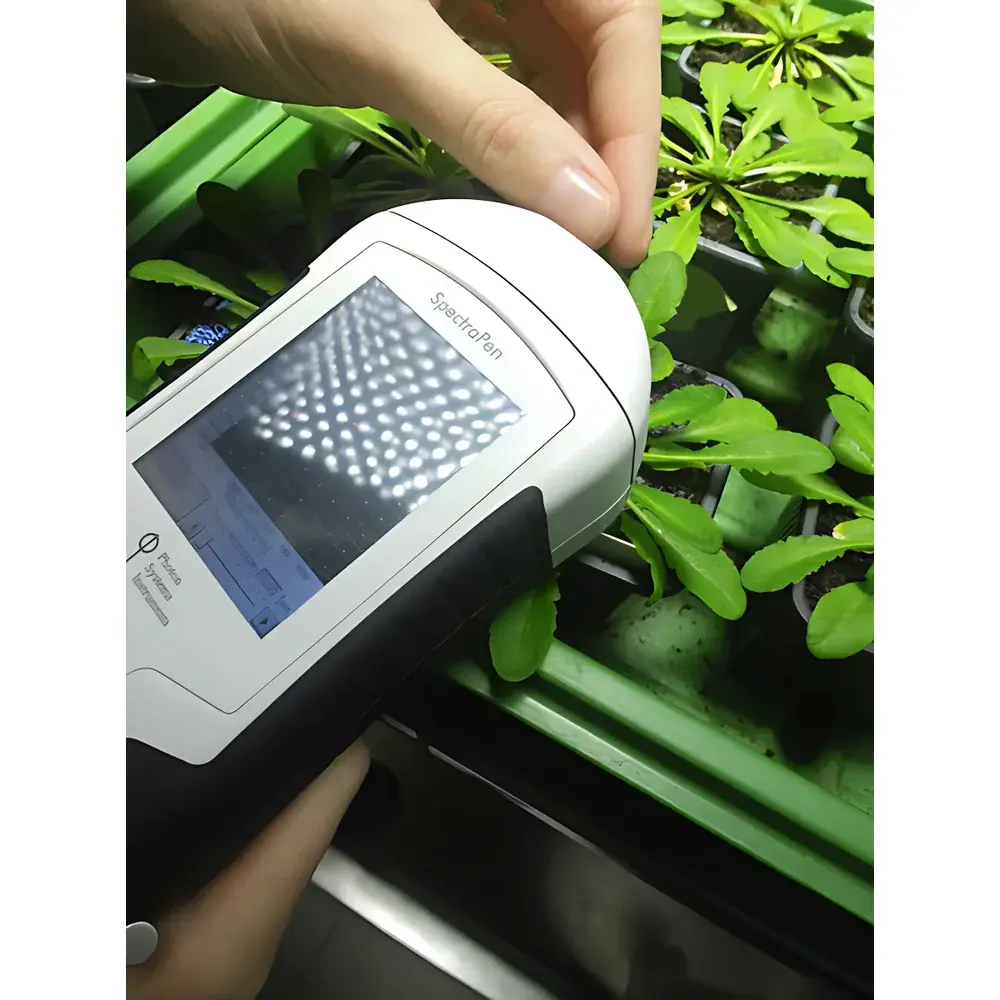
PSI SpectraPen SP110 Handheld Spectrometer
| Brand | PSI / Photon Systems Instruments |
|---|---|
| Origin | Czech Republic |
| Model | SpectraPen SP110 |
| Wavelength Range Options | SP110-UVIS (340–780 nm) or SP110-NIR (640–1050 nm) |
| Power Supply | Rechargeable Li-ion battery |
| Display | Integrated capacitive touchscreen |
| Data Interface | USB 2.0 and Bluetooth 4.2 |
| Measurement Modes | Reflectance, Transmittance, Absorbance, Fluorescence, Radiance, Colorimetry (CIE XYZ, L*a*b*) |
| Detector Type | Linear CMOS array |
| Optical Resolution | ~3.3 nm (FWHM, typical) |
| Integration Time | 1–10,000 ms adjustable |
| Storage | Internal memory + USB export |
| Accessories (optional) | Cosine corrector head, 1-m fiber optic probe |
Overview
The PSI SpectraPen SP110 Handheld Spectrometer is a field-deployable, self-contained optical measurement system engineered for quantitative spectral analysis across visible and near-infrared (NIR) spectral regions. Based on linear CMOS array detection and calibrated grating-based dispersion optics, the SP110 operates on the principle of non-scanning, snapshot spectral acquisition—enabling rapid, high-reproducibility measurements of radiance, reflectance, transmittance, absorbance, and fluorescence without requiring external computing hardware. Its dual-wavelength configuration (UVIS: 340–780 nm; NIR: 640–1050 nm) supports broad applicability in plant phenotyping, photobiology, optical material characterization, and environmental light monitoring. Unlike benchtop spectrometers, the SP110 integrates a capacitive touchscreen interface, onboard data processing firmware, GPS geotagging, and dual-mode wireless connectivity—making it suitable for GLP-aligned field surveys, controlled-environment trials, and quality control workflows where portability and operational autonomy are critical.
Key Features
- Self-powered operation via rechargeable lithium-ion battery with >8 hours continuous runtime under typical integration settings
- Integrated 4.3-inch capacitive touchscreen display enabling real-time visualization of full spectral curves, wavelength-resolved intensity values, and derived metrics (e.g., NDVI, PRI, R/B ratio)
- Dual communication architecture: USB 2.0 for high-speed data dump and firmware updates; Bluetooth 4.2 for remote parameter configuration and live telemetry to mobile devices or laptops
- Built-in GPS receiver providing synchronized geospatial metadata (latitude, longitude, altitude, timestamp) for every acquired spectrum—essential for spatially referenced ecological or agronomic studies
- Calibration traceability to NIST-traceable standards; factory calibration includes dark current subtraction, pixel sensitivity correction, and spectral response normalization
- Modular accessory support: optional cosine-corrected irradiance head for absolute light source characterization; detachable 1-meter fiber optic probe for non-contact or confined-space sampling
Sample Compatibility & Compliance
The SpectraPen SP110 accommodates diverse sample geometries and optical properties without sample preparation: flat or curved plant leaves, soil surfaces, LED panels, optical filters, protective glass, painted substrates, and biological tissues. Its contactless reflectance mode requires only stable positioning within 1–5 cm of the surface; transmittance mode utilizes dual-port geometry with optional fiber-coupled illumination (external source required). The instrument complies with IEC 61326-1:2013 for electromagnetic compatibility in laboratory and industrial environments. While not certified for medical device use, its measurement stability and repeatability meet ASTM E308-22 requirements for colorimetric analysis and ISO 17025-relevant criteria for in-field instrumentation used in accredited testing laboratories. Firmware supports audit trail logging for GLP/GMP-aligned deployments.
Software & Data Management
Data acquisition and post-processing are managed through the embedded SpectraPen Control Suite—firmware-resident software supporting on-device calculation of spectral indices, color space conversion (CIE 1931 XYZ, CIELAB), and baseline correction algorithms. Raw spectra (.spc binary format) and processed reports (.csv, .xlsx) are exportable via USB mass storage mode. Optional PC-based SpectraSoft v3.x application provides advanced features including multi-spectrum averaging, spectral library matching, time-series trending, and batch export with metadata filtering. All exported files retain embedded EXIF-style headers containing instrument ID, calibration date, GPS coordinates, integration time, and detector temperature—ensuring full traceability per FDA 21 CFR Part 11 principles when used in regulated environments.
Applications
- Plant science: In vivo leaf reflectance profiling for chlorophyll content estimation, water stress detection (NDWI), photochemical reflectance index (PRI), and pigment ratio analysis
- Controlled environment agriculture: Spectral mapping of LED grow lights, uniformity assessment across canopy zones, and dynamic light recipe validation
- Materials science: Characterization of anti-reflective coatings, UV-blocking films, solar cell encapsulants, and dichroic filters
- Environmental photometry: Daylight quality monitoring, sky spectral radiance modeling, and urban light pollution assessment
- Industrial QA: Batch-to-batch consistency verification of colored plastics, paints, textiles, and display panels using CIELAB ΔE*ab metrics
- Fluorescence screening: Detection of natural fluorophores (e.g., chlorophyll-a, flavonoids) and synthetic dyes under UV excitation (requires external UV source)
FAQ
Does the SpectraPen SP110 include an integrated light source?
No—the SP110 is a passive spectrometer and does not contain an internal illuminator. For reflectance and fluorescence measurements, an external broadband or monochromatic light source is required.
Can the SP110-UVIS and SP110-NIR models be used interchangeably in the same study?
While both share identical ergonomics and firmware, their spectral ranges do not overlap significantly. Cross-calibration between units requires reference standards measured on both devices; PSI recommends using a single unit per project for longitudinal consistency.
Is spectral calibration user-serviceable?
Factory calibration is performed at PSI’s Czech facility using NIST-traceable standards. Users may perform dark/white reference corrections in-field but should not attempt physical recalibration of grating alignment or detector gain.
What file formats are supported for data export?
Native binary (.spc) with full metadata header; ASCII-compatible CSV with wavelength/intensity columns; Excel (.xlsx) with embedded spectral plots and calculated indices.
How is GPS data synchronized with spectral acquisitions?
GPS timestamps are recorded at the start of each integration cycle and embedded in the spectrum header. Positional drift during long exposures (<10 s) is negligible; for moving platforms, sub-second logging intervals are recommended.






