
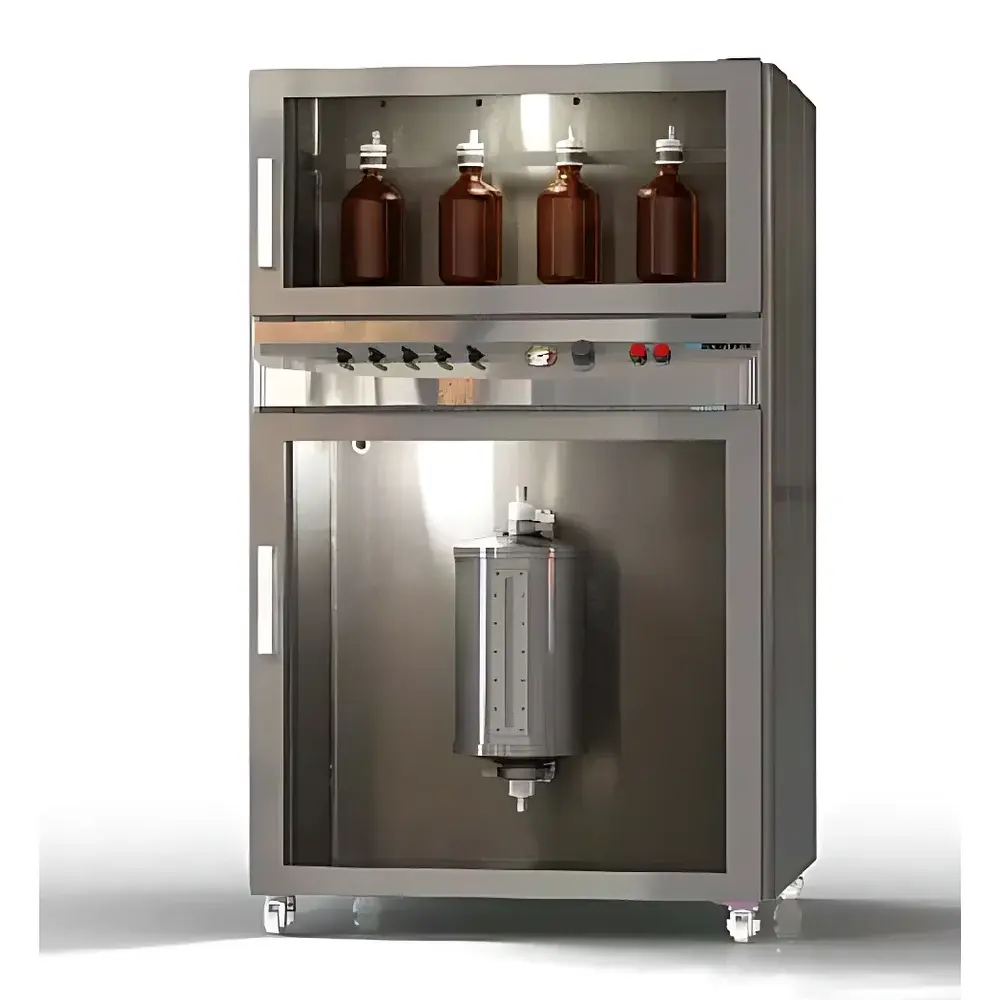
PSISCIENTIFIC E860 Series GMP-Compliant Kilogram-Scale Peptide Synthesizer
| Brand | PSISCIENTIFIC |
|---|---|
| Origin | USA |
| Model | E860 / EX860 |
| Synthesis Scale | 62.5–250 mmol |
| Reaction Vessel Volume | 5–20 L (configurable) |
| Heating | Optional |
| Coupling Efficiency | >99% |
| Stirring Mechanism | 180° Vertical Inversion |
| Compliance | FDA 21 CFR Part 11, cGMP (US & China), ATEX/IECEx for EX860 |
| Activation Methods | HOBt/DIC, DCC, HBTU, HATU, PyBOP, OxymaPure, etc. |
| Amino Acid Reservoir Capacity | 250 mL – 2 L |
| Stirring Speed | 0–100 rpm (infinitely variable) |
| Dimensions | 1800 × 1020 × 810 mm (W×D×H) |
Overview
The PSISCIENTIFIC E860 Series is a fully automated, GMP-compliant, kilogram-scale solid-phase peptide synthesizer engineered for pharmaceutical-grade manufacturing under regulated environments. Designed in accordance with current Good Manufacturing Practice (cGMP) requirements in both the United States and China, the E860 implements Fmoc- and t-Boc-based chemistries within a closed, inert-gas-purged reaction chamber to prevent oxidation, moisture ingress, and side reactions. Its core architecture centers on a patented 180° vertical inversion stirring mechanism—unique among production-scale synthesizers—which eliminates stagnant zones during coupling and deprotection steps, ensuring uniform reagent exposure across all resin beds regardless of vessel fill level or peptide chain length. This mechanical design directly contributes to reproducible coupling efficiencies exceeding 99%, a critical threshold for synthesizing long-chain (>50 residues), hydrophobic, or sterically hindered peptides at commercial scale.
Key Features
- 180° vertical inversion agitation system: Eliminates dead zones and ensures homogeneous mixing without mechanical shear or resin attrition—critical for maintaining resin integrity over extended synthesis cycles.
- GMP-integrated process control: Full compliance with FDA 21 CFR Part 11, including electronic signatures, audit-trail logging, role-based four-tier password authentication, and immutable data storage in an encrypted relational database.
- Dual-platform configuration: Standard E860 models support ambient or heated reaction vessels (5 L / 10 L / 20 L options); EX860 variants integrate ATEX/IECEx-certified explosion-proof motors, pneumatic actuators, and intrinsically safe control circuitry for Class I, Division 1 hazardous environments.
- Modular reagent delivery architecture: Independently controlled, solvent- and amino acid-specific fluid paths with non-return valves and pressure monitoring minimize cross-contamination risk between coupling cycles.
- Real-time safety interlock system: Automatic cessation of all motion and reagent flow upon detection of chamber door opening, pressure deviation, temperature excursion, or inert gas flow interruption.
- Flexible chemistry support: Compatible with standard activation chemistries including DIC/HOAt, HATU/DIEA, BOP, PyBOP, and OxymaPure/DIC—enabling optimization for difficult sequences and post-synthetic modifications.
Sample Compatibility & Compliance
The E860 Series accommodates a broad range of resin types—including Wang, Rink amide, 2-Cl-Trt, and Sieber amide—and supports loading capacities from 62.5 mmol to 250 mmol per batch. Reaction vessels are constructed from borosilicate glass or electropolished 316L stainless steel (EX860), rated for repeated exposure to DMF, DCM, piperidine, TFA, and other aggressive solvents used in SPPS. All hardware, firmware, and software components meet ISO 13485:2016 (Medical Devices), ASTM E2500-13 (User Requirement Specification for Pharmaceutical Equipment), and Annex 11 (EU GMP) guidelines. Validation documentation packages—including IQ/OQ/PQ protocols, traceable calibration records, and raw material certifications—are supplied as standard.
Software & Data Management
The embedded SynthOS™ v4.2 control platform provides deterministic real-time scheduling, step-by-step execution validation, and full parameter logging (temperature, pressure, stir rate, valve state, reagent volume dispensed, dwell time). Each synthesis run generates a timestamped, digitally signed report containing raw sensor data, operator ID, version-controlled method files, and checksum-verified audit logs. Data export complies with CDISC SDTM standards and integrates natively with LIMS and MES platforms via OPC UA and HL7 interfaces. All electronic records are retained for ≥25 years per FDA retention guidance and support retrospective review during regulatory inspections.
Applications
- Commercial manufacturing of therapeutic peptides (e.g., GLP-1 analogs, antimicrobial peptides, hormone derivatives)
- Process development and tech transfer from lab-scale (0.1–2 mmol) to clinical/commercial batches
- Synthesis of peptide–drug conjugates (PDCs) and peptide–PEG hybrids requiring strict stoichiometric control
- GMP-compliant production of reference standards and certified working materials for QC laboratories
- Contract manufacturing organizations (CMOs) serving biotech clients requiring full regulatory submission support (IND, BLA, MAA)
FAQ
Does the E860 support both Fmoc and t-Boc chemistries?
Yes—the system is fully configurable for either strategy, including orthogonal deprotection schemes and acid-labile linker handling.
Can the E860 be validated for use in an FDA-inspected facility?
Yes—PSISCIENTIFIC supplies complete validation documentation, including URS, FRS, DQ/IQ/OQ/PQ protocols, and change control records aligned with FDA and EMA expectations.
What safety certifications apply to the EX860 variant?
The EX860 carries ATEX II 2G Ex db IIB T4 Gb and IECEx Ex db IIB T4 Gb certifications for use in Zone 1 explosive atmospheres.
Is remote monitoring and troubleshooting supported?
Yes—via secure TLS 1.3-enabled web interface with granular access controls; remote diagnostics require prior written authorization per cybersecurity policy.
How is data integrity ensured during power failure or unexpected shutdown?
All critical process variables and state transitions are written to non-volatile memory every 200 ms; recovery mode resumes from last verified stable checkpoint without manual intervention.
Related Products





