
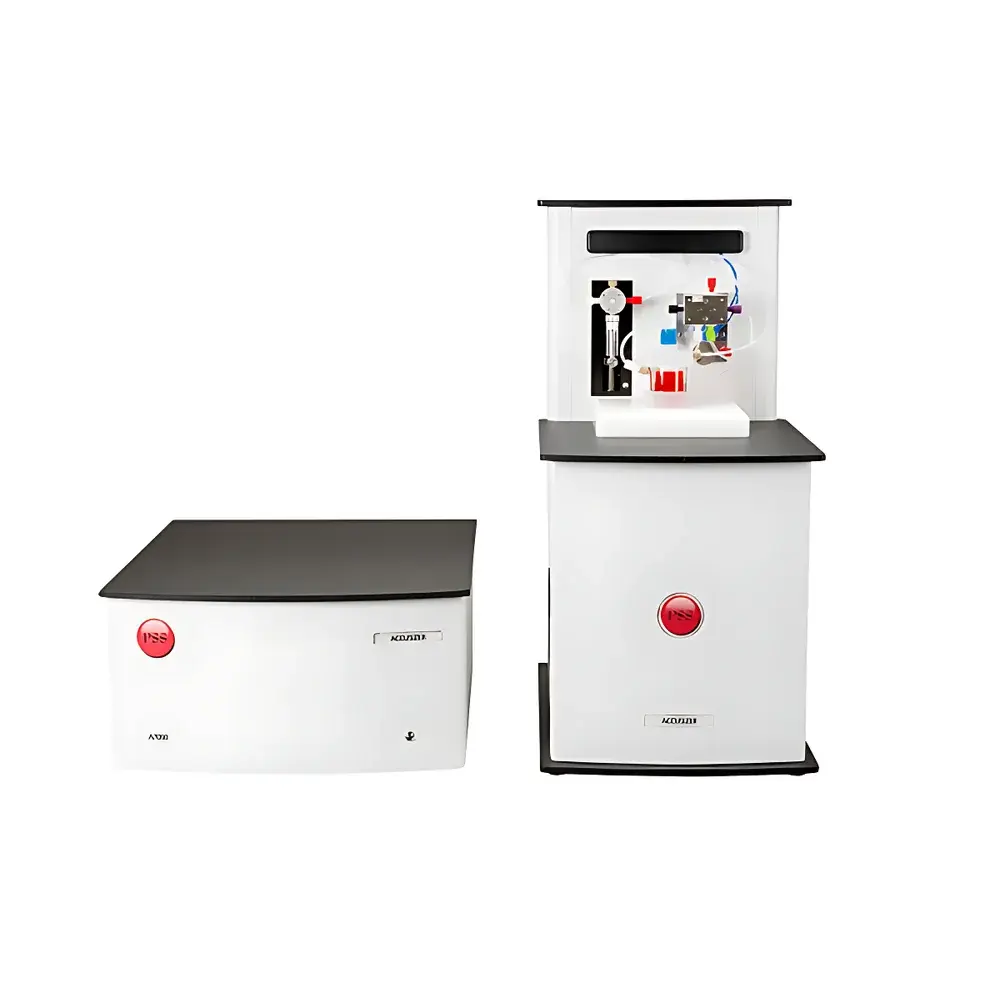
PSS AccuSizer 780 A9000 FX-MD Automated High-Concentration Large-Particle Counter
| Brand | PSS (Particle Sizing Systems) |
|---|---|
| Model | AccuSizer 780 A9000 FX-MD |
| Detection Principle | Focused Light Obscuration & Single Particle Optical Sizing (SPOS) |
| Size Range | 0.6 µm – 20 µm |
| Maximum Sample Concentration | 1 × 10¹² particles/mL |
| Number of Adjustable Channels | 32 user-defined |
| Flow Rate | 15 – 180 mL/min |
| Sample Volume | 2 – 10 mL |
| Diluent | Ultrapure water (standard), organic solvents (optional) |
| Power Supply | 100–120 VAC, 60 Hz or 220–240 VAC, 50 Hz |
| Dimensions (Counter Unit) | 20 cm × 45 cm × 20 cm |
| Dimensions (Auto-Dilution Unit) | 25 cm × 45 cm × 56 cm |
| Weight | ~30 kg |
| Compliance | ISO 21501-4, USP <788>, <789>, ASTM F2149, FDA 21 CFR Part 11 ready |
Overview
The PSS AccuSizer 780 A9000 FX-MD is an automated high-concentration particle counter engineered for precise, statistically robust quantification and sizing of large particles in liquid suspensions—particularly where conventional optical particle counters fail due to concentration-induced coincidence error. It employs a patented Focused Light Obscuration (FLO) technique combined with Single Particle Optical Sizing (SPOS), enabling true single-particle resolution even at concentrations up to 1 × 10¹² particles per milliliter. Unlike traditional light obscuration systems that require extensive manual dilution and suffer from signal saturation or undercounting above 10⁶ particles/mL, the FX-MD integrates real-time, on-the-fly dilution control with spatially confined detection volume optimization. This architecture eliminates the need for pre-dilution assumptions and preserves the integrity of the tail-end distribution—critical for detecting low-frequency but high-risk oversized particles in pharmaceutical injectables, biologics, cell therapies, and advanced material dispersions.
Key Features
- Patented auto-dilution module delivering precise, programmable dilution ratios up to 1:10⁶—ensuring optimal particle separation without operator intervention.
- Dual-sensor configuration: primary FLO detector for high-fidelity counting and sizing (0.6–20 µm), supported by optional scattering-based sub-micron extension for contextual validation.
- 32 user-definable analysis channels allow granular binning for regulatory-compliant reporting (e.g., USP <788> Class I–IV thresholds or ISO 14644-1 cleanliness classes).
- Modular hardware design supports field-upgradable components—including flow cell variants, solvent-compatible wetted materials (e.g., PEEK, sapphire), and enhanced cleaning protocols.
- Integrated magnetic stirring and programmable sample agitation ensure homogeneous suspension prior to aspiration—minimizing settling bias in viscous or dense formulations.
- Full audit trail capability compliant with FDA 21 CFR Part 11: electronic signatures, user access levels, version-controlled method files, and immutable raw data logging.
Sample Compatibility & Compliance
The FX-MD accommodates aqueous and organic-phase samples—including saline buffers, ethanol/water mixtures, glycerol solutions, and non-aqueous drug carriers—via chemically resistant fluidic pathways (standard PTFE/PFA tubing, optional Hastelloy or sapphire flow cells). Its detection stability across refractive index mismatches (1.33–1.52 RI) enables reliable measurement of lipid nanoparticles, protein aggregates, microcrystalline suspensions, and ceramic slurries. The system meets ISO 21501-4 for calibration traceability using NIST-traceable polystyrene latex standards, and supports validation per USP <788>, <789>, EP 2.9.19, and JP 6.07. All firmware and software modules are designed for GLP/GMP environments, including electronic record retention, change control documentation, and IQ/OQ/PQ protocol templates.
Software & Data Management
Operation is managed via PSS’s proprietary AccuSizer v8.x platform—a Windows-native application supporting multi-user role assignment, method templating, and automated report generation (PDF, CSV, XML). Raw pulse-height data is preserved in binary format with timestamped metadata (flow rate, temperature, dilution factor, valve position). Trend analysis tools enable batch-to-batch comparison, statistical process control (SPC) charting, and failure mode identification (e.g., sudden spike >3× baseline in >10 µm channel). Data export conforms to ASTM E1447 and SDTM standards for regulatory submissions. Optional cloud-sync module provides secure, encrypted remote access for cross-site collaboration while maintaining local data sovereignty.
Applications
- Final fill inspection of parenteral drug products (vials, syringes, cartridges) per USP <788> and Annex 1 requirements.
- Stability-indicating monitoring of protein therapeutics—detecting subvisible aggregates (>2 µm) during accelerated storage studies.
- Quality control of mRNA-LNP formulations, where large particle impurities correlate with immunogenicity risk.
- In-process monitoring of ceramic, metal, or polymer nanoparticle synthesis—quantifying agglomerate formation in real time.
- Validation of sterile filtration integrity through challenge testing with calibrated polystyrene beads.
- Environmental particulate analysis in ultrapure water systems used in semiconductor fabrication.
FAQ
How does the FX-MD differ from standard light obscuration (LO) instruments?
Unlike conventional LO systems limited to ≤10⁶ particles/mL, the FX-MD uses focused beam geometry and adaptive dilution to maintain single-particle resolution at concentrations up to 10¹²/mL—eliminating manual dilution errors and preserving low-abundance large-particle statistics.
Can it measure particles below 0.6 µm?
The FX-MD’s primary detection range is 0.6–20 µm. For sub-0.6 µm analysis (e.g., viruses, exosomes), integration with PSS’s NanoSight NS500 or FX-Nano module is recommended—both sharing the same software and database infrastructure.
Is method transfer possible between legacy AccuSizer models and the FX-MD?
Yes—method files (.acm) from AccuSizer 780 series instruments are backward compatible; calibration curves and channel definitions migrate seamlessly, reducing revalidation burden.
What maintenance is required for long-term operational reliability?
Daily flush with ultrapure water post-run; quarterly optical alignment verification; annual recalibration using NIST-traceable standards. The system logs all maintenance events automatically within the audit trail.
Does the instrument support 21 CFR Part 11 compliance out-of-the-box?
Yes—the software includes electronic signature workflows, audit trail activation, and password-protected user roles. Full Part 11 readiness requires site-specific SOPs and network configuration per FDA guidance.



