
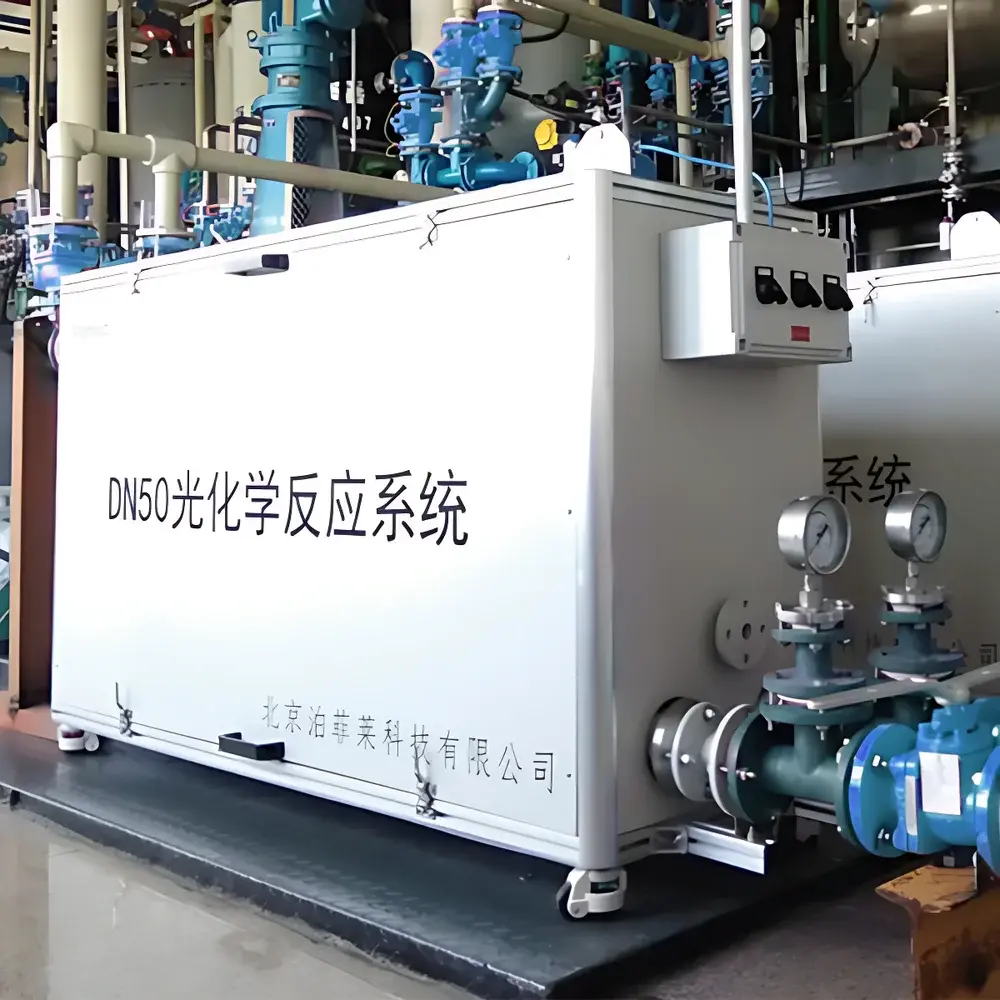
PufeiLai DN50 Photochemical Flow Reactor
| Brand | PufeiLai (PerfectLight) |
|---|---|
| Origin | Beijing, China |
| Model | DN50 |
| Reactor Type | Tubular Continuous-Flow Photoreactor |
| Light Source | Flexible LED Array (365–760 nm, Multi-Wavelength Selectable) |
| Total Unit Power | 7.5 kW |
| Reaction Volume per Channel | 14 L × 2 |
| Max Liquid Flow Rate | 82.5 L/min |
| Tube Material | Borosilicate Glass or Fused Quartz (Customizable per Reaction Chemistry) |
| Dimensions (W×D×H) | 2245 mm × 580 mm × 1235 mm |
| Temperature Range | Ambient to Low-Temperature Operation (External Chiller Required) |
| Reaction Modes | Continuous Flow or Semi-Batch |
| Process Intensification | Integrated Static Mixer for Enhanced Mass & Heat Transfer |
| Application Scope | Homogeneous Liquid–Liquid and Liquid–Solid Photocatalytic Reactions, Radical Chain Reactions Initiated by UV/Visible Light, Solar-Spectrum Simulation |
Overview
The PufeiLai DN50 Photochemical Flow Reactor is an engineered tubular continuous-flow photoreactor designed for scalable photochemical synthesis under controlled irradiation conditions. It operates on the principle of photon-driven reaction kinetics, where precisely tunable visible-to-UV light (365–760 nm) initiates and sustains radical chain reactions, photocatalytic transformations, and energy-transfer processes in transparent liquid-phase media. Unlike batch photochemistry—limited by photon penetration depth and thermal heterogeneity—the DN50 employs a high-aspect-ratio tubular geometry with integrated optical path optimization and dynamic flow control to ensure uniform photon flux distribution and consistent residence time distribution (RTD). Its modular architecture supports both continuous operation for process development and semi-batch mode for kinetic screening. The system is specifically configured for applications requiring extended irradiation duration, improved photon efficiency, and reproducible scalability from lab-scale discovery to pilot-stage validation—validated in GMP-aligned environments at a publicly listed pharmaceutical enterprise.
Key Features
- Upgraded from the DN40 platform to accommodate higher throughput and enhanced photonic utilization via increased tube diameter and extended optical path length.
- Flexible multi-wavelength LED light source with spectral selectivity across 365–760 nm; enables wavelength-specific reaction control for selective bond activation or catalyst excitation.
- Adjustable optical power output (0–100% of rated 7.5 kW total unit power) allows precise dosing of photon fluence without thermal runaway.
- Integrated static mixer elements within the reactor tubing promote radial mixing and reduce axial dispersion—critical for achieving narrow RTD and suppressing side reactions.
- Dual-channel configuration (2 × 14 L effective volume) supports parallel reaction screening or staggered residence time studies under identical irradiation conditions.
- Modular tube construction using borosilicate glass or fused quartz—chemically inert, UV-transparent, and compatible with aggressive reagents including halogenated solvents and strong oxidants.
Sample Compatibility & Compliance
The DN50 accommodates homogeneous liquid–liquid and liquid–solid photocatalytic systems, including but not limited to Ru/Ir polypyridyl complexes, organic dyes (e.g., eosin Y, rose bengal), and heterogeneous semiconductor suspensions (e.g., TiO₂, g-C₃N₄). It supports reactions initiated by direct substrate excitation (e.g., aryl diazonium decomposition) or photocatalyst-mediated pathways (e.g., C–N cross-coupling, asymmetric α-functionalization). While the base system operates at ambient or externally chilled temperatures (no built-in heating/cooling), it is fully compatible with external cryostats or jacketed heat exchangers to maintain isothermal conditions per ICH Q5A and USP guidelines. All wetted materials comply with USP Class VI biocompatibility standards; optional quartz tubing meets ASTM F799 requirements for UV transmission stability. System design facilitates audit-ready documentation per GLP and GMP Annex 11 expectations when paired with validated data acquisition software.
Software & Data Management
The DN50 integrates with PufeiLai’s proprietary FlowControl Suite v3.2—a Windows-based application supporting real-time monitoring of flow rate (via Coriolis or electromagnetic sensors), LED intensity (via calibrated photodiode feedback), coolant temperature (if externally coupled), and pressure differentials. All operational parameters are timestamped and stored in encrypted SQLite databases compliant with FDA 21 CFR Part 11 requirements—including electronic signatures, audit trails, and role-based access control. Export formats include CSV, PDF reports, and HDF5 for downstream kinetic modeling (e.g., in MATLAB or Python-based PFR simulation tools). Optional OPC UA interface enables seamless integration into existing MES or DCS infrastructure for automated campaign logging and QA release workflows.
Applications
- Synthesis of pharmaceutical intermediates via visible-light-mediated C–H functionalization and decarboxylative couplings.
- Production of fine chemicals—including fragrances and agrochemical precursors—under solar-spectrum-mimicking irradiation.
- Kinetic profiling of photocatalytic degradation pathways for environmental remediation studies (e.g., micropollutant abatement).
- Development of photoredox protocols compatible with flow chemistry platforms for telescoped multistep sequences.
- Photostability testing of APIs under controlled UV/visible stress per ICH Q1B guidelines.
FAQ
Is the DN50 suitable for reactions requiring strict temperature control below 0 °C?
Yes—when connected to an external low-temperature chiller (−20 °C to +40 °C range) with compatible fluid coupling, the system maintains stable isothermal operation; however, no internal thermoelectric or refrigerant-based cooling is integrated.
Can quartz tubing be substituted for glass during operation?
Yes—tubing material is user-selectable at order stage; fused quartz offers superior UV-C transmission (<250 nm) and thermal shock resistance, while borosilicate glass provides cost-effective performance for 300–700 nm applications.
Does the system support automated wavelength switching during a single run?
Yes—FlowControl Suite permits pre-programmed spectral ramps or stepwise transitions between up to four user-defined wavelengths, synchronized with flow rate modulation.
What safety certifications does the DN50 hold?
The system complies with CE marking requirements (EMC Directive 2014/30/EU and Low Voltage Directive 2014/35/EU); laser safety classification is Class 1 (IEC 60825-1:2014) when interlocked enclosures are engaged.
Is remote monitoring supported?
Yes—via secure TLS-encrypted VNC or dedicated web dashboard (optional hardware module), enabling off-site supervision of critical parameters and emergency shutdown protocols.



