
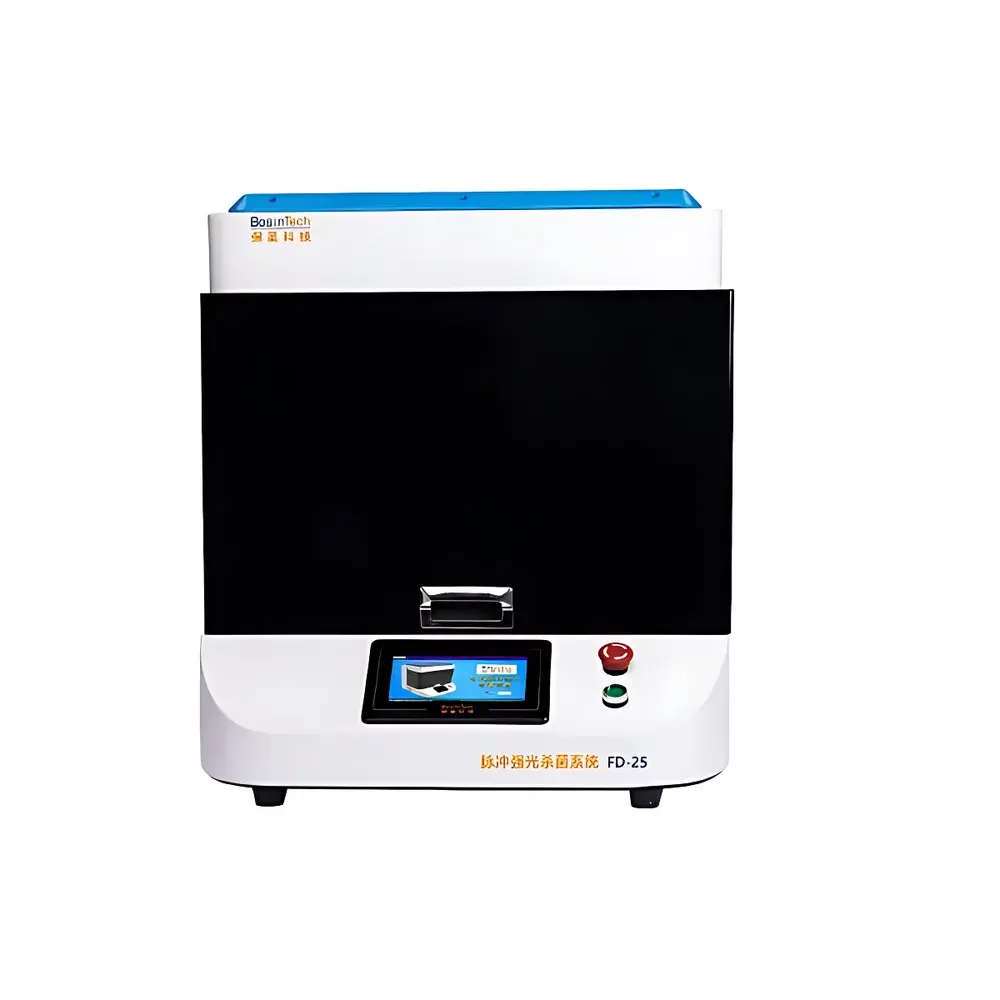
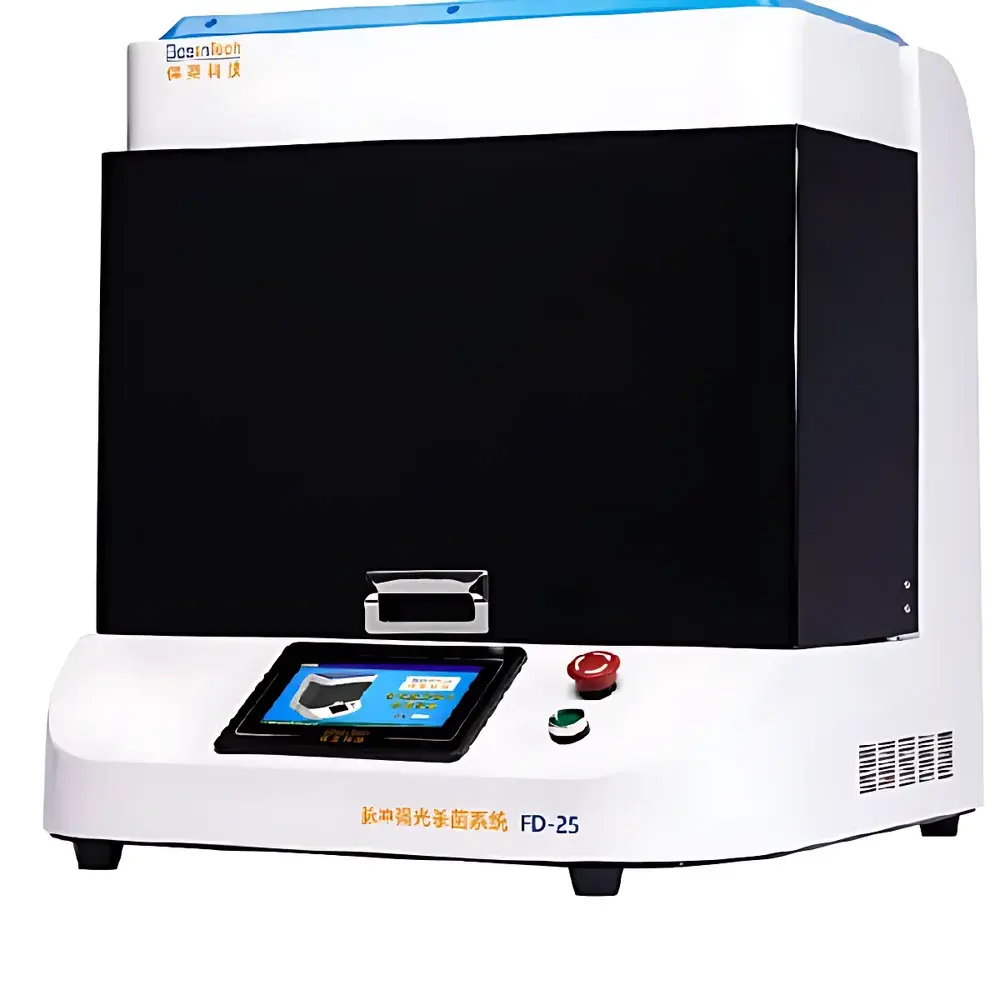
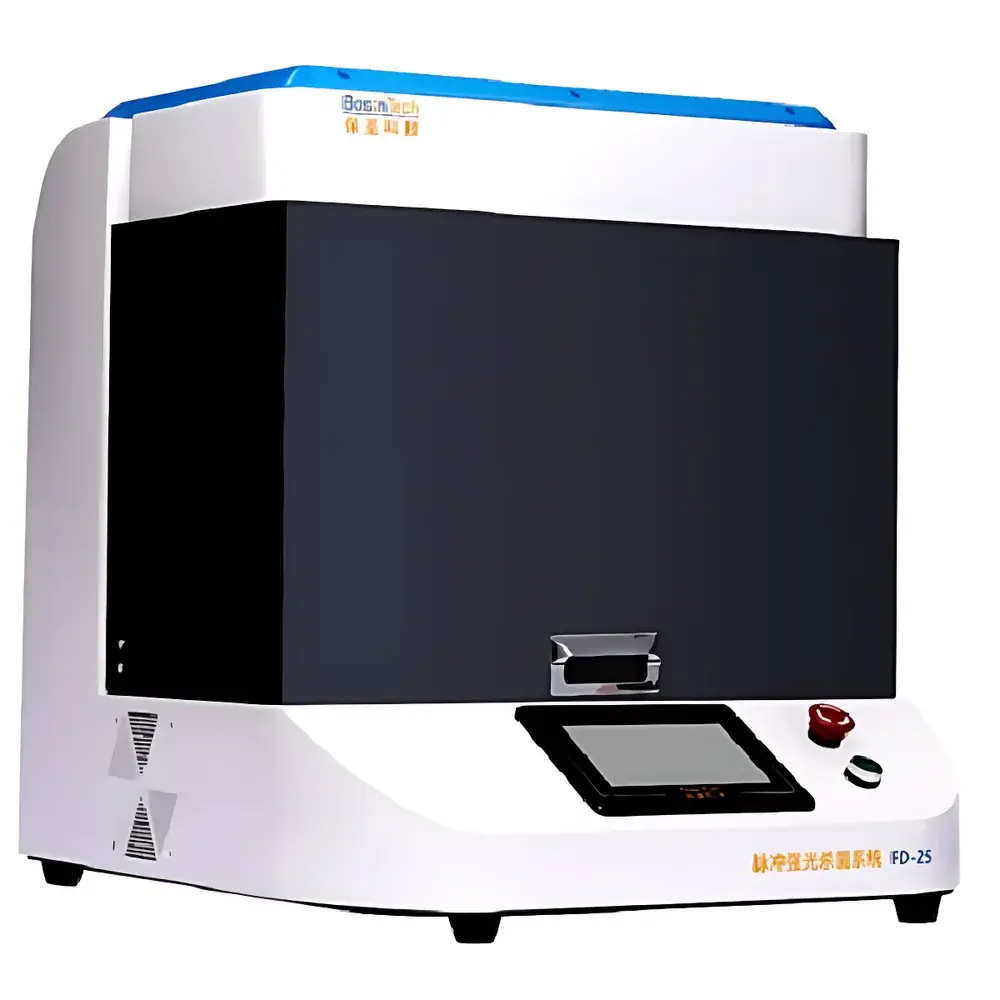
Pulsed Light Sterilization System FD-25 by BosinTech
| Brand | BosinTech |
|---|---|
| Origin | Shanghai, China |
| Manufacturer Type | OEM Manufacturer |
| Country of Origin | China |
| Model | FD-25 |
| Pricing | Available Upon Request |
Overview
The BosinTech FD-25 Pulsed Light Sterilization System is an industrial-grade, non-thermal microbial inactivation platform engineered for high-efficiency surface decontamination of food products, packaging materials, medical devices, and environmental surfaces. It operates on the principle of broad-spectrum pulsed light (PL) technology—delivering intense, short-duration (10–100 µs), multi-wavelength optical pulses encompassing UV-C (200–280 nm), UV-B (280–315 nm), visible (400–700 nm), and near-infrared (700–1100 nm) radiation. Unlike continuous-wave UV sources, the FD-25 generates peak power outputs in the megawatt range during each pulse, enabling rapid photobiochemical and photothermal disruption of microorganisms without bulk heating. This mechanism ensures minimal impact on heat-sensitive substrates—including fresh meat, seafood, ready-to-eat meals, herbs, spices, cut flowers, and polymer-based packaging—while maintaining sensory attributes, enzymatic activity, and nutritional integrity.
Key Features
- Non-thermal, physical sterilization process eliminating chemical residues and thermal degradation
- Broad-spectrum emission covering germicidal UV-C, photosensitizing UV-B/visible, and mild photothermal NIR bands
- Pulse duration precisely controlled within 10–100 µs range for optimal microbial DNA damage and membrane destabilization
- Modular lamp array design supporting configurable irradiation geometry for flat, curved, or irregular surfaces
- Integrated safety interlocks, real-time lamp energy monitoring, and automatic pulse calibration for consistent dose delivery
- Compliant with IEC 62471 (Photobiological Safety of Lamps) and aligned with FDA guidance for non-thermal food processing validation
Sample Compatibility & Compliance
The FD-25 is validated for use across a wide range of substrates including polyolefin films, PET trays, aluminum foil laminates, stainless steel, glass, and biological tissues. Its non-contact, ambient-temperature operation avoids material warping, yellowing, or off-flavor generation common with thermal or ozone-generating methods. The system supports validation protocols compliant with ISO 13408-1 (Aseptic Processing of Health Care Products), ASTM E2197 (Standard Test Method for Quantitative Evaluation of Virucidal Activity), and USP <1227> (Validation of Microbiological Recovery from Pharmaceutical Products). All operational parameters—including fluence (J/cm²), pulse frequency (Hz), and total exposure time—are fully traceable and auditable to meet GLP/GMP documentation requirements.
Software & Data Management
The FD-25 is equipped with proprietary control software featuring programmable treatment profiles, real-time energy dosimetry logging, and CSV-exportable irradiation records. Each session captures lamp voltage, current, pulse count, cumulative fluence, and timestamped operator ID—enabling full 21 CFR Part 11 compliance when configured with electronic signatures and audit trail modules. Historical data is stored locally with optional integration into enterprise MES or LIMS platforms via OPC UA or Modbus TCP interfaces. Firmware updates are delivered through secure, authenticated channels to maintain cybersecurity integrity per NIST SP 800-53 controls.
Applications
- Surface decontamination of pre-packaged RTE foods (e.g., sliced deli meats, salad kits, baked goods)
- Sterilization of primary and secondary food packaging prior to filling (blister packs, pouches, clamshells)
- Disinfection of reusable medical instrument trays, endoscope housings, and labware
- Reduction of airborne bioburden in cleanroom pass-through chambers and air handling units
- Treatment of water in closed-loop rinsing systems for produce wash lines
- Inactivation of spores, vegetative bacteria, yeasts, molds, and non-enveloped viruses (e.g., norovirus surrogates)
FAQ
How does pulsed light differ from conventional UV-C mercury lamps?
Pulsed light delivers orders-of-magnitude higher peak irradiance in microseconds, inducing synergistic photochemical (DNA dimerization) and photothermal (membrane rupture) effects—whereas low-pressure UV-C lamps rely solely on continuous 254 nm exposure with limited penetration and higher risk of photoreactivation.
Can the FD-25 be integrated into existing production lines?
Yes—the system supports conveyor synchronization via encoder input, PLC-compatible digital I/O, and adjustable dwell time settings to match line speeds up to 60 m/min.
Is ozone generated during operation?
No—FD-25 uses xenon-based flashlamps emitting negligible ozone-producing wavelengths (<200 nm); no ventilation or catalytic scrubbing is required.
What microbial log reductions are achievable?
Validated reductions exceed 5-log for Escherichia coli, Salmonella, and Aspergillus niger on inert surfaces at fluences of 0.5–3.0 J/cm², depending on substrate reflectivity and shadowing geometry.
Does pulsed light affect packaging integrity?
Extensive testing per ISO 11607-2 confirms no measurable change in seal strength, barrier properties, or extractables profile for common food-grade polymers after repeated exposure at recommended doses.






