
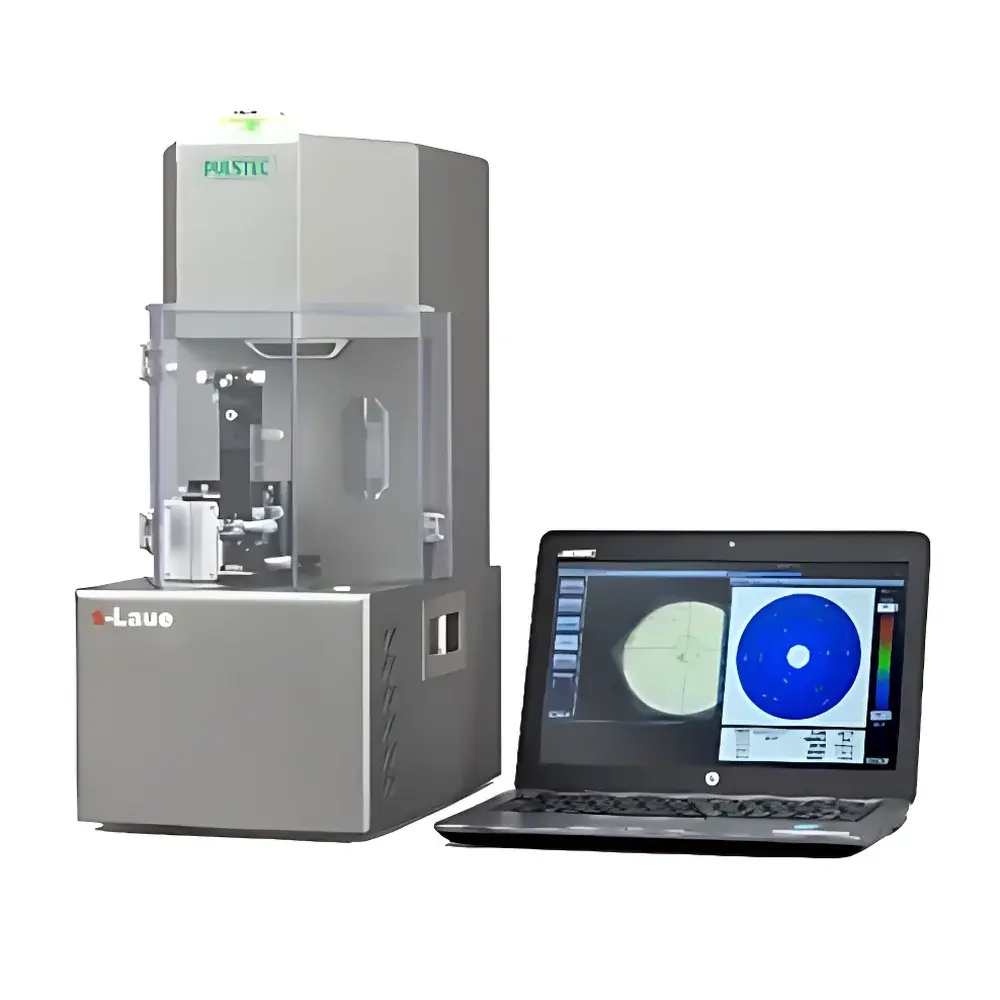
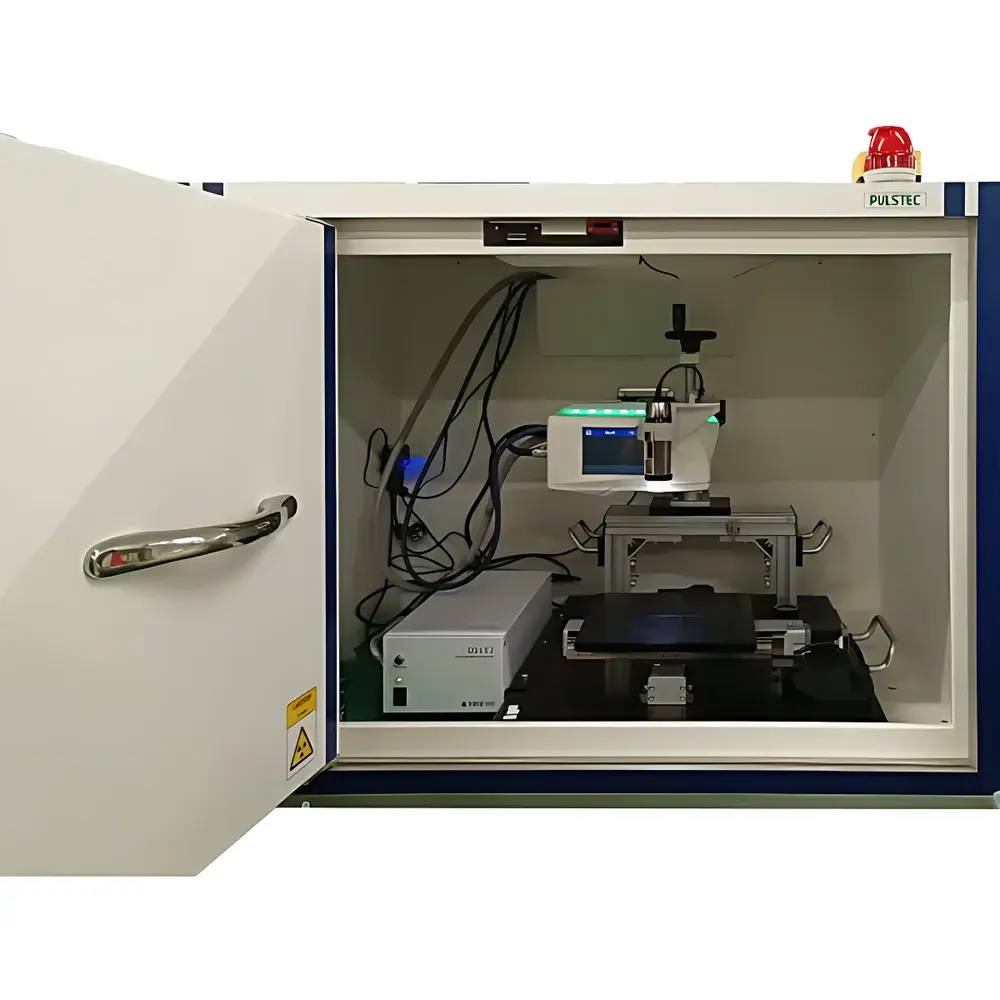
Pulstec s-Laue/m-Laue Next-Generation X-ray Single-Crystal Orientation System
| Brand | Pulstec |
|---|---|
| Origin | Japan |
| Model | s-Laue/m-Laue |
| X-ray Source | Tungsten anode |
| Voltage/Current | 30 kV / 1.6 mA |
| Cooling | Air-cooled |
| Irradiation Spot Size | φ0.8 mm (standard collimator) |
| Sample-to-Detector Distance | 33 mm |
| Typical Exposure Time | 15 s |
| Sample Stage | 6-axis (Θ, translation, radial, X, Y, Z) |
| Power Supply | AC 100–240 V, 50/60 Hz |
| Max. Power Consumption | 150 W |
| Safety | Integrated door interlock |
| Dimensions (s-Laue) | 224 × 414 × 480 mm |
| Dimensions (m-Laue) | 800 × 600 × 600 mm |
| XY Translation Stage | Included on m-Laue only |
Overview
The Pulstec s-Laue/m-Laue is a next-generation X-ray single-crystal orientation system engineered for rapid, non-destructive crystallographic alignment of single crystals using Laue diffraction geometry. Unlike conventional monochromatic or rotating-anode systems, the s-Laue/m-Laue leverages a compact microfocus tungsten X-ray source (30 kV / 1.6 mA) coupled with a circular full two-dimensional area detector to capture complete back-reflection Laue patterns in a single exposure. This design eliminates the need for goniometric scanning or wavelength tuning, enabling orientation determination within seconds—typically 15 s per measurement—while maintaining sub-degree angular resolution. The system operates on the fundamental principle of polychromatic X-ray diffraction from a fixed crystal under stationary geometry, where the symmetry and spacing of Laue spots directly encode the crystal’s orientation relative to the incident beam and sample frame. Its low-power, air-cooled architecture ensures minimal radiation dose and operational safety, making it suitable for routine use in academic laboratories, materials R&D centers, and industrial QC environments without dedicated shielding infrastructure.
Key Features
- Compact microfocus tungsten X-ray source (30 kV / 1.6 mA) with air cooling and integrated door interlock for Class I radiation safety compliance.
- Circular full 2D area detector optimized for back-reflection Laue geometry—enabling simultaneous capture of all diffraction orders without mechanical repositioning.
- 6-axis precision sample stage (Θ, translation, radial, X, Y, Z) supporting fine angular alignment, coarse positioning, and tilt compensation across diverse crystal geometries.
- Dual-platform configuration: s-Laue (benchtop, footprint < 0.1 m²) for small specimens (e.g., boules, wafers, seed crystals); m-Laue (modular floor-standing unit) with motorized XY translation stage for spatially resolved mapping across large or irregular components.
- Large working volume above the sample stage (particularly on m-Laue), facilitating integration of custom fixtures, cryostats, or in-situ mechanical loading rigs.
- Plug-and-play operation with automated pattern indexing via Pulstec’s proprietary Laue analysis software—no prior crystal structure knowledge required for initial orientation assignment.
Sample Compatibility & Compliance
The s-Laue/m-Laue accommodates a broad range of single-crystalline materials including silicon, sapphire, quartz, LiNbO₃, GaAs, SiC, and high-temperature superconductors—regardless of symmetry class (cubic, hexagonal, orthorhombic, etc.). Samples may be as small as 0.5 mm in diameter or as large as 200 mm in diameter (with appropriate mounting). Both configurations comply with IEC 61000-6-3 (EMC) and IEC 61000-6-4, and meet Japanese Industrial Standard JIS Z 3002 for X-ray equipment safety. The integrated door interlock satisfies regulatory requirements for interlocked radiation enclosures under national radiological protection frameworks. While not certified for GLP or GMP production environments out-of-the-box, the system supports audit-ready metadata logging—including operator ID, timestamp, exposure parameters, and raw image checksums—facilitating traceability in ISO/IEC 17025-accredited laboratories.
Software & Data Management
Pulstec’s LaueAnalysis Suite provides real-time image acquisition, automatic spot detection, lattice parameter refinement, and orientation matrix output in standard formats (e.g., Euler angles, rotation matrices, pole figures). All raw .tif images and processed .xml reports are time-stamped and stored with embedded instrument metadata. Software supports batch processing of multi-point maps (m-Laue), export to common crystallographic formats (.cif, .ang), and direct interface with third-party simulation tools such as MTEX and OIM Analysis. Audit trails record user actions, parameter changes, and calibration events—fully compatible with FDA 21 CFR Part 11 requirements when deployed with network authentication and electronic signature modules (optional add-on). Data retention policies and folder-level encryption can be configured per institutional IT governance standards.
Applications
- Pre-growth alignment of seed crystals in Czochralski and Bridgman furnaces.
- Rapid verification of cut-plane orientation in semiconductor wafers, optical substrates, and piezoelectric elements.
- In-field orientation mapping of turbine blades, single-crystal superalloy components, or additively manufactured metal parts.
- Teaching crystallography and diffraction physics in undergraduate and graduate laboratory curricula.
- Supporting neutron scattering sample environment setup by pre-characterizing mosaicity and domain distribution.
- Quality control of epitaxial thin films where substrate orientation dictates heterostructure strain states.
FAQ
What crystal systems can the s-Laue/m-Laue determine?
It supports all 7 crystal systems (triclinic through cubic) and does not require prior knowledge of space group or unit cell parameters for initial orientation solution.
Is radiation shielding required for installation?
No additional shielding is needed beyond the built-in lead-lined enclosure and interlocked access door; the system meets Class I X-ray equipment requirements per JIS Z 3002 and equivalent international standards.
Can the system be used for residual stress or strain mapping?
While primarily designed for orientation determination, the m-Laue configuration—when combined with calibrated energy-dispersive detectors and incremental tilting—can support qualitative strain contrast analysis; quantitative stress evaluation requires complementary instrumentation (e.g., high-resolution monochromatic diffractometer).
Does the software support automated report generation for ISO/IEC 17025 compliance?
Yes—customizable templates allow inclusion of uncertainty estimates, calibration certificates, operator credentials, and instrument identification; all exported reports retain embedded digital signatures and version-controlled metadata.
What is the minimum detectable misorientation angle?
Under optimal conditions (high-quality crystals, low noise, stable thermal environment), angular reproducibility is better than ±0.1° for repeated measurements on the same location.




