
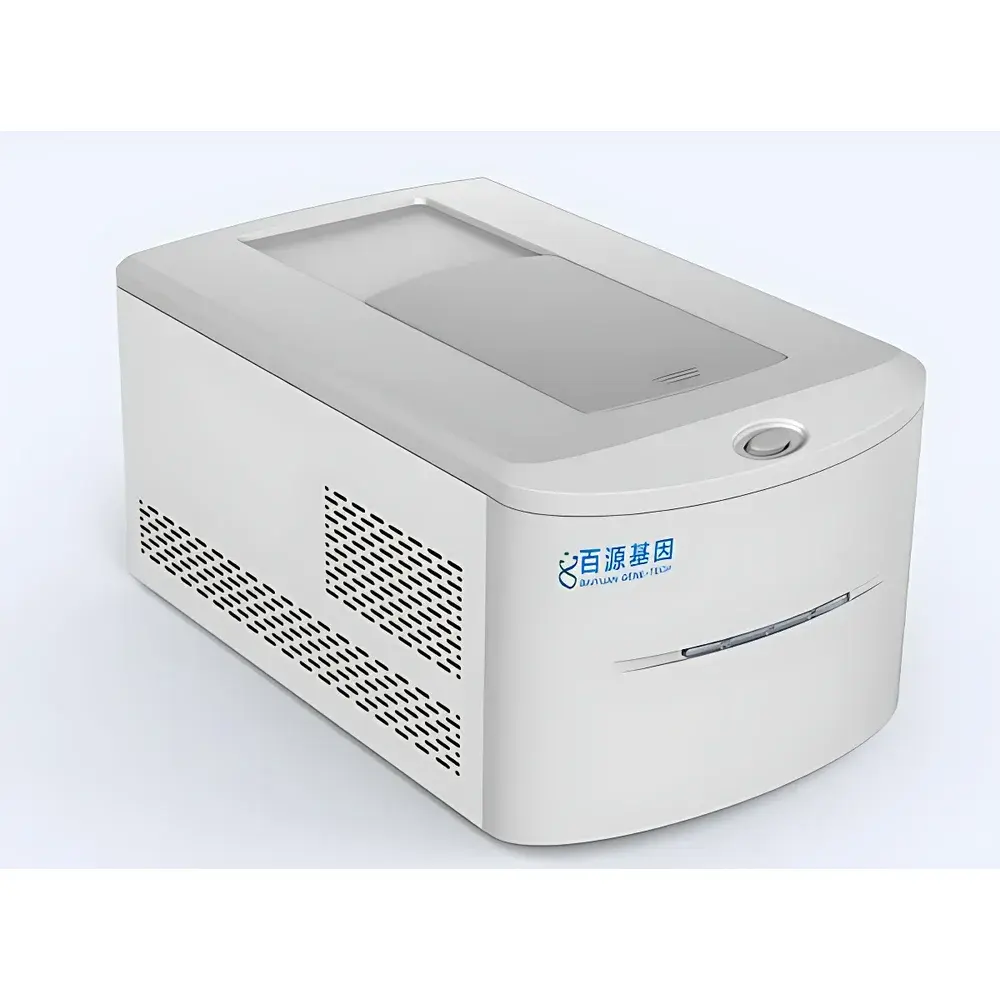
Pumai ASA-9600 Real-Time Fluorescent Quantitative PCR System
| Origin | Jiangsu, China |
|---|---|
| Manufacturer Type | Distributor |
| Origin Category | Domestic |
| Model | ASA-9600 |
| Price Range | USD 14,000–42,000 |
| Instrument Type | Real-Time Fluorescent Quantitative PCR System |
| Sample Throughput | 96-well format |
| Heating Rate | Avg. ≥1.5 °C/s, Max. ≥2.5 °C/s |
| Temperature Accuracy | ≤±0.5 °C |
| Well-to-Well Temperature Uniformity | ≤±1.0 °C |
| Cooling Rate | Avg. ≥1.5 °C/s, Max. ≥2.0 °C/s |
| Temperature Range | 4–99 °C |
| Lid Temperature | 104 °C |
| Excitation Wavelength Range | 380–780 nm |
| Emission Detection Channels | Up to 5 excitation + 5 emission filters |
| Fluorescence Detection Reproducibility (CV) | ≤3% |
| Inter-channel Crosstalk | Target-channel threshold not exceeded by adjacent channel signal |
| Linearity (R²) | ≥0.990 for fluorescence, ≥0.980 for sample concentration |
| Dynamic Range | 10 orders of magnitude |
Overview
The Pumai ASA-9600 Real-Time Fluorescent Quantitative PCR System is a precision-engineered thermal cycler designed for nucleic acid amplification and quantitative detection using SYBR Green, hydrolysis probes (TaqMan), molecular beacons, and other fluorescent chemistries. It operates on the principle of real-time monitoring of amplicon accumulation via sequence-specific fluorescent signal generation during each PCR cycle. The system integrates a thermally optimized 96-well reaction module with a high-sensitivity optical detection subsystem—comprising a stabilized halogen light source, fiber-optic excitation delivery, multi-position filter wheels, and a cooled CCD imaging sensor—to enable simultaneous, channel-resolved fluorescence acquisition across all wells. Its architecture supports both absolute and relative quantification, melt curve analysis, genotyping (including SNP and mutation detection), and pathogen load determination in clinical, research, and quality control laboratories.
Key Features
- Modular temperature control with six independently regulated thermal blocks, enabling parallel experiments at distinct annealing temperatures within a single run.
- Programmable 12-column linear temperature gradient spanning up to 20 °C, facilitating rapid optimization of primer annealing conditions.
- High-speed thermal cycling: maximum heating rate ≥2.5 °C/s and cooling rate ≥2.0 °C/s, reducing total run time without compromising amplification fidelity.
- Thermal uniformity ≤±1.0 °C across all 96 wells and accuracy ≤±0.5 °C over the full operating range (4–99 °C), ensuring reproducible Ct values and inter-run comparability.
- Five-channel excitation/emission capability (380–780 nm), supporting multiplex detection of up to five targets per well with minimal spectral overlap and inter-channel crosstalk.
- Cooled CCD detector with low-noise performance and CV ≤3% for fluorescence intensity repeatability, critical for low-abundance target quantification.
- Integrated lid heating (104 °C) prevents condensation and maintains reaction integrity throughout extended cycling protocols.
Sample Compatibility & Compliance
The ASA-9600 accepts standard 0.2 mL PCR tubes and 96-well plates compliant with ANSI/SLAS dimensional specifications. It is validated for use with human-derived clinical specimens—including plasma, serum, saliva, nasopharyngeal swabs, and tissue homogenates—following pre-extraction nucleic acid purification. The system meets essential requirements for in vitro diagnostic (IVD) workflows under ISO 13485-aligned quality systems. While not CE-IVD or FDA 510(k)-cleared out-of-the-box, its hardware and software architecture support configuration for GLP/GMP environments: audit trail logging, user access levels, electronic signature readiness, and data export formats compatible with LIMS integration. All thermal and optical performance metrics are traceable to internal calibration routines and conform to ASTM E1534 and ISO 15197 principles for analytical validation.
Software & Data Management
The ASA-9600 is operated via Windows-compatible application software (v01), supporting Windows 7 and later (minimum spec: Intel Pentium IV 2 GHz, 512 MB RAM, 10 GB HDD). The interface provides intuitive workflow navigation—from protocol design (including gradient setup, step editing, and hold functions) to real-time amplification plot visualization, automatic baseline/Ct calling, melt curve derivation, and comparative ΔΔCt analysis. Raw fluorescence data (RFU vs. cycle) and processed results (Ct, efficiency, R², Tm) are stored in vendor-neutral CSV and XML formats. Software supports retrospective reanalysis, batch comparison, and customizable reporting templates. Data integrity safeguards include timestamped operation logs, user authentication, and version-controlled method files—all compliant with ALCOA+ principles for regulated environments.
Applications
- Quantitative detection of viral/bacterial/fungal nucleic acids in clinical diagnostics (e.g., SARS-CoV-2, HBV, HPV, Mycobacterium tuberculosis).
- Expression profiling of mRNA and miRNA using reverse transcription qPCR (RT-qPCR).
- Allele discrimination and SNP genotyping via high-resolution melt (HRM) analysis or probe-based assays.
- Copy number variation (CNV) assessment and gene dosage analysis.
- Verification of CRISPR editing efficiency and off-target screening.
- QC release testing of biologics, vaccines, and cell therapies per USP <71> and ICH Q5A guidelines.
FAQ
What operating systems are supported by the ASA-9600 software?
Windows 7, 8, 10, and 11 (64-bit recommended); legacy support for Windows XP is deprecated and not advised for production use.
Does the ASA-9600 support passive reference dyes such as ROX?
Yes—the system includes dedicated optical channels and software options for ROX normalization to correct for well-to-well volume variation and pipetting error.
Can melt curve data be acquired immediately after amplification without pausing the run?
Yes; the instrument automatically initiates high-resolution melt acquisition (0.02 °C increments, 10 s/step) following amplification completion, with real-time derivative plotting (dF/dT) available in post-processing.
Is remote monitoring or network connectivity supported?
The ASA-9600 communicates exclusively via USB 2.0; Ethernet or Wi-Fi interfaces are not included, but data files can be exported and shared via secure network drives or LIMS middleware.
What maintenance is required for long-term optical stability?
Annual recalibration of thermal and fluorescence modules is recommended; halogen lamp lifetime is rated at ≥2,000 hours, and filter wheels undergo factory alignment verification before shipment.





