
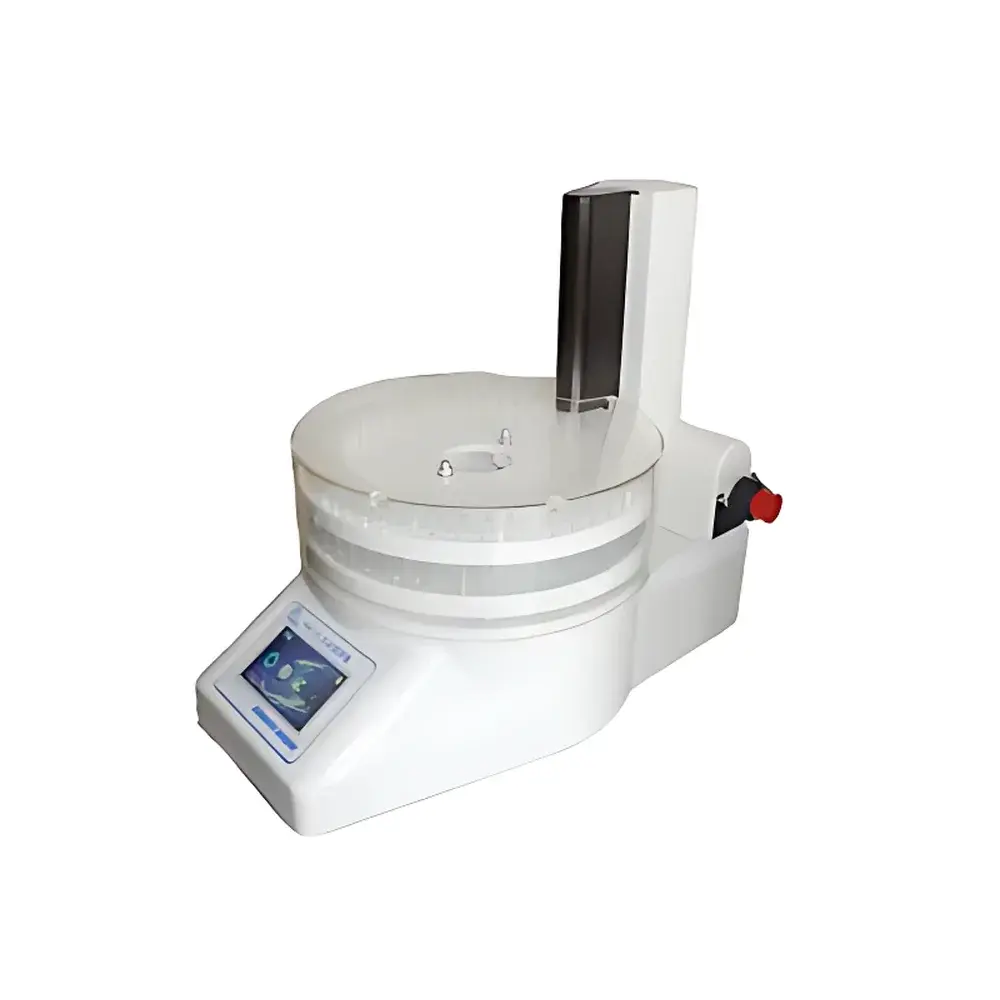
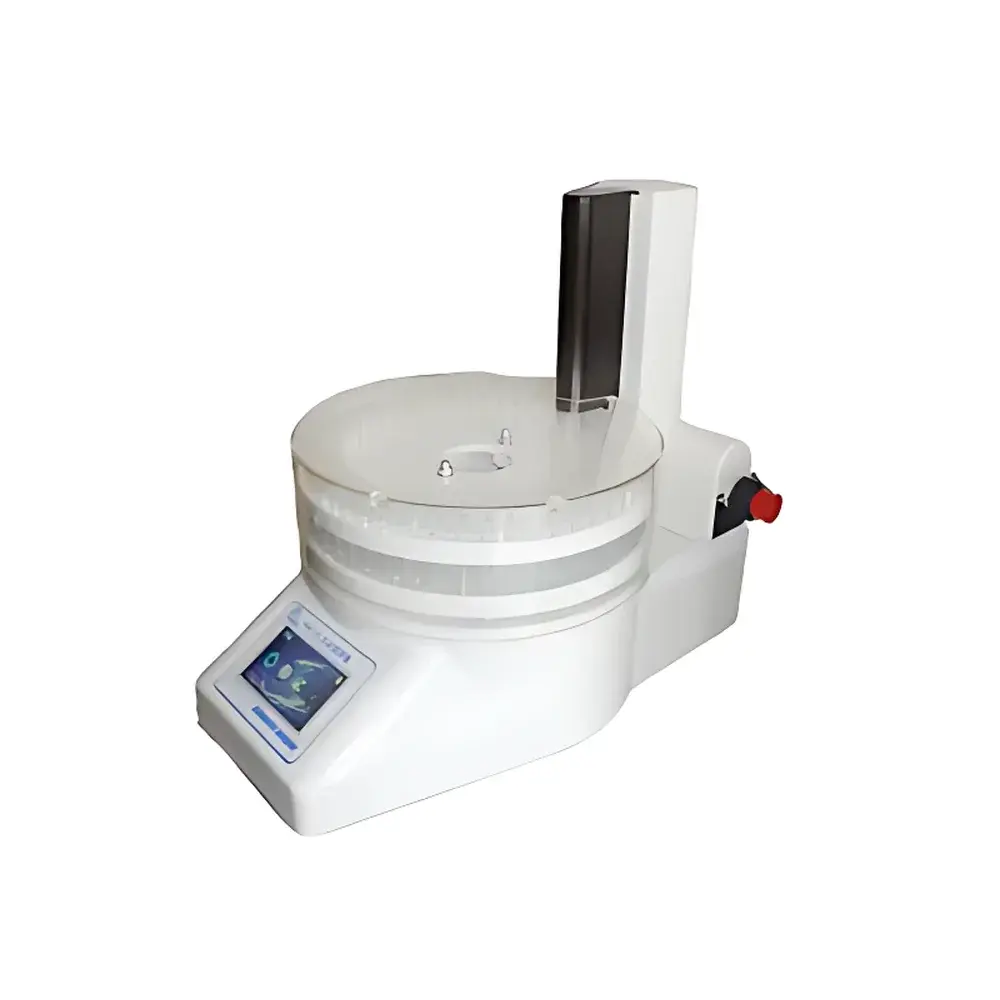
PUREN PAS-II Multifunctional Autosampler for Liquid Chromatography
| Brand | PUREN |
|---|---|
| Origin | Shandong, China |
| Manufacturer Type | Original Equipment Manufacturer (OEM) |
| Product Category | Domestic |
| Model | PAS-II |
| Instrument Type | Liquid Chromatography Autosampler |
| Control Interface | RS485 Serial Communication |
| Human-Machine Interface | LCD Touchscreen |
| Sampling Method | Motor-Driven Full-Loop Injection Valve |
| Sample Handling | Trace-Level Injection with Programmable Volume, Wash Volume, and Replicate Analysis Count |
| Compliance | Designed to Support GLP/GMP-Lab Workflows and ASTM D4327 / ISO 14911 Alignment for Ion Chromatography Applications |
Overview
The PUREN PAS-II Multifunctional Autosampler is an independently operating, microprocessor-controlled sample introduction system engineered for high-precision liquid chromatography (LC) and ion chromatography (IC) workflows. It implements a full-loop, motor-driven injection valve architecture—distinct from partial-loop or needle-in-loop designs—to ensure volumetric accuracy and minimal carryover during trace-level analysis. Unlike legacy autosamplers relying on pneumatic or manual actuation, the PAS-II integrates closed-loop positional feedback for syringe drive and valve timing, enabling reproducible injection volumes from 0.1 µL to 1000 µL with programmable step resolution. Its modular mechanical design supports direct integration with third-party LC/IC systems via TTL-triggered start signals or RS485-based command protocols (Modbus RTU), eliminating dependency on proprietary controllers. The instrument operates without continuous PC supervision, executing preloaded sequence files stored in internal flash memory—a critical capability for unattended overnight runs in regulated QC laboratories.
Key Features
- Full-loop injection mechanism with electrically actuated 6-port or 10-port high-pressure valve, rated for ≤35 MPa system backpressure
- Integrated touchscreen HMI (4.3″ LCD, capacitive touch) enabling local method setup, queue editing, and real-time status monitoring
- RS485 serial interface compliant with Modbus RTU protocol for bidirectional communication with LIMS or CDS software
- Programmable rinse cycle with dual-solvent selection (A/B lines) and adjustable wash volume (1–500 µL per step)
- Needle positioning system featuring three-axis motorized actuation: vertical lift (Z), horizontal extension (X), and rotational indexing (θ) — all equipped with optical end-stop detection
- Sample tray accommodating up to 120 × 1.5 mL vials or 60 × 4 mL vials; optional deep-well plate support (96-well, 384-well)
- Onboard non-volatile memory storing ≥500 sequence entries with timestamped audit trail (ISO/IEC 17025-compliant event logging)
Sample Compatibility & Compliance
The PAS-II accommodates aqueous, organic, and mixed-phase samples across pH 1–14, with chemically resistant fluidic pathways constructed from PEEK, sapphire, and Hastelloy C-276. It meets mechanical safety requirements per IEC 61010-1 and electromagnetic compatibility per EN 61326-1. For regulated environments, its firmware supports 21 CFR Part 11–compliant electronic signatures when paired with validated chromatography data systems (CDS). Audit trail records—including user login/logout, method modification, injection execution, and error events—are time-stamped, immutable, and exportable as CSV or PDF. The system has been verified against key IC validation parameters outlined in ASTM D4327 (determination of anions in water) and ISO 14911 (ion chromatographic determination of cations), particularly for retention time stability (<0.15% RSD over 24 h) and peak area repeatability (<1.2% RSD, n=10 at 10 ppb Cl⁻).
Software & Data Management
No proprietary software installation is required for basic operation—the PAS-II functions autonomously using onboard firmware. For advanced integration, it supports ASCII command sets compatible with Thermo Chromeleon™, Waters Empower™, and Shimadzu LabSolutions™ via RS485 or optional USB-to-serial bridge. Sequence files (.seq) can be generated externally using the open-format XML schema published in the technical reference manual. All audit logs are stored in SQLite database format with SHA-256 hash integrity verification. Remote diagnostics are accessible via optional Ethernet module (PAS-II-E), enabling SNMP-based health monitoring and firmware OTA updates under IT-managed network policies.
Applications
- High-throughput anion/cation profiling in environmental water testing (drinking water, wastewater, rainwater)
- Organic acid quantification in food and beverage matrices (e.g., citric, malic, lactic acids in juices)
- Pharmaceutical counterion analysis per USP and EP 2.2.46
- Trace metal speciation in geochemical extracts using chelation-IC coupling
- Method development support for gradient elution optimization with variable injection timing
- Automated calibration curve generation with multi-level bracketing and duplicate injections
FAQ
Does the PAS-II support cold storage for temperature-sensitive samples?
Yes—when mounted on a certified refrigerated sample rack (optional accessory, −5 °C to +15 °C range), the system maintains sample integrity for labile analytes such as sulfite or nitrite.
Can I use the PAS-II with HPLC systems from vendors other than PUREN?
Absolutely—the RS485 interface and TTL trigger inputs are vendor-agnostic; integration guides for Agilent, Waters, and Shimadzu platforms are included in the installation package.
How is carryover minimized during high-concentration sample runs?
The system executes a three-stage rinse protocol: pre-injection solvent flush, post-injection needle exterior wash, and internal loop purge—each individually programmable in volume and solvent composition.
Is firmware update capability available remotely?
Firmware updates require physical access via USB drive or local network connection through the optional Ethernet module; no cloud-based update mechanism is implemented to preserve air-gapped lab security policies.
What documentation is provided for regulatory validation?
A complete IQ/OQ protocol template, factory calibration certificate, and raw test data for injection precision, carryover, and linearity (5–500 µL) are supplied with each unit.



