
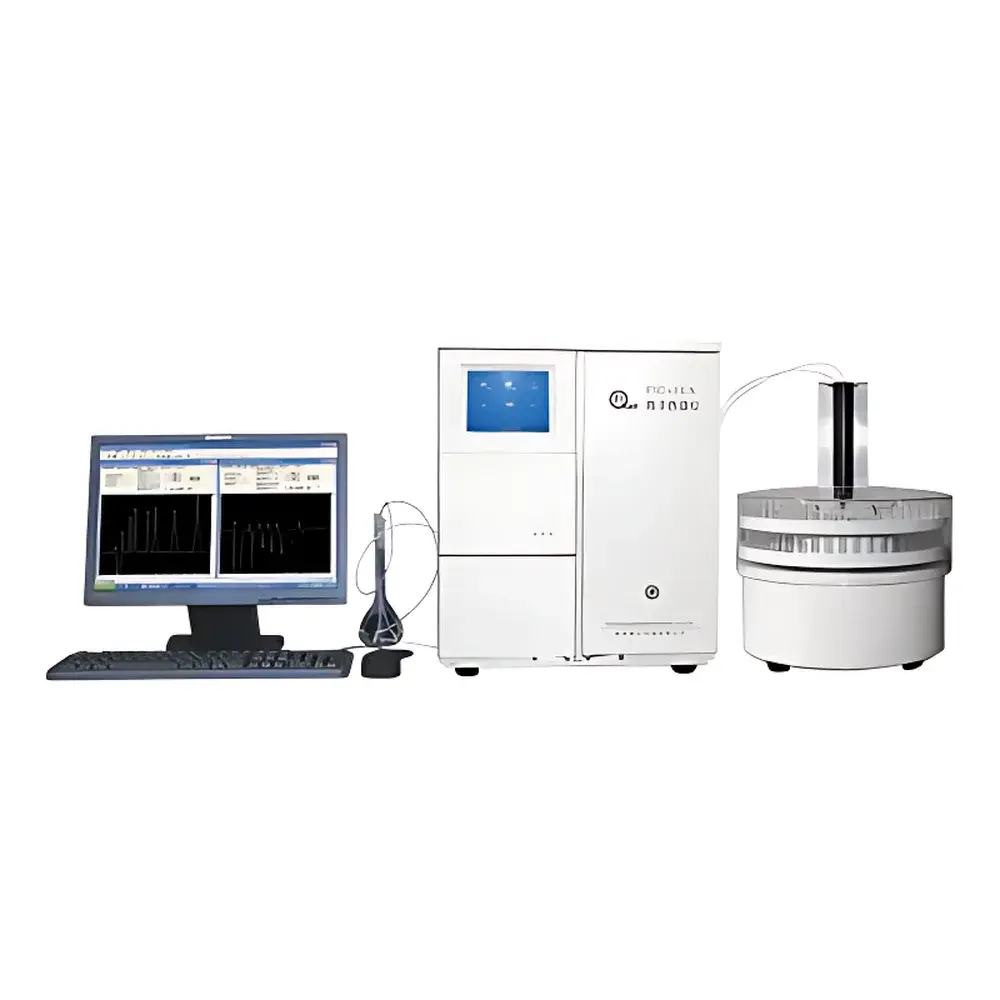
PUREN PIC-10A Dual-System Fully Automated Ion Chromatograph
| Brand | PUREN |
|---|---|
| Origin | Shandong, China |
| Manufacturer Type | Original Equipment Manufacturer (OEM) |
| Product Category | Domestic Laboratory Instrument |
| Model | PIC-10A Dual-System |
| Instrument Type | Benchtop Laboratory Ion Chromatograph |
| Application Scope | General-Purpose Quantitative Analysis of Inorganic Ions |
| Pump Max Pressure | 0–42.0 MPa (Stainless Steel), 0–35 MPa (PEEK) |
| Flow Rate Range | 0.001–9.999 mL/min (0.001 mL/min increments) |
| Eluent Flow Rate | 0.7–1.5 mL/min |
| Maximum Operating Pressure | 10 MPa (1500 psi) |
| Operating Temperature Range | 5–65 °C |
| Temperature Reproducibility | ±0.1 °C |
| Eluent Concentration Range | 1.92–4.8 mM |
Overview
The PUREN PIC-10A Dual-System Fully Automated Ion Chromatograph is a high-integrity, dual-channel benchtop instrument engineered for simultaneous quantitative analysis of inorganic anions and cations in complex aqueous matrices. Based on suppressed conductivity detection coupled with high-resolution ion-exchange chromatography, the system implements a dual-pump, dual-valve, dual-detector architecture—enabling independent or concurrent operation of two fully isolated chromatographic channels. Each channel supports independent gradient elution, column temperature control, and detector calibration, ensuring method flexibility without cross-channel interference. The system complies with fundamental requirements for regulated environments, including support for audit-trail-enabled data acquisition, electronic signature readiness, and full traceability of analytical parameters—aligning with GLP principles and foundational expectations under FDA 21 CFR Part 11 for non-GxP research use.
Key Features
- Dual independent high-pressure PEEK/stainless steel reciprocating piston pumps with intelligent flow pulse suppression algorithms, delivering stable flow across the full range (0.001–9.999 mL/min) at pressures up to 42 MPa.
- Integrated dual-conductivity detectors with real-time background suppression via continuous electrochemical regeneration membrane suppressors (pH 0–14 compatible, zero chemical consumption, <24 h stabilization time).
- Patented一体式 column-oven module (Patent No. ZL200820019630.3) maintaining precise, uniform temperature control (5–65 °C, ±0.1 °C reproducibility) across both separation columns and suppressors.
- Automated sample introduction via motorized full-loop injection valve with mechanical precision positioning; supports trace-level injection (≤10 µL) with ≤0.5% RSD injection volume repeatability.
- Chemically resistant PEEK fluidic path throughout—compatible with strong acids (e.g., HNO₃, H₂SO₄), strong bases (e.g., KOH, NaOH), and 100% organic solvents (e.g., methanol, acetonitrile) for column equilibration, cleaning, and method development.
- 24-bit high-resolution analog-to-digital conversion with dynamic range >10⁶, enabling linear response from sub-ppb to ppm-level concentrations without manual range switching.
Sample Compatibility & Compliance
The PIC-10A accommodates a broad spectrum of environmental and industrial sample types—including drinking water, wastewater, soil extracts, air particulate leachates, pharmaceutical excipients, food extracts, and petrochemical process streams—following appropriate pretreatment (e.g., filtration, dilution, matrix elimination). Its dual-system design allows parallel validation of anion and cation methods per ISO 10304-1:2012 and ASTM D4327-21, while its eluent concentration range (1.92–4.8 mM) supports standardized carbonate/bicarbonate and hydroxide-based gradients compliant with USP and EP 2.2.38. All hardware components meet CE marking requirements for electromagnetic compatibility (EN 61326-1) and electrical safety (EN 61010-1). While not pre-certified for GMP production release, the system’s architecture—including parameter locking, user-level access control, and raw-data integrity safeguards—facilitates qualification under laboratory-specific SOPs aligned with ISO/IEC 17025:2017.
Software & Data Management
The proprietary IC workstation operates via USB 2.0 interface and provides full instrument control, real-time signal monitoring, and post-run processing within a single Windows-native application. It supports automated method loading, sequence definition, and remote status polling. Key software capabilities include baseline correction (adaptive polynomial fitting), peak identification via retention time windows, automatic integration with configurable slope/threshold settings, and customizable report generation (PDF/CSV/XLS export). Audit trail functionality logs all user actions—including method edits, calibration updates, and data reprocessing—with timestamps and operator IDs. Raw chromatogram files (.icd) are stored with embedded metadata (instrument ID, date/time, method version, detector settings), ensuring ALCOA+ compliance for research-grade documentation.
Applications
The PIC-10A is routinely deployed in municipal water quality laboratories for routine compliance testing of regulated anions (F⁻, Cl⁻, NO₂⁻, Br⁻, NO₃⁻, PO₄³⁻, SO₄²⁻) and disinfection by-products (ClO₂⁻, ClO₃⁻, BrO₃⁻) per EPA Method 300.0 and ISO 10304-3. In industrial QA/QC settings, it quantifies alkali and alkaline earth metals (Li⁺, Na⁺, NH₄⁺, K⁺, Ca²⁺, Mg²⁺, Sr²⁺, Ba²⁺) in battery electrolytes, catalyst precursors, and semiconductor rinse waters. Its dual-channel capability enables orthogonal confirmation—e.g., simultaneous anion profiling in flue gas desulfurization slurry and cation analysis in associated scrubber liquor—without method reconfiguration. Optional amperometric detection (DC, pulsed, integrated, or differential pulse modes) extends applicability to redox-active species including iodide, sulfide, cyanide, and transition metal ions (Cu²⁺, Pb²⁺, Cd²⁺), supporting ASTM D3752 and ISO 15202-2 workflows.
FAQ
Can the PIC-10A perform simultaneous anion and cation analysis in a single run?
Yes—the dual-system architecture permits fully independent operation of two chromatographic channels, allowing concurrent anion and cation separations using optimized eluents, columns, and detection conditions.
Is the suppressor maintenance-free?
The continuous electrochemical regeneration micro-membrane suppressor requires no chemical regenerant or periodic replacement; it operates indefinitely with proper eluent purity and flow stability.
What data integrity features does the software provide?
The workstation enforces user authentication, records immutable audit trails for all critical actions, stores raw data with embedded metadata, and supports electronic signatures per internal lab policy—meeting core ALCOA+ expectations.
Does the system support gradient elution?
Yes—each pump channel supports programmable binary gradient formation via high-precision proportioning valves, enabling complex multi-step elution profiles for challenging sample matrices.
Is PEEK-compatible fluidics suitable for high-pH hydroxide eluents?
Yes—PEEK components are chemically inert up to pH 14 and thermally stable to 65 °C, making them ideal for modern KOH/NaOH eluent generators and high-pH separations.





