
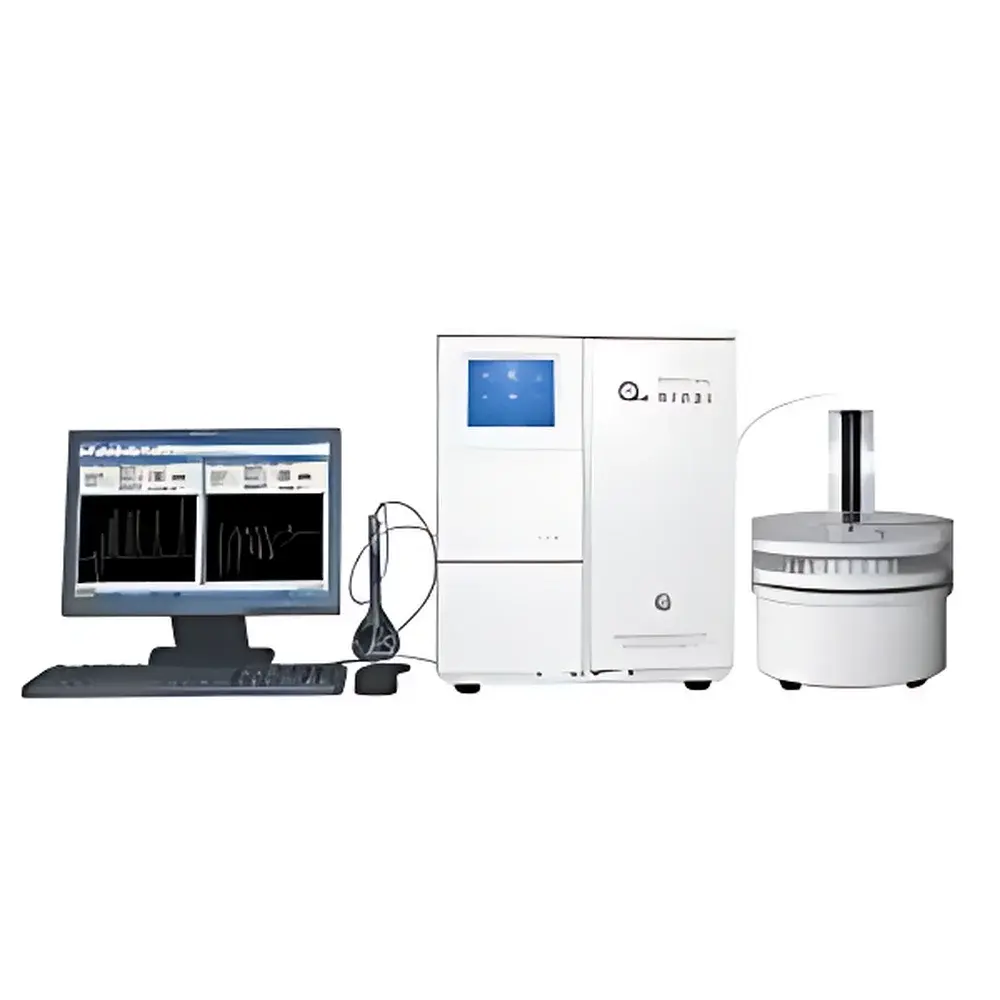
PUREN PIC-10A Dual-System Ion Chromatograph with Integrated Autosampler
| Brand | PUREN |
|---|---|
| Origin | Shandong, China |
| Manufacturer Type | Direct Manufacturer |
| Model | PIC-10A (Dual-System Autosampler Configuration) |
| Detection Modes | Conductivity Detection (Standard), Optional Pulsed Amperometric Detection (PAD), DC Amperometric Detection, Integral Amperometric Detection, Differential Pulse Voltammetry |
| Anion Separation Range | F⁻, Cl⁻, NO₂⁻, NO₃⁻, SO₄²⁻, Br⁻, PO₄³⁻, ClO₂⁻, ClO₃⁻, BrO₃⁻ |
| Cation Separation Range | Li⁺, Na⁺, NH₄⁺, K⁺, Ca²⁺, Mg²⁺, Sr²⁺, Ba²⁺ |
| Detector | Dual Conductivity Detector (Simultaneous Anion/Cation Monitoring) |
| Pump System | Dual Microprocessor-Controlled Double-Plunger Reciprocating Pumps |
| Flow Pulsation | Minimized via Intelligent Flow Algorithm |
| Gradient Capability | Binary to Quaternary Gradient Elution |
| Fluidic Path Materials | PEEK (Imported, Acid/Base/100% Organic Solvent Compatible) |
| Suppressor | Auto-Regenerating Membrane Suppressor (pH 0–14, On-Line Regeneration, Low Background Conductivity, Maintenance-Free Operation) |
| Thermostat | Integrated Internal Column & Detector Thermostat (Patent No. 200820019630.3) |
| Data Acquisition | High-Precision Digital-to-Analog Conversion |
| Interface | USB (Workstation Communication), RS-232/485 (Pump & Peripheral Control) |
| Autosampler | Electric-Valve Full-Loop Injection, Trace-Sample Compatible, Residual-Free, High Reproducibility (RSD < 1.2%) |
| Software Functions | Real-Time Parameter Remote Control, Baseline Subtraction, Automatic Peak Integration, Negative Peak Recognition, Fault Diagnostics & Instrument State Monitoring, Report Generation (PDF/CSV/XLS), Audit-Trail Ready Data Logging |
Overview
The PUREN PIC-10A Dual-System Ion Chromatograph is an engineered analytical platform designed for high-fidelity, simultaneous separation and quantification of inorganic anions and cations in complex aqueous matrices. Based on suppressed conductivity detection—compliant with ISO 10304-1:2012 and ASTM D4327—this system employs a dual-channel architecture integrating independent fluidic paths, detectors, injection valves, and pump modules. Each channel operates autonomously or synchronously, enabling concurrent analysis of anionic and cationic species without cross-contamination or method compromise. The system’s core separation mechanism relies on ion-exchange chromatography using high-efficiency, low-backpressure columns packed with functionalized polymer resins. Mobile phase delivery is governed by microprocessor-controlled double-plunger reciprocating pumps, ensuring stable flow rates (0.01–9.99 mL/min, adjustable in 0.01 mL/min increments) with pulse suppression below 0.1% RSD. All wetted components—including pump heads, check valves, and eluent lines—are constructed from PEEK, providing full chemical inertness across pH 0–14 and compatibility with strong acids (e.g., HNO₃, H₂SO₄), strong bases (e.g., KOH, NaOH), and 100% organic modifiers (e.g., methanol, acetonitrile). This robust fluidic architecture supports long-term method stability under regulatory QC/QA workflows.
Key Features
- Dual-conductivity detection module with real-time background suppression, delivering baseline stability < 1 nS and noise < 0.2 nS (RMS, 25 °C)
- Auto-regenerating membrane suppressor with on-line chemical regeneration, eliminating manual acid/base replenishment and supporting continuous operation over 2,000 injections per cartridge
- Integrated column and detector thermostat (±0.1 °C stability), patented under CN200820019630.3, ensuring retention time reproducibility < 0.15% RSD (n = 10)
- Electric-valve full-loop autosampler with 100-position vial capacity, 0.1–1000 µL injection volume range, and < 0.8% injection volume precision (n = 20)
- USB-connected dedicated workstation software with FDA 21 CFR Part 11–ready audit trail, electronic signature support, and GLP-compliant data archiving
- RS-232/485 interfaces for bidirectional instrument control—enabling remote gradient programming, flow rate adjustment, and detector gain calibration from host PC
- Four optional electrochemical detection modes (DC amperometry, pulsed amperometry, integral amperometry, differential pulse voltammetry) for trace-level determination of redox-active analytes including I⁻, CN⁻, S²⁻, Pb²⁺, Cu²⁺, and selected organics
Sample Compatibility & Compliance
The PIC-10A accommodates direct injection of filtered (0.45 µm nylon or PVDF), non-particulate aqueous samples—including drinking water, wastewater, soil leachates, pharmaceutical excipients, petrochemical process streams, and biological fluids (after deproteinization). It complies with multiple international standards governing ion analysis: ISO 10304-1 (determination of dissolved anions), ISO 14911 (cation analysis in water), USP (conductivity testing), and EPA Methods 300.0, 300.1, and 317.0. Its hardware design meets IEC 61010-1 safety requirements for laboratory equipment. The suppressor’s pH 0–14 operational range permits use of aggressive eluents required for challenging separations—such as carbonate/bicarbonate gradients for early-eluting anions or methanesulfonic acid for alkali metals—without degradation of column performance or detector response linearity.
Software & Data Management
The embedded workstation utilizes a real-time Windows-based application with native 64-bit architecture and multi-threaded acquisition. Raw chromatograms are acquired at 20 Hz sampling frequency, digitized via 24-bit ADC, and stored in vendor-neutral .ICD format (compatible with third-party chemometric tools). Software features include automated system suitability testing (SST), peak purity assessment via spectral deconvolution (when coupled with optional UV/Vis detector), customizable reporting templates (ASTM-, ISO-, or internal QA-formatted), and role-based user access control (administrator, analyst, reviewer). All method parameters, raw data, processed results, audit logs, and instrument status events are timestamped and cryptographically hashed to satisfy GLP/GMP data integrity requirements. Backup and restore functions support network-mapped drives and encrypted cloud repositories compliant with ISO/IEC 27001 protocols.
Applications
The PIC-10A serves as a primary analytical tool in environmental laboratories performing routine compliance monitoring of regulated ions in potable water (e.g., NO₃⁻, BrO₃⁻, ClO₃⁻ per WHO/EPA limits); in pharmaceutical QC labs verifying counterion content in APIs and excipients (e.g., Na⁺ in sodium heparin, Cl⁻ in ceftriaxone sodium); in food safety testing for preservative anions (e.g., NO₂⁻ in cured meats, SO₄²⁻ in wine); and in geochemical research quantifying major cations (Ca²⁺, Mg²⁺, Sr²⁺) in groundwater and seawater. Its dual-system configuration enables method development parallelism—e.g., optimizing anion separation on one channel while validating cation stability on the other—reducing total method lifecycle time by up to 40%. When equipped with amperometric detection, it extends capability to ultra-trace iodide in thyroid medication or cyanide in industrial effluents at sub-pptr levels.
FAQ
Does the PIC-10A support gradient elution?
Yes—its dual-pump architecture supports binary, ternary, or quaternary gradient profiles programmable via the workstation, with gradient delay volume < 350 µL and composition accuracy ±0.2%.
Is the autosampler compatible with standard 10-mm OD vials?
Yes—it accepts 10 × 32 mm screw-thread or crimp-top vials, with optional adapters for 12 × 32 mm and 15 × 45 mm formats.
Can the system be integrated into a LIMS environment?
Yes—via ODBC-compliant database export (SQL Server, Oracle, PostgreSQL), HL7 messaging, or RESTful API endpoints for metadata exchange.
What is the typical column lifetime under routine use?
With proper mobile phase filtration (0.22 µm), guard column usage, and daily system flushing, analytical columns maintain resolution > 95% of initial specification for ≥ 2,500 injections.
Is firmware upgrade supported remotely?
Yes—secure firmware updates are delivered via signed .BIN packages through the workstation’s maintenance portal, requiring administrator authentication and automatic rollback on verification failure.
Related Products






