
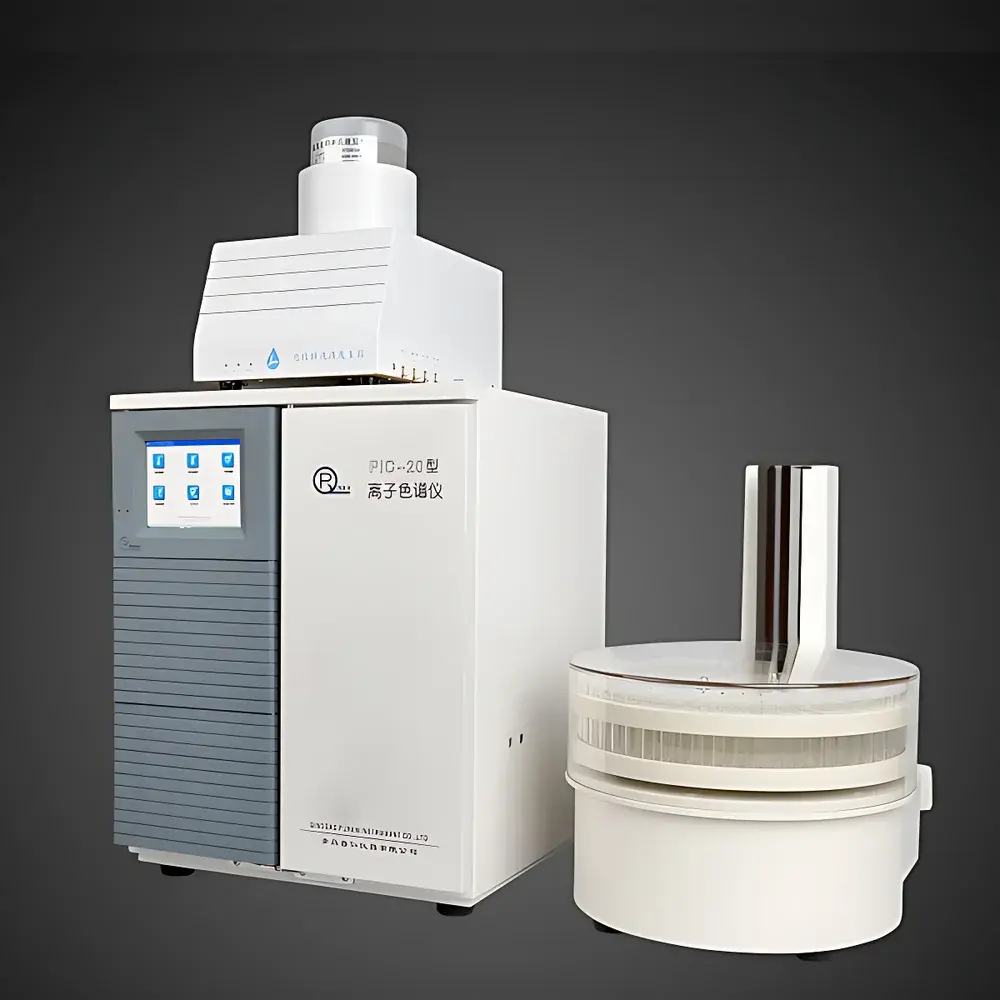
PUREN PIC-20 Fully Automated Ion Chromatograph
| Brand | PUREN |
|---|---|
| Origin | Shandong, China |
| Manufacturer Type | Direct Manufacturer |
| Instrument Type | Laboratory Benchtop Ion Chromatograph |
| Application Scope | Universal (Anions & Cations) |
| Maximum Pump Pressure | 0–42.0 MPa (Stainless Steel), 0–36 MPa (PEEK) |
| Flow Rate Range | 0.001–9.999 mL/min (0.001 mL/min increments) |
| Eluent Flow Rate | 0.7–1.5 mL/min |
| Max System Operating Pressure | 10 MPa (1500 psi) |
| Column Oven Temperature Range | 5–65 °C |
| Temperature Reproducibility | ±0.004 °C |
| Eluent Concentration Range | 1.92–4.8 mM |
Overview
The PUREN PIC-20 Fully Automated Ion Chromatograph is a modular, high-integration benchtop system engineered for precise, reproducible separation and quantification of inorganic anions, cations, organic acids, and selected transition metals in environmental, pharmaceutical, food, and industrial quality control laboratories. It operates on the fundamental principle of ion-exchange chromatography, where analyte ions are separated based on their charge density and hydration radius on dedicated ion-exchange columns, followed by suppressed conductivity detection or complementary electrochemical (amperometric) and UV-Vis detection. The system integrates dual-pump high-pressure fluidics, thermally stabilized column and detector compartments, electrochemical suppression, online degassing, and embedded real-time data acquisition — all within a single chassis. Its architecture supports simultaneous anion/cation analysis via independent dual-channel detection paths, enabling gradient elution and multi-analyte profiling without hardware reconfiguration.
Key Features
- Fully autonomous operation: Embedded 5.7-inch high-resolution color touchscreen interface with built-in chromatography workstation eliminates dependency on external PCs for method setup, real-time peak integration, report generation (exportable as .docx or .xlsx), and instrument diagnostics.
- Multi-detection capability: Supports configurable combinations of dual-channel conductivity detection, single-channel pulsed amperometric detection (PAD), and dual-channel UV-Vis detection — each optimized for specific analyte classes including halides (F⁻, Cl⁻, Br⁻, I⁻), oxyanions (NO₂⁻, NO₃⁻, SO₄²⁻, ClO₃⁻, BrO₃⁻), organic acids (acetate, formate, oxalate), transition metals (Pb²⁺, Cu²⁺, Zn²⁺, Cd²⁺), and redox-active species (Fe²⁺/Fe³⁺, Cr³⁺/Cr⁶⁺).
- Integrated thermal management: Monolithic column-detector oven with dual-layer insulation maintains ±0.004 °C temperature stability across conductance cells, separation columns, and suppressors — critical for retention time reproducibility and baseline noise reduction.
- Advanced fluidic design: Dual-piston reciprocating PEEK or stainless-steel pumps deliver flow rates from 0.001 to 9.999 mL/min at pressures up to 42 MPa; integrated vacuum-based online degassers (pre- and post-suppressor) remove dissolved CO₂ and O₂, reducing background conductivity by >90% and enhancing signal-to-noise ratio for sub-ppb detection.
- Electrochemical suppression: Continuously regenerated micro-membrane suppressor (pH 0–14 compatible) provides stable low-background conductivity, minimal dead volume, and maintenance-free operation over >5,000 injections.
- Modular expandability: Optional electrolytic eluent generator enables reagent-free operation using only ultrapure water; PAS-series autosampler (patent ZL201110457038.8) enables trace-level injection with <0.5% RSD precision; column valve switching modules support mixed-mode separations (IC, HPLC, SEC).
Sample Compatibility & Compliance
The PIC-20 accommodates aqueous samples across wide pH (0–14) and ionic strength ranges, including environmental waters (drinking, wastewater, seawater), biological fluids (urine, serum), food extracts, pharmaceutical excipients, and industrial process streams. Its PEEK fluidic path ensures compatibility with strong acids (e.g., HNO₃, H₂SO₄), strong bases (KOH, NaOH), and 100% organic modifiers (acetonitrile, methanol). The system meets core regulatory requirements for GLP/GMP environments: full audit trail logging (user actions, method changes, calibration events), electronic signatures (21 CFR Part 11 compliant when paired with validated software), and traceable calibration protocols aligned with ISO/IEC 17025 and ASTM D4327 (anions), D6919 (cations), and USP (conductivity detection). All detectors provide NIST-traceable response factors under standardized test conditions.
Software & Data Management
The embedded 24-bit ADC workstation performs real-time peak detection, baseline correction, automatic negative peak recognition, and quantitative integration using user-defined or ISO-standard algorithms (tangent skim, perpendicular drop). Data files are stored locally in vendor-neutral .icd format and synchronized automatically to cloud storage via Ethernet/Wi-Fi — enabling remote access, version-controlled backups, and cross-laboratory data sharing. USB export supports direct transfer to U-disks; network interface permits remote monitoring and method deployment via secure HTTP/S. When connected to external PCs, the system supports bidirectional control (method upload/download, live parameter adjustment) using PUREN’s certified chromatography software (Software Copyright No. 2012SR037194), which includes automated linearity validation, QC flagging, and customizable reporting templates compliant with LIMS integration standards (ASTM E1467, HL7).
Applications
- Environmental monitoring: Quantification of regulated anions (Cl⁻, NO₃⁻, SO₄²⁻) and disinfection by-products (ClO₂⁻, BrO₃⁻) in drinking water per EPA Method 300.0 and ISO 10304-1.
- Pharmaceutical QA/QC: Counterion analysis (Na⁺, K⁺, Ca²⁺) in APIs, residual acetate/formate in biologics, and nitrate/nitrite impurities in excipients per USP and .
- Food safety: Detection of preservatives (sorbate, benzoate), flavor enhancers (glutamate), and contaminants (iodide, thiocyanate) in dairy, beverages, and infant formula.
- Battery electrolyte analysis: Li⁺, PF₆⁻, and F⁻ speciation in lithium-ion battery formulations under controlled inert atmosphere.
- Geochemical research: Multi-element cation/anion profiling in brines and hydrothermal fluids using high-capacity columns with extended pH stability.
FAQ
Does the PIC-20 require external computers for routine operation?
No — all core functions including method execution, real-time chromatogram display, peak integration, and report generation are fully supported by the onboard touchscreen workstation.
Can the system perform simultaneous anion and cation analysis in a single run?
Yes, using the dual-system configuration with independent eluent streams, detectors, and suppression modules — validated per ISO 14911 for concurrent determination.
What is the maximum allowable eluent concentration range for gradient methods?
The system supports programmable eluent concentration from 1.92 mM to 4.8 mM using either pre-mixed solutions or the optional electrolytic eluent generator.
Is the amperometric detector compatible with heavy metal analysis?
Yes — the pulsed amperometric detection module is calibrated for quantitative determination of Pb²⁺, Cu²⁺, Zn²⁺, and Cd²⁺ in acidified matrices using gold or mercury film working electrodes.
How does the CO₂ removal system improve detection limits?
Post-suppressor CO₂ degassing reduces baseline conductivity by 2–3× compared to standard systems, directly lowering the limit of detection for low-conductivity anions such as fluoride and acetate.





