
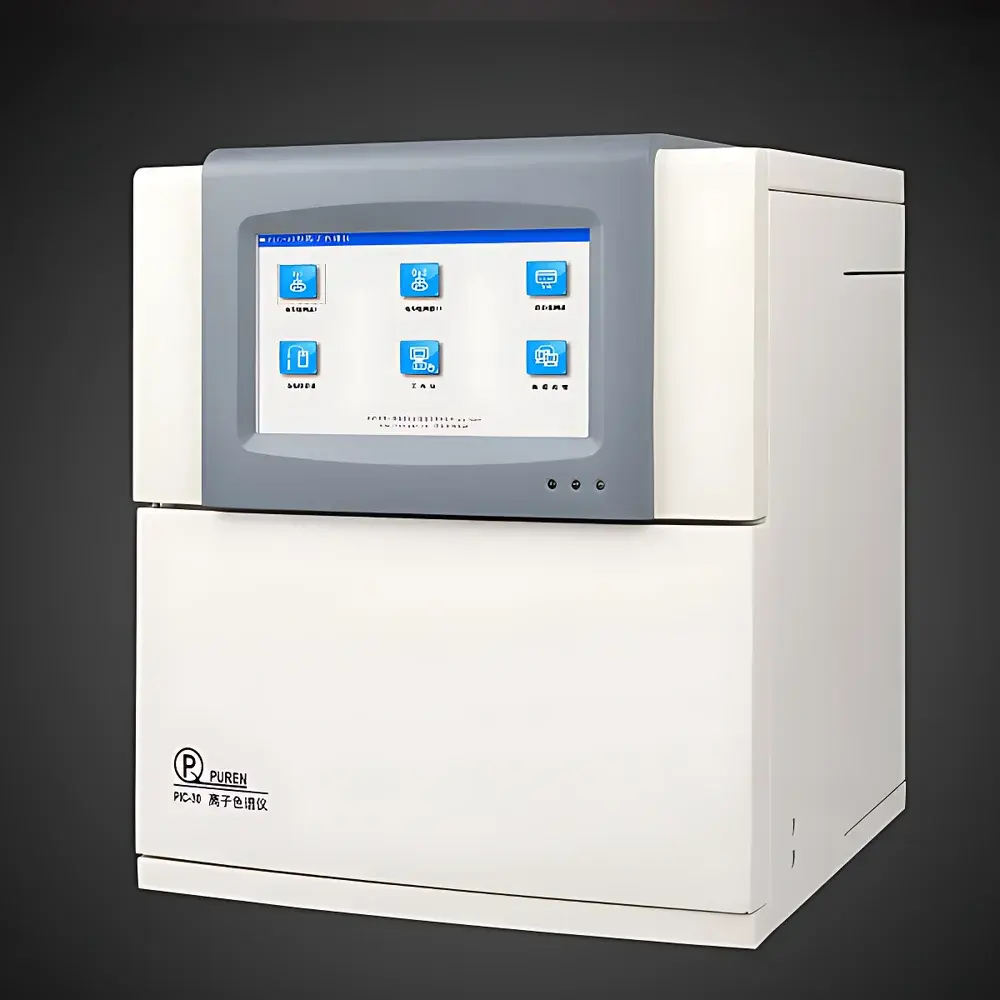
PUREN PIC-30 Ion Chromatograph
| Brand | PUREN |
|---|---|
| Origin | Shandong, China |
| Manufacturer Type | Direct Manufacturer |
| Region of Origin | Domestic (China) |
| Model | PIC-30 |
| Instrument Type | Laboratory Benchtop System |
| Application Scope | General-Purpose Anion/Cation Analysis |
| Maximum Pump Pressure | 36 MPa |
| Flow Rate Range | 0.001–9.999 mL/min |
| Eluent Flow Rate Range | 0.001–9.999 mL/min |
| Maximum Operating Pressure | 10 MPa |
| Operating Temperature Range | 5–65 °C |
| Temperature Reproducibility | ±0.04 °C |
| Eluent Concentration Range | 0–20 mM |
| Detector Options | Dual-Channel Conductivity Detector / Single-Channel Voltammetric Detector / Dual-Channel UV-Vis Detector |
| Fluidic Path | All-PEEK Non-Metallic Flow Path |
| Integrated Components | Embedded Chromatography Workstation, Auto-Sampler Interface, Onboard Dilution Module, Eluent Generator Compatibility (Optional), Internal Degasser, CO₂ Suppressor, Column Oven with Integrated Conductivity Cell & Suppressor |
Overview
The PUREN PIC-30 Ion Chromatograph is a fully integrated, benchtop-capable analytical platform engineered for high-precision, reproducible separation and quantification of inorganic anions, cations, organic acids, and low-molecular-weight amines in environmental, pharmaceutical, food, and industrial quality control laboratories. Based on suppressed conductivity detection principles—employing either chemical or electrolytic suppression—the system delivers stable baseline performance and sub-ppb detection sensitivity for target analytes. Its modular architecture integrates all core chromatographic functions—including high-pressure eluent delivery, thermally stabilized separation, real-time signal acquisition, and embedded data processing—within a single compact chassis. Designed to meet the operational rigor of ISO/IEC 17025-accredited labs and support GLP/GMP workflows, the PIC-30 complies with key regulatory expectations for audit trail integrity, data traceability, and instrument qualification documentation.
Key Features
- Integrated all-PEEK fluidic path—including pump head, six-port injection valve (Rheodyne-compatible), tubing, fittings, and eluent reservoirs—ensuring full compatibility with acidic, basic, and organic-modified eluents while eliminating metal ion leaching and cross-contamination.
- Embedded 10.1-inch high-brightness capacitive touchscreen display with intuitive graphical user interface; enables standalone operation without external PC connection for method setup, real-time chromatogram monitoring, peak integration, and report generation.
- Onboard temperature-controlled column oven with integrated conductivity cell, suppressor, and six-port valve; maintains uniform thermal environment (5–65 °C, ±0.04 °C reproducibility) and minimizes extra-column band broadening via ultra-short inter-component tubing.
- Dual independent high-precision piston pumps capable of delivering flow rates from 0.001 to 9.999 mL/min at up to 36 MPa, supporting gradient elution, multi-method sequencing, and compatibility with sub-2-µm particle columns.
- Automated sample preparation module featuring programmable dilution (manual or auto-triggered) and standard solution preparation—enabling unattended calibration curve generation and direct analysis of high-concentration samples without manual intervention.
- Expandable detector configuration: supports dual-channel conductivity detection (with optional electrolytic suppression), single-channel pulsed amperometric detection (PAD), or dual-channel UV-Vis detection (200–400 nm), allowing flexible method development across diverse analyte classes.
Sample Compatibility & Compliance
The PIC-30 accommodates aqueous matrices including drinking water, wastewater, soil extracts, biological fluids (e.g., urine, serum), food digests, and pharmaceutical excipients. Its non-metallic flow path ensures compatibility with aggressive eluents such as potassium hydroxide (0–20 mM), methanesulfonic acid, and sodium carbonate/bicarbonate buffers. The system supports ASTM D4327, ISO 14911, USP , and EPA Methods 300.0, 300.1, and 317.0 for anion analysis, and EPA Method 321.8 for cation determination. All electronic records comply with ALCOA+ principles; audit trails, user authentication logs, and electronic signatures are maintained per FDA 21 CFR Part 11 requirements when operated with validated software configurations.
Software & Data Management
The embedded PUREN Chromatography Workstation v4.x provides full instrument control, real-time data acquisition, automated peak identification, quantitative calibration (linear/nonlinear), and customizable reporting. It features drag-to-zoom spectral navigation, batch processing of autosampler sequences, and one-click export to Excel or Word formats. Data integrity is reinforced through local SSD storage (≥1 TB), automatic cloud backup via encrypted HTTPS protocols, and synchronized remote access through the official PUREN Mobile App (iOS/Android). The app enables live status monitoring, remote method upload/download, and secure retrieval of chromatograms and audit logs—facilitating off-site troubleshooting and compliance review without physical lab access.
Applications
- Environmental monitoring: quantification of F⁻, Cl⁻, NO₂⁻, Br⁻, NO₃⁻, PO₄³⁻, SO₄²⁻, and AsO₄³⁻ in surface water, groundwater, and effluent streams.
- Pharmaceutical QC: assay of counterions (Na⁺, K⁺, Ca²⁺, Mg²⁺) in APIs and excipients; residual acetate or citrate in biologics formulations.
- Food safety: detection of preservatives (benzoate, sorbate), nitrate/nitrite in cured meats, and iodide in dairy products.
- Power industry: trace chloride and sulfate analysis in ultrapure boiler feedwater per ASTM D4582.
- Academic research: speciation studies of transition metal complexes and organic acid metabolites using coupled UV/conductivity detection.
FAQ
Does the PIC-30 support gradient elution?
Yes—the dual-pump architecture allows precise binary or ternary gradient formation with programmable flow and composition profiles.
Can it be used for both anion and cation analysis on the same platform?
Yes—by swapping columns, suppressors, and eluents, the system supports standardized methods for either mode without hardware modification.
Is the embedded software compliant with FDA 21 CFR Part 11?
When deployed with enabled electronic signature modules, role-based access controls, and immutable audit trails, the workstation meets core Part 11 technical requirements for regulated environments.
What maintenance intervals are recommended for the PEEK fluidic components?
Under normal use (≤1000 injections/month), PEEK tubing and valves require inspection every 6 months; pump seals are rated for ≥5000 hours of continuous operation.
How does the internal degasser function without external vacuum sources?
It employs membrane-based helium or nitrogen sparging with integrated pressure regulation, eliminating need for external vacuum pumps or gas cylinders.
Related Products





