
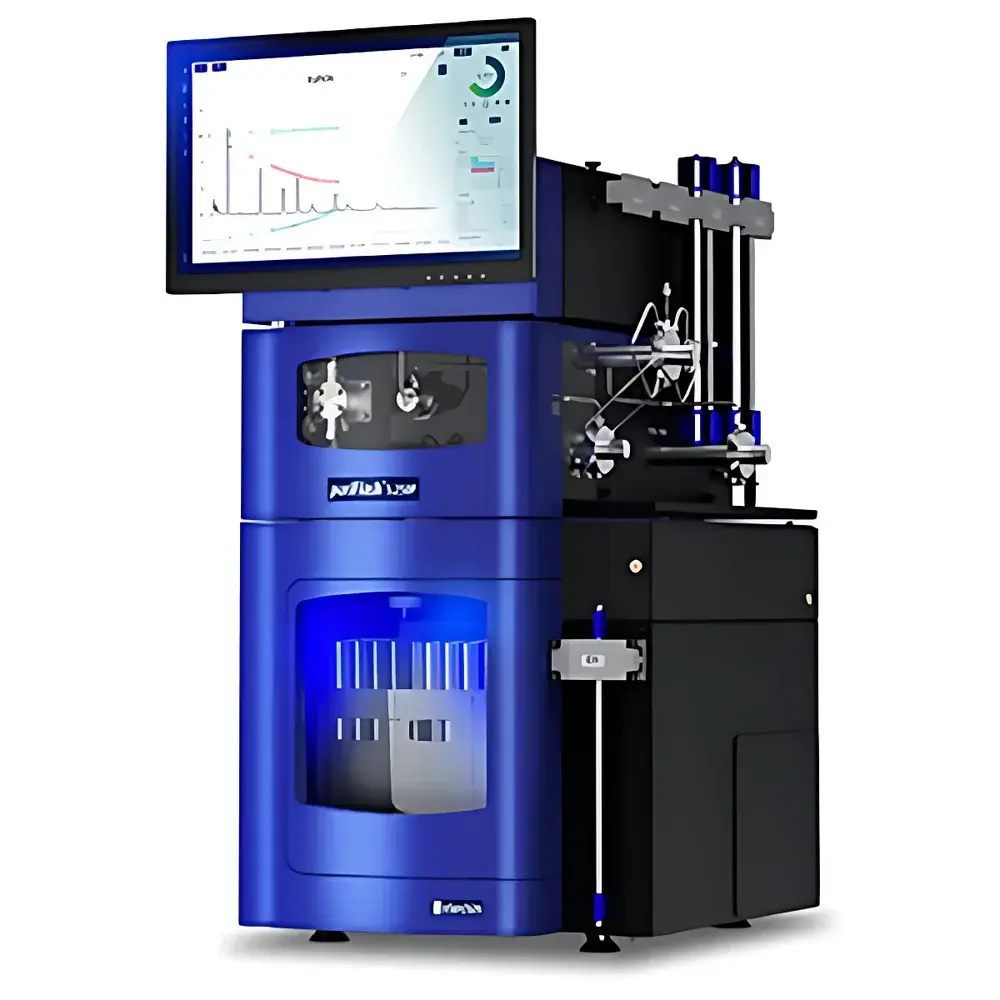
puriFlash® 5.250P Peptide Purification System
| Brand | Advion Interchim Scientific |
|---|---|
| Origin | France |
| Model | puriFlash® 5.250P |
| Maximum Flow Rate | 125 mL/min |
| Maximum Pressure | 250 bar |
| Application Focus | Complex Peptide Mixture Separation |
| Import Status | Imported Instrument |
| Distributor Type | Authorized General Distributor |
| Pricing | Available Upon Request |
Overview
The puriFlash® 5.250P Peptide Purification System is a high-performance, semi-preparative flash chromatography platform engineered by Advion Interchim Scientific for the robust and reproducible purification of synthetic and native peptides. Designed specifically to address the physicochemical challenges inherent in peptide separations—including structural heterogeneity, aggregation propensity, and sensitivity to pH and organic solvent gradients—the system integrates a precision dual-piston HPLC-grade pump, low-dead-volume fluidic architecture, and UV/Vis detection optimized for amide bond absorbance (210–220 nm). Its operational principle relies on gradient elution chromatography using reversed-phase C18 or specialized wide-pore silica-based media (e.g., C4, C8, or polymer-based resins), enabling high-resolution fractionation of crude peptide mixtures generated via solid-phase peptide synthesis (SPPS) or enzymatic cleavage. The system operates within a validated pressure range up to 250 bar and supports flow rates from 0.1 to 125 mL/min—making it suitable for analytical-scale scouting runs as well as milligram-to-gram scale purification under controlled, repeatable conditions.
Key Features
- High-pressure capability (up to 250 bar) ensures compatibility with sub-20 µm stationary phases for enhanced resolution of closely eluting peptide variants.
- Wide dynamic flow range (0.1–125 mL/min) allows seamless method translation from analytical screening to preparative isolation without column re-optimization.
- Integrated UV/Vis detector with dual-wavelength monitoring (210 nm and 254 nm) provides real-time tracking of peptide elution profiles and early detection of truncated sequences or deletion peptides.
- Modular fraction collector with programmable tube rack recognition and solvent-resistant vial handling supports unattended operation across extended purification campaigns.
- Chemically resistant fluid path (PEEK, stainless steel, and sapphire components) maintains integrity during exposure to TFA, HFIP, DCM, and high-concentration acetonitrile/water gradients commonly used in peptide workups.
- Onboard method storage and recall functionality enables GLP-compliant workflow continuity across multiple users and shifts.
Sample Compatibility & Compliance
The puriFlash® 5.250P accommodates a broad spectrum of peptide samples—including linear and cyclic peptides up to 50 residues, phosphopeptides, glycopeptides, and disulfide-bonded species—when paired with appropriate column chemistries and mobile phase systems. It complies with ISO 9001-certified manufacturing standards and supports audit-ready documentation when operated in conjunction with compliant data acquisition software. While not intrinsically 21 CFR Part 11 certified, the system’s digital I/O interface and timestamped event logging facilitate integration into validated environments where electronic records and signature requirements apply. Method parameters, run logs, and fraction metadata can be exported in CSV or XML formats for inclusion in regulatory submissions aligned with ICH Q5, Q6, and USP <725> guidelines for peptide characterization.
Software & Data Management
Control and data acquisition are managed via Interchim’s puriFlash® Software Suite, a Windows-based application supporting method development, real-time chromatogram visualization, peak integration, and fraction triggering logic based on absorbance thresholds or time windows. The software includes built-in libraries for common peptide purification gradients (e.g., water/acetonitrile + 0.1% TFA), retention time prediction tools, and batch report generation with customizable templates. All acquisition events—including pump pressure, flow deviation, UV lamp status, and fraction collection timestamps—are logged with microsecond precision. Raw data files adhere to open-format conventions compatible with third-party analysis platforms such as Chromeleon, Empower, or Python-based chromatographic processing pipelines.
Applications
- Purification of crude SPPS lysates prior to lyophilization and structural validation (e.g., MALDI-TOF MS, NMR).
- Isolation of individual peptide analogs from combinatorial libraries for structure–activity relationship (SAR) studies.
- Removal of diastereomeric impurities following racemization-prone coupling steps.
- Desalting and buffer exchange of synthetic peptides prior to biophysical assays (e.g., SPR, ITC, CD spectroscopy).
- Scalable purification of therapeutic peptide candidates under non-GMP research conditions, with full traceability for IND-enabling studies.
FAQ
What column dimensions and particle sizes are recommended for optimal peptide resolution on the puriFlash® 5.250P?
Standard configurations include 10–30 mm ID columns packed with 10–15 µm C18 or C4 media; sub-10 µm particles may be used at reduced flow rates to maximize efficiency.
Can the system be integrated with mass-directed fraction collection?
Yes—via optional API-MS interface modules and compatible software plugins that enable real-time m/z-triggered fractionation for heterogeneous peptide mixtures.
Is method transfer from analytical UHPLC to puriFlash® 5.250P supported?
The system includes automated scaling algorithms that preserve k’ and α values during linear velocity and gradient time translation, minimizing re-optimization effort.
Does the puriFlash® 5.250P support gradient delay compensation for low-volume detectors?
Yes—software-configurable dwell volume correction ensures accurate gradient arrival timing at the column head, critical for reproducible retention of late-eluting hydrophobic peptides.
What maintenance intervals are recommended for long-term reliability?
Pump seals should be inspected every 500 hours of operation; UV lamp output verification is advised quarterly; and injector rotor seal replacement is scheduled every 10,000 injections under standard peptide loading conditions.



