
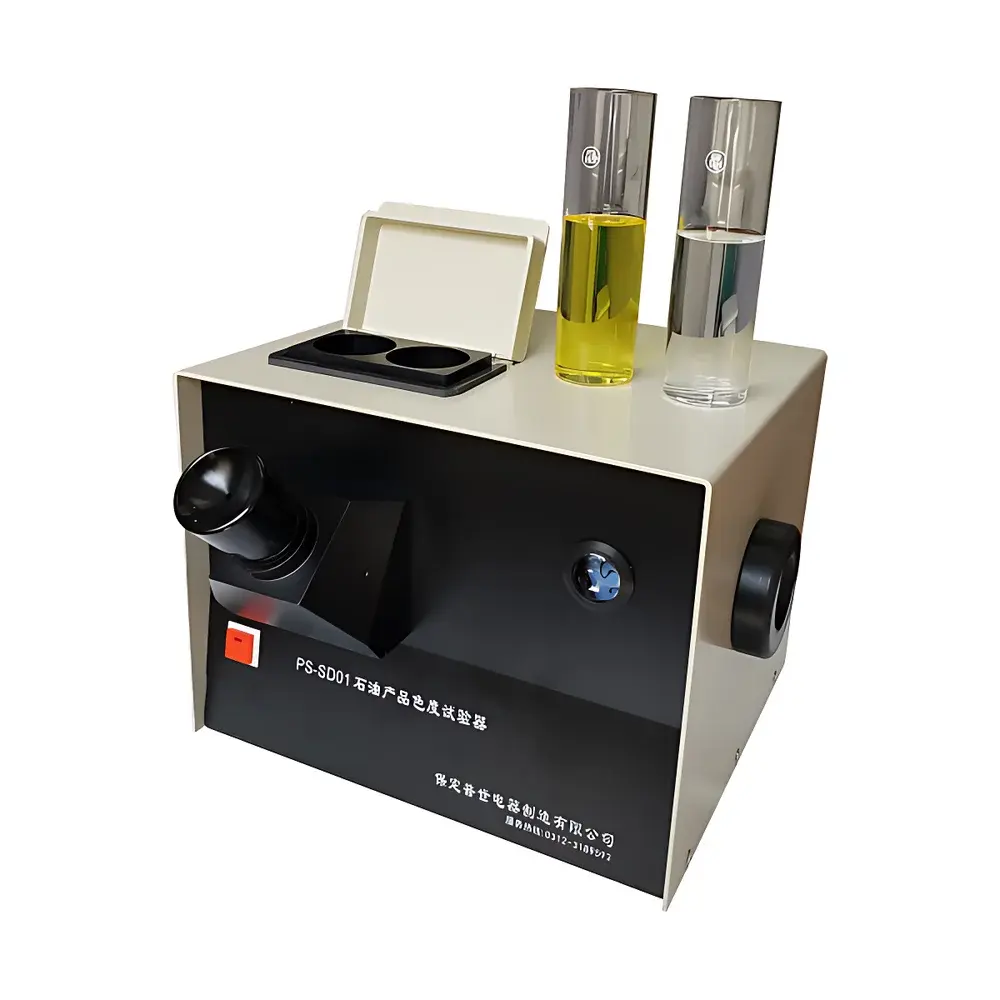
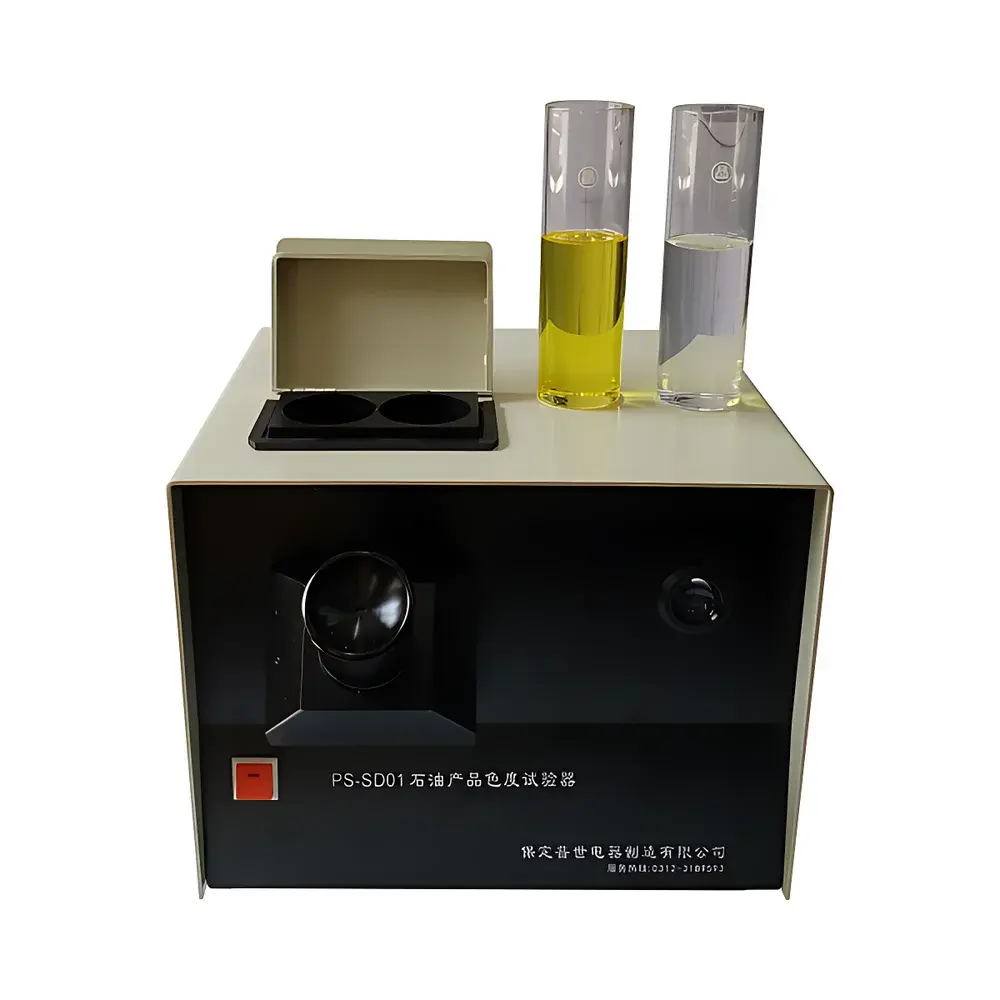
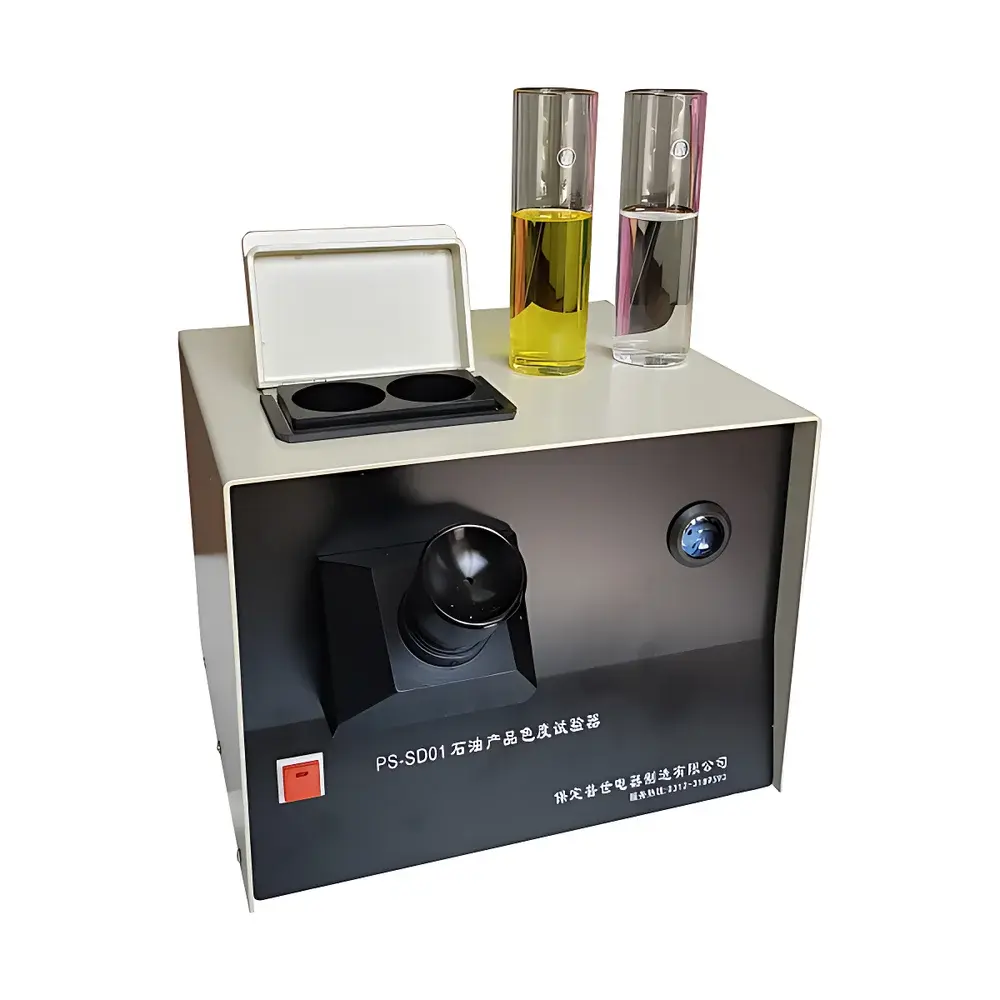
PUSH PS-SD01 Petroleum Product Colorimeter
| Brand | PUSH |
|---|---|
| Origin | Hebei, China |
| Manufacturer Type | Manufacturer |
| Model | PS-SD01 |
| Light Source | 220 V / 100 W frosted incandescent lamp (color temperature 2750 ± 50 K) |
| Color Disc | 26 apertures (Φ14 mm), 25 loaded with calibrated glass color standards (ASTM D1500 / GB/T 6540 / ISO 2049 equivalent No. 1–25), 1 blank aperture |
| Viewing System | Compound optical eyepiece (concave + convex lenses) with focus and brightness adjustment |
| Power Supply | 220 V ± 10 %, 50 Hz ± 1 Hz |
| Compliance | SH/T 0168–92, GB/T 6540–2016, ASTM D1500–22, ISO 2049:2018 |
Overview
The PUSH PS-SD01 Petroleum Product Colorimeter is a dedicated visual color comparison instrument engineered for precise determination of color grade in refined petroleum products—including lubricating oils, base stocks, diesel fuels, and white oils—according to standardized visual assessment protocols. It operates on the principle of matched-field visual comparison: a sample, contained in a standardized 100-mm pathlength colorimetric tube, is simultaneously viewed alongside certified reference glass color standards under controlled illumination. The instrument employs a tungsten-filament incandescent light source calibrated to 2750 ± 50 K—matching the correlated color temperature specified in ASTM D1500, GB/T 6540, and ISO 2049—to ensure spectral consistency critical for interlaboratory reproducibility. Unlike spectrophotometric methods, this comparator-based approach delivers rapid, operator-independent grading when used by trained personnel following SH/T 0168–92—the Chinese petroleum industry standard aligned with international practice. Its design prioritizes metrological traceability, mechanical stability, and long-term calibration integrity over digital automation, making it suitable for QC laboratories requiring routine, low-cost, high-reliability color grading in compliance with refinery specifications and regulatory reporting requirements.
Key Features
- Optically optimized dual-lens viewing system combining concave and convex elements to superimpose sample and reference fields within a single visual field—enabling side-by-side comparison without parallax or alignment drift.
- 26-position rotating color disc with precision-machined Φ14 mm apertures; 25 positions house NIST-traceable, interference-filtered glass color standards corresponding directly to ASTM D1500 (No. 0.5–8.0), GB/T 6540 (No. 0.5–8.0), and ISO 2049 (No. 0.5–8.0); one position reserved as optical blank for zero-reference verification.
- Stabilized 100 W incandescent lamp housed in a thermally shielded, diffused optical chamber to maintain consistent luminance and chromaticity across repeated measurements—minimizing observer fatigue and reducing inter-operator variability.
- Integrated brightness and focus controls on the eyepiece assembly allow real-time adaptation to ambient lighting conditions and individual visual acuity, supporting GLP-compliant documentation of viewing parameters.
- Rugged all-metal housing with grounded chassis and EMI-suppressed power input ensures stable operation in industrial laboratory environments with variable electrical infrastructure.
Sample Compatibility & Compliance
The PS-SD01 accepts standard 100-mm pathlength, 13-mm OD borosilicate glass colorimetric tubes compliant with ASTM D1500 Annex A1 and GB/T 6540 Section 5.2. It accommodates clear to moderately hazy liquid samples with viscosity ≤ 150 cSt at 40 °C; particulate-free filtration (per SH/T 0168–92 Section 4.2) is required prior to measurement. The instrument satisfies mandatory test method requirements for color grading in API RP 2540, CNPC Standard Q/SH 0171–2008, and Sinopec Quality Control Manual Chapter 7. All glass color standards are certified per ISO/IEC 17025-accredited calibration procedures, with certificates including uncertainty budgets (k = 2) traceable to NIM (National Institute of Metrology, China). The device supports audit-ready operation under ISO/IEC 17025, GLP, and internal QA systems requiring documented observer training, daily blank verification, and quarterly standard validation.
Software & Data Management
The PS-SD01 is a fully manual, non-digital comparator—intentionally omitting electronic sensors, displays, or data logging to eliminate firmware-related drift, software validation overhead, and cybersecurity exposure. All observations are recorded manually in bound laboratory notebooks or LIMS-integrated paper forms, ensuring full audit trail integrity per FDA 21 CFR Part 11 Annex B (for paper-based systems) and ISO/IEC 17025 Clause 7.8.2. Calibration records, standard replacement logs, and operator competency assessments are maintained separately in accordance with internal SOPs. Optional accessories include a calibrated photometer adapter kit (PUSH-PAK-202) for periodic luminance verification against NIST SRM 2030, supporting preventive maintenance scheduling.
Applications
- Final quality release testing of turbine oils, hydraulic fluids, and transformer oils against OEM color limits (e.g., GEK 32554, Siemens TLV 9013).
- Monitoring thermal degradation or oxidation onset during lubricant service life extension programs via trending of ASTM D1500 color number shifts.
- Batch-to-batch consistency verification in white oil manufacturing (USP/Ph. Eur. Grade I–III) where color grade serves as a surrogate indicator of aromatic content and refining efficiency.
- Regulatory submission support for fuel blending operations subject to ASTM D975 (diesel) and ASTM D3699 (kerosene) color compliance.
- Educational use in petroleum engineering labs for teaching standardized visual assessment methodology and metrological principles of colorimetry.
FAQ
Does the PS-SD01 require annual recalibration of its color standards?
Yes—certified glass standards must be replaced every 24 months or after 5000 visual comparisons, whichever occurs first, to maintain traceability per ISO 2049:2018 Clause 6.4. Calibration certificates are supplied with each replacement set.
Can the instrument be used for water-white solvents such as hexane or toluene?
Yes, provided samples are filtered to <0.45 µm and measured in clean, scratch-free tubes; the blank aperture enables detection of faint yellowing indicative of peroxide formation or trace metal contamination.
Is the 2750 K lamp source compliant with current ASTM D1500–22 revision requirements?
Yes—the PS-SD01’s lamp specification meets the “standard illuminant C” spectral power distribution tolerance defined in ASTM D1500–22 Section 6.1.1 and is verified using a calibrated spectroradiometer during factory acceptance testing.
How is observer variability controlled during routine use?
Per SH/T 0168–92 Section 6.3, two qualified observers must independently assign a color number; if results differ by more than one grade, a third observer adjudicates. Training records and pass/fail color matching exercises are retained for GLP audits.
Does PUSH provide installation qualification (IQ) or operational qualification (OQ) documentation?
Yes—upon request, PUSH supplies a vendor-executed IQ/OQ protocol package aligned with ISO/IEC 17025 Annex A.3, including mechanical inspection checklists, lamp voltage stability tests, and optical alignment verification reports.





