PVD Standard Polystyrene Latex (PSL) Spheres for Critical Dimension Calibration
| Brand | PVD |
|---|---|
| Origin | USA |
| Distributor Type | Authorized Distributor |
| Origin Category | Imported |
| Model | Standard Particles |
| Price | Upon Request |
Overview
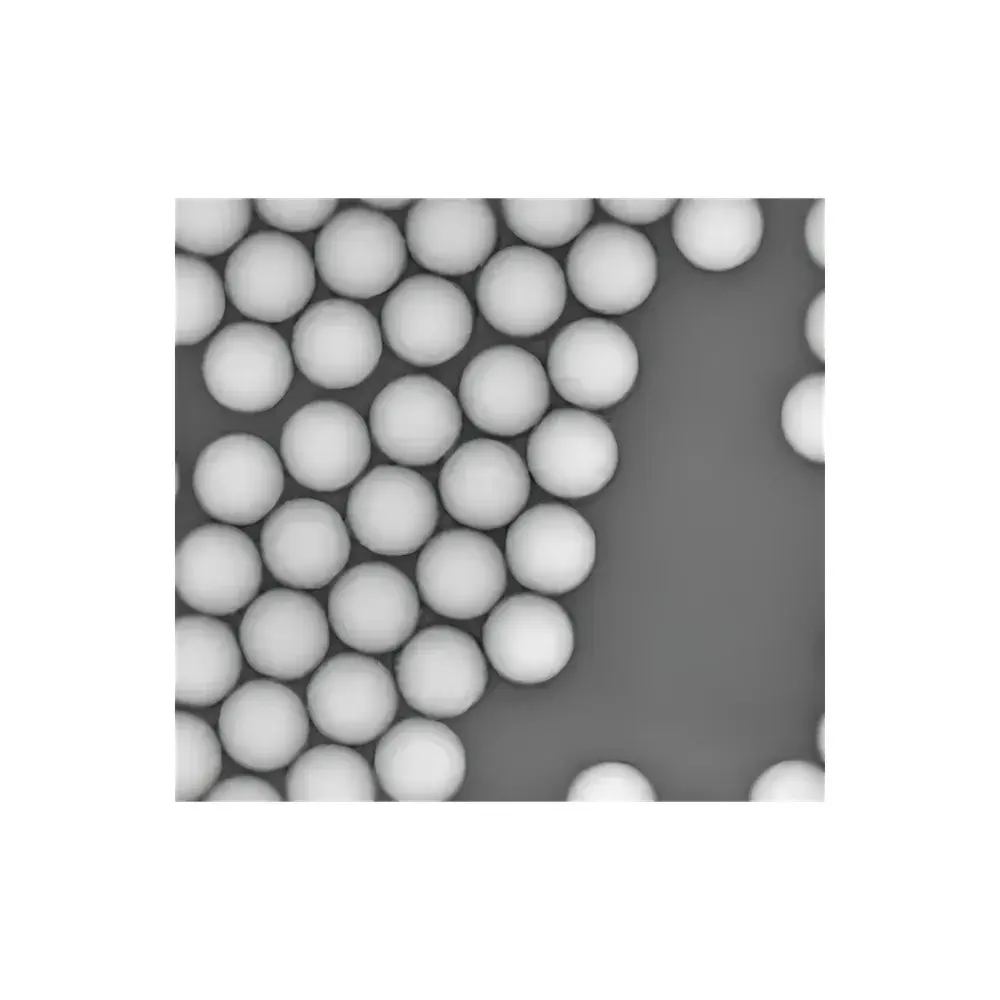
PVD Standard Polystyrene Latex (PSL) Spheres are NIST-traceable, monodisperse polymeric reference materials engineered for high-precision calibration of critical dimension (CD) metrology systems in semiconductor manufacturing and advanced nanotechnology laboratories. These spherical particles operate on the fundamental principle of light scattering—specifically Mie scattering—where particle size, refractive index (1.59 @ 589 nm), and density (1.05 g/cm³) are rigorously controlled to generate predictable, repeatable optical responses. Unlike irregularly shaped calibration artifacts, PSL spheres eliminate shape-induced bias in laser-based wafer inspection tools—including KLA-Tencor SP1/SP2/SP3 platforms and Hitachi SSIS (Surface Scanning Inspection Systems)—ensuring metrological integrity across CD-SEM, optical scatterometry, and automated defect review workflows. Each lot is calibrated against NIST linear dimensional standards using traceable transmission electron microscopy (TEM) and dynamic light scattering (DLS) protocols, with uncertainty budgets fully documented per ISO/IEC 17025–compliant calibration reports.
Key Features
- NIST-traceable diameter certification for all sizes from 20 nm to 900 nm, with certified uncertainties ranging from ±1 nm (30 nm) to ±12 nm (900 nm), aligned with NIST SRM equivalency
- Monodisperse distribution: coefficient of variation (CV) ≤ 1.0% for all cataloged diameters, verified via multi-modal particle sizing (TEM, DLS, and centrifugal sedimentation)
- Optimized colloidal stability in aqueous suspension (15 mL or 100 mL dropper bottles), formulated with trace non-ionic surfactant to prevent aggregation without interfering with surface chemistry assays
- Controlled optical properties: refractive index 1.59 @ 589 nm (25 °C), enabling accurate Mie theory modeling for instrument response function validation
- Batch-specific traceability: each vial carries a unique lot number linked to full calibration history, chemical composition data, and physical property tables per ISO 13321 and ASTM E2494
- Stable shelf life: ≤24 months when stored at 2–8 °C; no freezing required; minimal sedimentation due to low density differential vs. water
Sample Compatibility & Compliance
PVD PSL Spheres are validated for use in GMP/GLP-regulated environments requiring audit-ready documentation. Certificates of Analysis (CoA) include full uncertainty propagation, calibration methodology (e.g., TEM image analysis per ISO/IEC 17025 Annex A.4), and compliance statements referencing ASTM F312 (Standard Practice for Particle Size Analysis of Colloidal Dispersions), ISO 22412 (Dynamic Light Scattering), and USP <788> (Particulate Matter in Injections). The material is compatible with semiconductor fab cleanroom Class 100/ISO 5 handling protocols and meets RoHS Directive 2011/65/EU requirements. No organic solvents or heavy metals are present; residual surfactant levels remain below detection limits for ICP-MS (≤0.1 ppm).
Software & Data Management
While PSL spheres themselves are physical reference standards, their integration into automated metrology workflows relies on vendor-agnostic digital traceability. Each CoA is supplied as a PDF with embedded metadata (XMP) compliant with ISO 15489–2 for records management. For instruments supporting ASTM E2812–19 (Standard Guide for Digital Calibration Certificate Exchange), PVD provides machine-readable calibration data files (CSV/JSON) containing nominal diameter, measured mean, standard deviation, uncertainty budget components, and NIST SRM cross-references. All documentation supports FDA 21 CFR Part 11 compliance when deployed within validated LIMS or MES platforms—enabling electronic signatures, audit trails, and version-controlled certificate archiving.
Applications
- Calibration and verification of wafer defect detection sensitivity thresholds on KLA-Tencor SP-series, Hitachi SSIS, and Applied Materials UVision platforms
- Validation of CD-SEM magnification linearity and pixel-to-nanometer scaling factors
- Reference standards for nanoparticle tracking analysis (NTA), tunable resistive pulse sensing (TRPS), and flow cytometry system alignment
- Primary standards for aerosol generation and classification—used to calibrate condensation particle counters (CPCs) and optical particle sizers (OPS) per ISO 27891
- Biophysical research applications: sizing benchmarks for viral capsids (20–100 nm), exosomes (30–150 nm), ribosomal subunits (20–30 nm), and synthetic lipid nanoparticles
- Method development and QC for ISO 14644–1 cleanroom particle monitoring programs
FAQ
Are these PSL spheres certified to NIST SRM equivalents?
Yes. Each lot is calibrated using NIST-traceable dimensional transfer methods and issued a Certificate of Calibration stating equivalence to relevant NIST SRMs (e.g., SRM 1963, SRM 1691), including full uncertainty budgets.
What is the recommended dispersion protocol before use?
Gently invert the vial 10–15 times; avoid vortexing or sonication unless validated for your specific instrument. Allow 5 minutes for thermal equilibration at 22–25 °C prior to dispensing.
Can I use these spheres for calibration of SEM or AFM?
Yes—provided the substrate preparation (e.g., carbon tape, silicon wafer) and imaging parameters (kV, working distance, detector type) are documented and consistent with ISO 13322–2 for electron microscopy-based size measurement.
Do you provide custom size batches or bulk packaging?
Custom diameters (±0.5 nm tolerance) and volumes (up to 1 L suspensions) are available under NDA; lead time is 8–12 weeks for lot-specific characterization and certification.
How are uncertainties determined for each size?
Uncertainties derive from combined Type A (statistical repeatability across ≥500 particles per TEM micrograph) and Type B (reference standard uncertainty, instrument calibration drift, environmental temperature/humidity effects) components per GUM (JCGM 100:2008).