
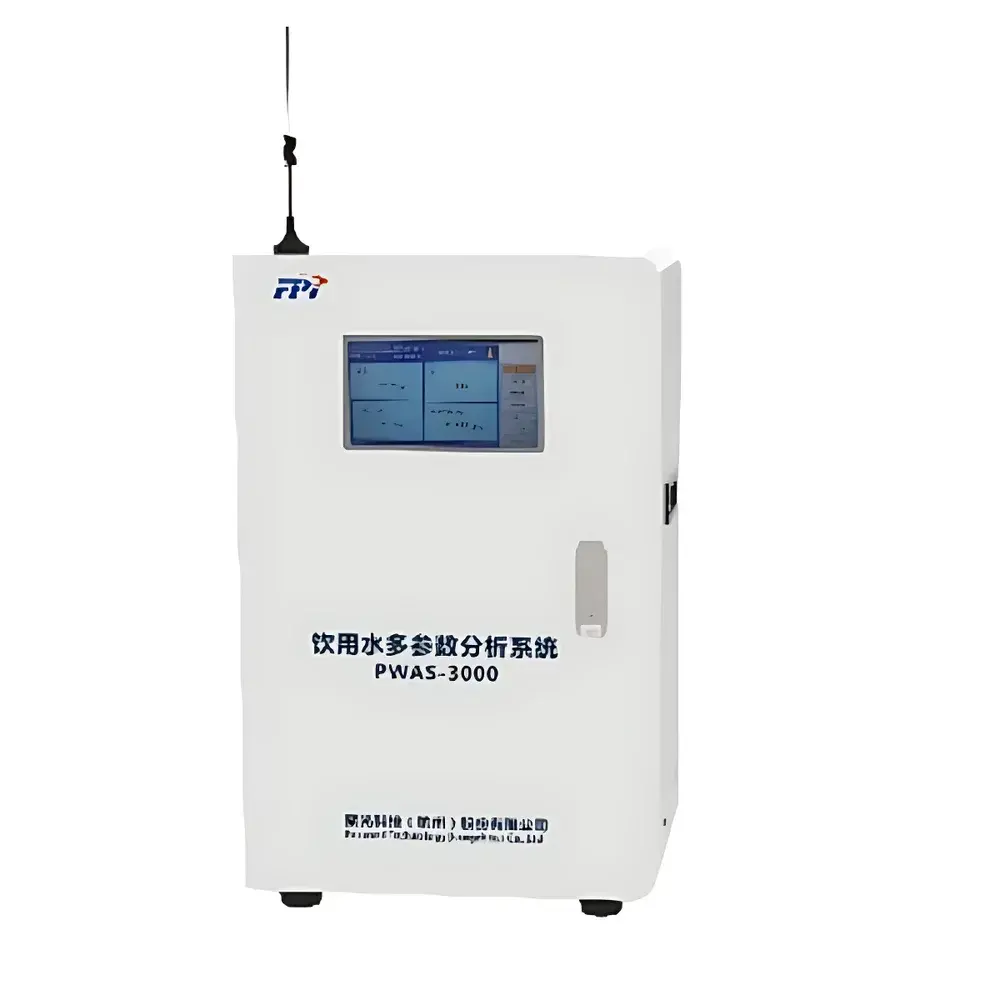
PWAS-3000 Drinking Water Multi-Parameter Online Monitoring System by EXPEC
| Brand | EXPEC |
|---|---|
| Origin | Zhejiang, China |
| Manufacturer Type | Authorized Distributor |
| Country of Origin | China |
| Model | PWAS-3000 |
| Pricing | Upon Request |
Overview
The PWAS-3000 Drinking Water Multi-Parameter Online Monitoring System is an integrated, modular platform engineered for continuous, unattended measurement of critical physicochemical parameters in potable water distribution systems. It operates on a dual-sensor architecture combining optical (e.g., UV-Vis absorbance, turbidity via 90° scattered light) and electrochemical (e.g., amperometric chlorine, potentiometric pH, conductometric conductivity) detection principles—eliminating the need for reagent addition and enabling truly reagent-free, environmentally sustainable operation. Designed to comply with core requirements of ISO 7027 (turbidity), ISO 8694 (electrochemical sensors), and US EPA Method 180.1 (free chlorine), the system delivers stable, traceable measurements under variable flow conditions. Its embedded flow-stabilized sample cell ensures hydraulic independence—measurement integrity is maintained regardless of upstream pressure fluctuations or pipe diameter changes—making it suitable for deployment across heterogeneous infrastructure including cast-iron mains, PE service lines, and stainless-steel booster stations.
Key Features
- 7-inch high-brightness capacitive touchscreen interface with intuitive HMI navigation and real-time parameter visualization
- Full-probe architecture: all sensors mounted directly in-line; no external wet chemistry modules or peristaltic pumps required
- GPRS/4G cellular telemetry with configurable data upload intervals (1 min to 24 h) and automatic fallback to local SD card logging during network outages
- Modular sensor bays supporting hot-swappable configurations: up to six simultaneous parameters (e.g., free chlorine, total chlorine, pH, conductivity, turbidity, temperature, ORP, dissolved oxygen)
- RS485 Modbus RTU protocol compliance for seamless integration into SCADA, PLC, or central water management platforms (e.g., OSIsoft PI, Wonderware)
- Low-flow design: operational flow rate range 50–500 mL/min; sample consumption < 1.2 L/h per module; minimal backpressure (< 0.1 bar)
- IP66-rated enclosure with corrosion-resistant 316L stainless steel sensor bodies and NEMA 4X front panel for outdoor cabinet or kiosk mounting
Sample Compatibility & Compliance
The PWAS-3000 is validated for use with chlorinated municipal drinking water meeting WHO Guidelines for Drinking-water Quality (4th ed.) and GB 5749–2022 (China’s National Standard for Potable Water). It accommodates water matrices with turbidity ≤ 100 NTU, conductivity 50–2000 µS/cm, pH 4.0–9.5, and free chlorine 0.05–5.0 mg/L. All electrochemical sensors feature solid-state reference electrodes and temperature-compensated analog outputs (4–20 mA or 0–5 V). The system supports audit-ready data integrity per GLP and GMP Annex 11 requirements through timestamped raw sensor readings, firmware version logging, and configurable event-triggered alarms (e.g., low flow, sensor timeout, calibration overdue). Calibration verification can be performed using NIST-traceable standards (e.g., potassium hydrogen phthalate for pH, KCl solutions for conductivity).
Software & Data Management
The embedded firmware includes EXPEC WaterLink™ Edge v3.2, supporting over-the-air (OTA) updates and remote diagnostics via secure TLS 1.2 encrypted sessions. Data are stored locally in CSV/JSON format with microsecond-level timestamps and sensor-specific metadata (e.g., electrode impedance, LED drive current, signal-to-noise ratio). Cloud synchronization utilizes MQTT protocol with QoS Level 1 delivery assurance and AES-256 encryption at rest and in transit. The system generates automated daily compliance reports aligned with ISO/IEC 17025 documentation requirements—including calibration history, drift assessment, and uncertainty budgeting per ISO/IEC GUIDE 98-3 (GUM). Audit trails retain full change logs for configuration edits, user logins, and alarm acknowledgments—fully compliant with FDA 21 CFR Part 11 electronic record and signature provisions.
Applications
- Real-time monitoring at drinking water treatment plant effluent points and clearwell outlets
- Distribution network surveillance: pressure-reducing valve stations, district metering areas (DMAs), and critical junctions
- Secondary water supply systems in high-rise residential and commercial buildings (per GB/T 35602–2017)
- Rural drinking water safety projects with solar-powered telemetry and low-power sleep modes
- Pre- and post-filtration monitoring in membrane-based advanced treatment facilities (MF/UF/RO)
- Swimming pool and recreational water quality assurance per EN 15288-1 and GB/T 23528–2009
FAQ
Does the PWAS-3000 require routine reagent replacement?
No. All core parameters are measured using maintenance-free optical absorption and solid-state electrochemical sensors. No liquid reagents, buffers, or carrier gases are consumed during operation.
Can the system operate offline and synchronize data later?
Yes. Local storage retains up to 12 months of minute-interval data (depending on parameter count). Upon network restoration, buffered records are transmitted with original timestamps and sequence integrity preserved.
Is third-party software integration supported?
Yes. Native Modbus RTU over RS485 enables direct connection to Siemens S7, Rockwell ControlLogix, and Schneider EcoStruxure platforms. Optional OPC UA server add-on available for enterprise MES/ERP integration.
What is the recommended calibration frequency?
Field calibration is recommended every 30 days for chlorine and pH sensors, and every 90 days for conductivity and turbidity—aligned with ISO 5667-22 and ASTM D1587 practices. Automatic zero/span checks occur hourly.
How is sensor fouling mitigated in long-term deployments?
Each probe incorporates ultrasonic anti-fouling transducers (40 kHz) activated on programmable schedules, plus hydrophilic PTFE-coated optical windows and self-cleaning flow geometry in the measurement chamber.
Related Products







