
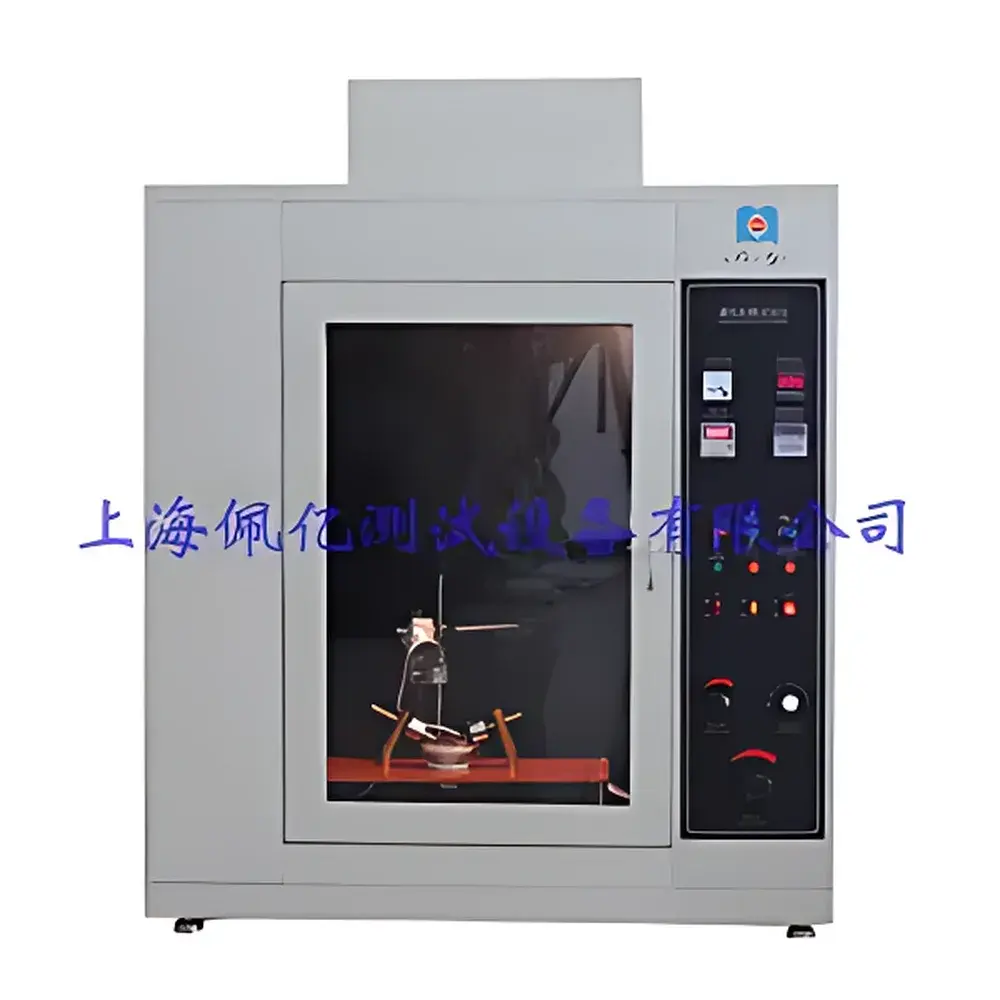
PY-LD07 Peiyi Comparative Tracking Index (CTI) Tester
| Brand | Peiyi |
|---|---|
| Origin | Shanghai, China |
| Model | PY-LD07 |
| Chamber Volume | ≥0.5 m³ |
| Test Voltage Range | 100–600 V AC |
| Electrode Force | 1.0 N ± 0.05 N |
| Electrode Material | Platinum |
| Droplet Volume | 44–50 drops/cm³ |
| Droplet Height Adjustment | 30–40 mm |
| Droplet Interval | 30 ± 5 s |
| Short-Circuit Current Threshold | ≥0.5 A (cut-off after 2 s) |
| Voltage Drop Limit | ≤10% at 1 A ± 0.1 A |
| Power Supply | AC 220 V / 50 Hz |
| Construction | Stainless Steel & Brass Housing |
| Compliance | IEC 60112, IEC 60335-1, GB/T 4207, GB 4706.1, GB 2099.1, VDE 0620 |
Overview
The PY-LD07 Peiyi Comparative Tracking Index (CTI) Tester is a precision-engineered apparatus designed to evaluate the electrical resistance of solid insulating materials against surface tracking under high-voltage, humid, and contaminant-laden conditions. Based on the standardized electrodynamical principle of comparative tracking index testing per IEC 60112 and GB/T 4207, the instrument applies controlled alternating voltage across two platinum electrodes while delivering calibrated electrolyte droplets onto the specimen surface. Under sustained electric stress and ionic contamination, conductive carbonized paths may form—leading to leakage current escalation, localized arcing, and eventual insulation failure. The PY-LD07 quantifies material performance by determining the highest voltage at which no tracking occurs over 50 droplets (CTI value), or by assessing pass/fail behavior under fixed voltage protocols (e.g., Proof Tracking Index, PTI). Its design targets laboratories engaged in safety certification, component qualification, and R&D for electrical enclosures, connectors, switchgear housings, relay bases, and appliance structural parts.
Key Features
- Robust chamber construction using corrosion-resistant stainless steel and brass components ensures long-term stability in aggressive test environments.
- Precision-machined rectangular platinum electrodes with certified mechanical loading (1.0 N ± 0.05 N) guarantee repeatable contact pressure and uniform field distribution.
- Adjustable droplet delivery system enables precise control of height (30–40 mm), volume density (44–50 drops/cm³), and timing interval (30 ± 5 s), meeting strict metrological requirements of IEC 60112 Annex B.
- Programmable AC voltage supply (100–600 V) with real-time monitoring and automatic cut-off logic: interrupts power within 2 seconds upon detection of ≥0.5 A leakage current, with voltage regulation maintained within ±10% tolerance at nominal 1 A load.
- Dedicated hardware-based safety interlocks, including door-position sensing, overtemperature protection, and arc-quenching circuitry, comply with Class I electrical safety requirements per IEC 61010-1.
Sample Compatibility & Compliance
The PY-LD07 accommodates flat, rigid specimens up to 15 mm thick and 100 mm × 100 mm in planar dimension—suitable for molded thermoplastics (e.g., PA66-GF30, PBT-GF25), thermosets (e.g., phenolic resins, epoxy laminates), and filled polymer composites used in household appliance housings, industrial control panels, and low-voltage terminal blocks. It supports both CTI determination (voltage step-down method) and PTI verification (fixed-voltage endurance test). Regulatory alignment includes full traceability to IEC 60112:2020, IEC 60335-1:2022 (Clause 29), GB/T 4207–2012, GB 4706.1–2015, GB 2099.1–2023, and VDE 0620-1. Test reports generated using this system are admissible in third-party certification submissions to CCC, CE, UL Recognition, and CB Scheme bodies—provided procedural adherence to GLP documentation standards is maintained.
Software & Data Management
While the PY-LD07 operates via embedded microcontroller-based logic without proprietary PC software, it integrates seamlessly into laboratory quality management systems through its analog/digital I/O interface (optional RS-485 or Ethernet module available upon request). All critical test parameters—including applied voltage, elapsed time, droplet count, leakage current threshold events, and pass/fail status—are logged internally with timestamping and retained for ≥1,000 test cycles. Audit-ready records support FDA 21 CFR Part 11 compliance when paired with validated external data acquisition platforms. Calibration certificates for electrode force, droplet volume, and voltage output are issued annually per ISO/IEC 17025-accredited procedures, with traceability to NIM (National Institute of Metrology, China) or equivalent national metrology institutes.
Applications
- Validation of polymer formulations for improved tracking resistance in UL 94 V-0/V-1 rated components.
- Comparative screening of halogen-free flame-retardant additives (e.g., aluminum hydroxide, magnesium hydroxide) in polyolefin blends.
- Production line quality assurance for socket outlets, dimmer switches, and residual-current circuit breakers (RCCBs).
- Failure analysis of field-return units exhibiting surface carbonization or flashover damage.
- Supporting IEC 60695-2-50 series fire hazard assessments for end-product safety dossiers.
FAQ
What standards does the PY-LD07 explicitly support?
IEC 60112, IEC 60335-1, GB/T 4207, GB 4706.1, GB 2099.1, VDE 0620-1, and ISO 60695-2-50.
Is calibration documentation provided with shipment?
Yes—each unit ships with a factory calibration report covering electrode force, droplet volume consistency, voltage accuracy, and timing fidelity, referenced to national metrological standards.
Can the PY-LD07 be integrated into an automated test cell?
Yes—via optional digital communication modules (RS-485 Modbus RTU or TCP/IP), enabling remote start/stop commands, real-time parameter readback, and event-triggered data export.
What maintenance intervals are recommended?
Platinum electrodes require cleaning after every 10 test cycles using analytical-grade ethanol; chamber interior should be wiped weekly with deionized water; annual recalibration is mandatory for ISO/IEC 17025-compliant operations.
Does the instrument meet electromagnetic compatibility (EMC) requirements for lab use?
Yes—the PY-LD07 conforms to IEC 61326-1:2023 for laboratory equipment, including immunity to electrostatic discharge (±8 kV contact), radiated RF fields (10 V/m), and fast transient bursts (2 kV).



