
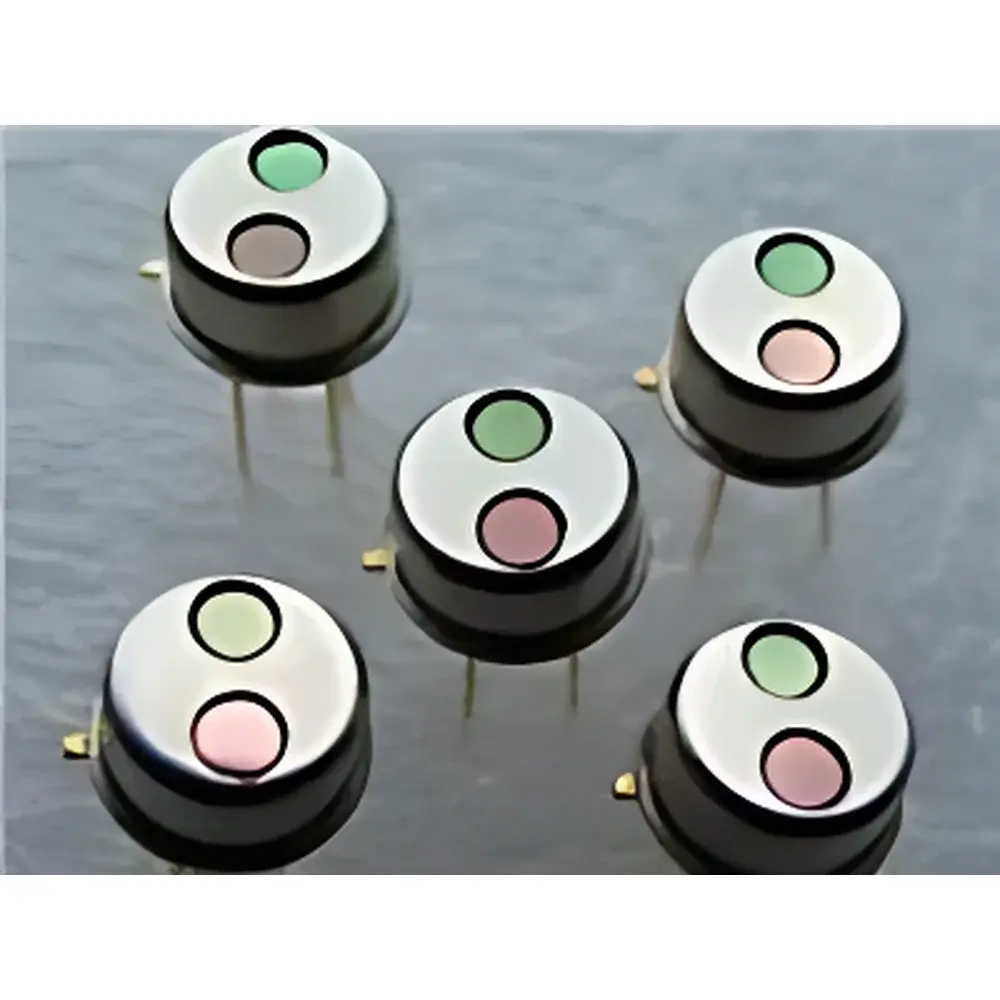
Pyreos Pyroelectric Thin-Film Infrared Detector
| Brand | Pyreos |
|---|---|
| Origin | United Kingdom |
| Model | PYR-TP Series (Thin-Film PZT) |
| Detector Material | Lead Zirconate Titanate (PZT) Ferroelectric Film |
| Film Thickness | 1 µm |
| Spectral Range | 1.2–20 µm |
| Detectivity (D*) | >1 × 10⁹ cm·√Hz/W @ 10 Hz (typ.), ~3.5 × 10⁸ cm·√Hz/W @ 10 Hz (1 mm × 1 mm element) |
| Responsivity | Up to 150,000 V/W @ 500 K, 10 Hz |
| Noise Equivalent Power (NEP) | ~0.4 mV·√Hz/W |
| Response Time | <5 ms (bandwidth up to 3.3 kHz) |
| Curie Temperature | ~600 °C |
| Operating Temperature Range | –40 °C to +85 °C (uncooled) |
| Pixel Configurations | Single-point, 128×1, 128×2, 512×1 linear arrays |
| Active Area Options | 150 µm × 150 µm to 3 mm × 2 mm |
| Filter Integration | Optional integrated linear variable filters (LVF) for NIR: 1.3–3.2 µm |
| MIR/FIR | 2–20 µm |
| Compliance | RoHS, REACH, ISO 9001-manufactured |
Overview
The Pyreos PYR-TP Series thin-film pyroelectric infrared detector is a solid-state, uncooled photodetector engineered for high-performance spectroscopic and radiometric applications across the near- to far-infrared spectrum (1.2–20 µm). Unlike conventional bulk pyroelectric sensors or thermopiles, it employs a precisely sputtered 1-µm-thick lead zirconate titanate (PZT) ferroelectric thin film as the active transduction layer. This monolithic architecture enables exceptional thermal isolation, rapid thermal diffusion, and intrinsic low microphonic sensitivity—critical for vibration-prone environments such as portable analyzers or industrial process monitors. The detector operates on the pyroelectric effect: incident IR radiation induces transient temperature gradients in the PZT film, generating surface charge proportional to the rate of temperature change. This principle delivers inherently AC-coupled response, eliminating DC drift and enabling stable, low-noise operation without thermoelectric cooling or vacuum packaging.
Key Features
- Uncooled high detectivity: D* >1 × 10⁹ cm·√Hz/W @ 10 Hz (typ.) — exceeding standard DTGS detectors by one order of magnitude, enabling detection of weak, modulated IR signals in gas analysis and low-flux FT-IR applications.
- Wide spectral coverage with filter flexibility: Native response from 1.2 µm to 20 µm; optional integrated linear variable filters (LVFs) support real-time spectral acquisition in linear array configurations (e.g., 128×1, 512×1), eliminating the need for external monochromators or scanning mechanisms.
- Fast temporal response: Rise time <5 ms (bandwidth up to 3.3 kHz), suitable for high-speed gas modulation, flame detection, and real-time occupancy monitoring where latency must be minimized.
- High thermal stability: Curie temperature ≈600 °C and low temperature coefficient of responsivity (<0.02 %/°C) ensure consistent performance across –40 °C to +85 °C ambient ranges—no TEC or oven stabilization required.
- Scalable form factor: Active areas configurable from 150 µm × 150 µm (for fiber-coupled microspectrometers) to 3 mm × 2 mm (for macro-optic systems); available as single-element, dual-channel, or quad-channel variants for differential or multi-gas sensing.
- Robust solid-state construction: No hygroscopic windows, no cryogenic housings, and full RoHS/REACH compliance simplify system integration, reduce BOM cost, and improve long-term reliability in field-deployed instrumentation.
Sample Compatibility & Compliance
The PYR-TP series is compatible with standard TO-39, TO-46, and custom ceramic packages, supporting direct mounting onto PCBs or integration into OEM optical modules. Its broad spectral response supports quantitative analysis of molecular absorption bands for CO₂ (4.26 µm), CH₄ (3.31 µm), CO (4.67 µm), NOₓ (5.2–5.4 µm), and hydrocarbons in the 3–5 µm and 8–12 µm atmospheric windows. When used in FT-IR spectrometers, it meets ASTM E1421 and ISO 13755 requirements for detector linearity and dynamic range verification. For regulated gas analyzers, the detector’s inherent stability and repeatability align with EN 15267-3 (performance certification of air quality monitoring systems) and support GLP-compliant data traceability when paired with validated signal conditioning electronics.
Software & Data Management
Pyreos provides reference firmware libraries (C/C++ and Python) for common microcontroller platforms (ARM Cortex-M, ESP32) and FPGA interfaces, enabling seamless integration with lock-in amplifiers, digital signal processors (DSPs), or embedded Linux systems. Raw output is analog voltage (high-impedance current-to-voltage conversion stage recommended), with optional I²C-enabled evaluation boards offering onboard gain calibration, temperature compensation, and timestamped ADC sampling at up to 10 kS/s. All firmware implements configurable averaging, baseline subtraction, and event-triggered burst capture—supporting FDA 21 CFR Part 11 audit trails when deployed in regulated QC/QA environments via compliant host software.
Applications
- FT-IR and dispersive spectrometry: Drop-in replacement for DTGS detectors, delivering improved SNR and faster scan rates without cryogenics.
- Infrared gas analysis: Core sensor in portable CO₂ monitors, landfill methane sniffers, and industrial combustible gas detectors—leveraging dual-/quad-channel variants for background subtraction and cross-sensitivity correction.
- Flame and fire detection: Used in Class A/B fire alarm systems per UL 268 and EN 54-10, exploiting fast response and immunity to visible-light interference.
- Occupancy analytics and thermal imaging: Integrated with silicon-based lens arrays or micro-opto-electro-mechanical systems (MOEMS) for low-cost, non-contact people counting and behavioral pattern recognition in smart buildings.
- Process analytical technology (PAT): Real-time monitoring of polymer curing, pharmaceutical drying, or chemical reaction exotherms in GMP-compliant manufacturing lines.
FAQ
Is this detector suitable for use in Fourier-transform infrared (FT-IR) spectrometers?
Yes—the PYR-TP series is specifically optimized as a DTGS alternative in benchtop and portable FT-IR systems, offering higher D*, broader spectral flatness, and no liquid nitrogen dependency.
Does the detector require temperature stabilization or active cooling?
No—its high Curie point (~600 °C) and low thermal coefficient enable stable operation from –40 °C to +85 °C without TECs, ovens, or vacuum enclosures.
Can I integrate an LVF directly onto the detector package?
Yes—Pyreos offers factory-integrated linear variable filters for both NIR (1.3–3.2 µm) and MIR/FIR (2–20 µm) bands, enabling compact, alignment-free spectral engines in linear array configurations.
What is the recommended bias and readout circuit for optimal SNR?
A low-noise JFET-input op-amp configured as a transimpedance amplifier (gain = 10⁶–10⁸ V/A) with guarded layout and 0.1–10 Hz bandpass filtering is advised; full schematic guidelines are included in the Pyreos Application Note AN-TP-002.
Are calibration certificates and NIST-traceable responsivity data available?
Yes—each batch undergoes spectral responsivity mapping at UKAS-accredited facilities; full calibration reports (including D*, NEP, and frequency response) are supplied with volume orders upon request.




