
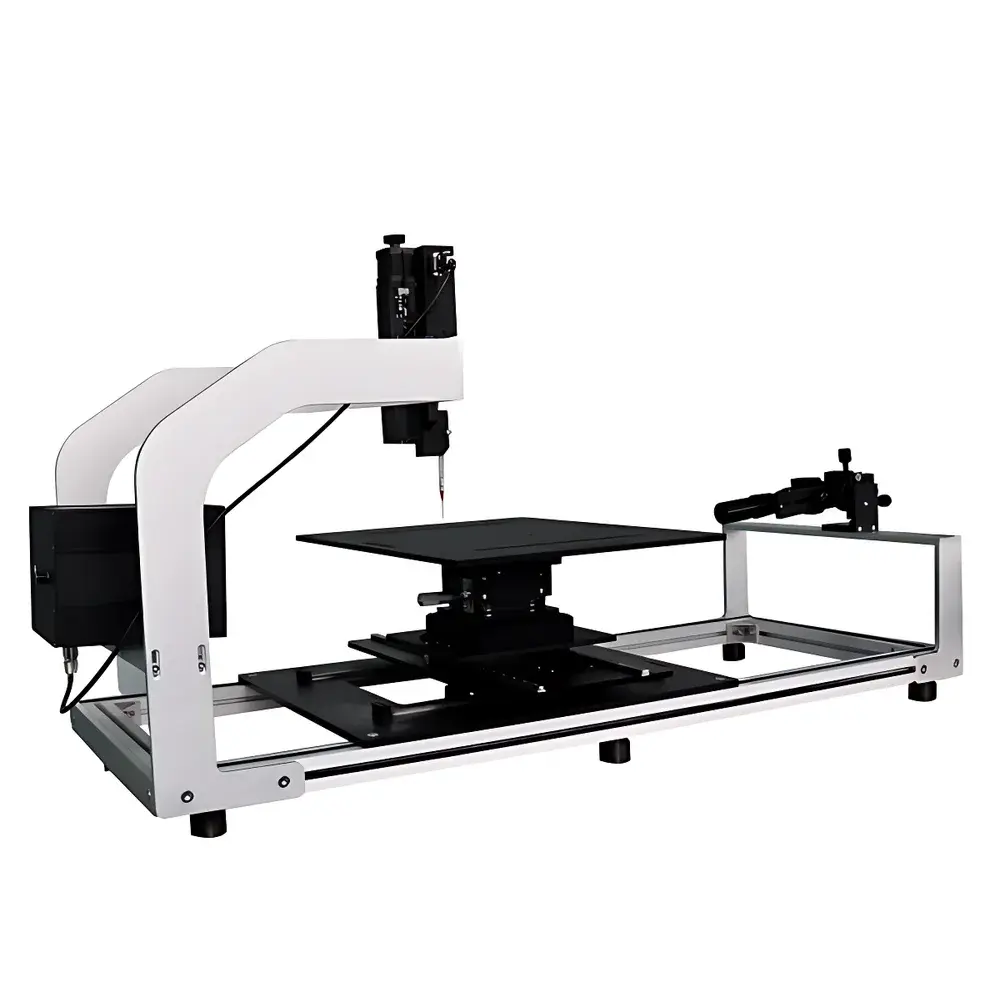
PZ-1000SD-A Video-Based Optical Contact Angle and Surface Tension Analyzer
| Brand | Product Intelligence and Creativity |
|---|---|
| Origin | Beijing, China |
| Model | PZ-1000SD-A |
| Instrument Type | Benchtop Laboratory System |
| Contact Angle Measurement Range | 0–180° |
| Contact Angle Accuracy | ±0.1° |
| Sample Stage Dimensions | 120 × 180 mm |
| Optical Magnification | 0.7–4.5× |
| Surface/Interfacial Tension Range | 0–2000 mN/m |
| Surface/Interfacial Tension Accuracy | ±0.01 mN/m |
| Heating System | Programmable High-Temperature Furnace (up to 1600 °C), 30-Step Ramp/Soak Control, ±0.1 °C Stability ≤1000 °C |
| Vacuum System | Molecular Pump, Wide-Range Vacuum Gauge |
| Imaging System | Monochrome Industrial CCD Camera (130 W pixels, 25 fps), Telecentric Zoom Lens |
| Light Source | Adjustable Blue-Tone LED Cold Illumination (Lifespan >25,000 h) |
| Software | Automated Image Analysis Suite with Circle, Ellipse, Oblique Ellipse, Differential Circle/Ellipse, and Dynamic Video Sequence Fitting Algorithms |
| Compliance | GB/T 24368-2009, SY/T 5153-2007, ASTM D724-99(2003), ASTM D5946-2004, ISO 15989 |
Overview
The PZ-1000SD-A is a high-precision, benchtop video-based optical contact angle and surface/interfacial tension analyzer engineered for quantitative characterization of solid-liquid-gas interfacial behavior under ambient, elevated temperature, and controlled atmosphere conditions. It operates on the principle of sessile drop contour analysis using high-resolution optical imaging—capturing the silhouette of a liquid droplet deposited on a solid substrate and applying geometric fitting algorithms to determine the contact angle θ at the three-phase boundary. When integrated with a programmable high-temperature furnace and vacuum chamber, the system enables in situ measurement of dynamic contact angle evolution and surface tension of molten metals, slags, glasses, and ceramic melts across temperatures up to 1600 °C. This capability supports fundamental thermophysical property determination—including wetting kinetics, interfacial energy, adhesion work, and surface energy components—critical for metallurgical process optimization, welding metallurgy, alloy design, and high-temperature materials development.
Key Features
- Modular aerospace-grade aluminum frame with vibration-damped optical platform and precision-machined kinematic mounts for long-term mechanical stability.
- High-temperature furnace with MoSi₂ heating elements, 30-segment programmable temperature control, uniform hot zone (φ50 × 120 mm), and dual tungsten-rhenium thermocouples (±0.1 °C accuracy) for real-time internal and external temperature monitoring.
- Coaxial dual-view quartz viewport flange (≥20 mm diameter, removable), integrated with vacuum feedthroughs, inert gas purging lines, and dual water-cooling channels to maintain optical clarity during extended high-temperature operation.
- Motorized, multi-axis optical alignment system: tilt adjustment (−10° to +10°, ±0.1° resolution), X/Y translation (±25 mm), Z height adjustment (±10 mm), and ≥150 mm rapid positioning travel with mechanical lock.
- Industrial-grade cold LED illumination (blue-tuned, adjustable intensity, >25,000 h lifetime) eliminates thermal drift-induced droplet evaporation and ensures consistent contrast for low-volume dispensed samples (down to 0.01 μL via quartz syringe).
- Monochrome CCD camera (130 W pixels, 25 fps) coupled with telecentric zoom lens (0.7–4.5× continuous magnification) delivers distortion-free, high-SNR image acquisition across multiple viewing angles—frontal, oblique, top-down, and full 360° rotational observation.
Sample Compatibility & Compliance
The PZ-1000SD-A accommodates diverse sample geometries—including flat wafers, sintered compacts, metal coupons, ceramic tiles, and glass substrates—within its 120 × 180 mm motorized stage (manual fine-positioning: ±60 mm X, ±35 mm Y, ±80 mm Z, 0.1 mm resolution). Its high-vacuum and inert-gas-compatible chamber enables measurements under oxygen-free or reducing atmospheres, essential for oxidation-sensitive systems such as molten aluminum, copper alloys, and refractory oxides. The instrument conforms to internationally recognized test standards including GB/T 24368-2009 (hydrophobic contaminant detection on glass), SY/T 5153-2007 (reservoir rock wettability), ASTM D724-99(2003) (paper surface wettability), ASTM D5946-2004 (polymer film contact angle), and ISO 15989 (corona-treated film hydrophilicity assessment). All measurement data—including raw images, fitted parameters, temperature logs, and vacuum pressure traces—are timestamped and stored with metadata required for GLP/GMP-compliant documentation.
Software & Data Management
The proprietary analysis software provides fully automated, operator-independent image processing via six validated fitting methods: Circle, Ellipse, Oblique Ellipse, LY, Differential Circle, and Differential Ellipse—each selectable based on droplet symmetry and substrate heterogeneity. Dynamic analysis modules support time-resolved contact angle tracking (advancing/receding angles), video-based sequential fitting (up to 1000 frames), and real-time surface energy calculation using Owens-Wendt, Wu, or van Oss-Chaudhury-Good models. Surface/interfacial tension is derived from pendant or sessile drop shape analysis using Young-Laplace equation solving. All results are exportable in CSV, XML, and PDF formats; audit trails record user actions, parameter changes, and calibration events in compliance with FDA 21 CFR Part 11 requirements for electronic records and signatures.
Applications
- Metallurgy: Quantification of surface tension and contact angle of molten steels, aluminum, and copper alloys at operating temperatures to optimize slag-metal separation, inclusion removal, and tundish refractory wetting behavior.
- Welding & Brazing: Evaluation of solder wettability on PCB substrates and base metals under reflow profiles; correlation of contact angle hysteresis with joint strength and void formation.
- Ceramics & Glass: In situ monitoring of surface tension-driven sintering, softening, and viscous flow during heat treatment; assessment of glaze-substrate interfacial compatibility in enamel systems.
- Energy Materials: Characterization of coal ash melt viscosity and slagging propensity via contact angle vs. temperature profiling; evaluation of electrode wetting in molten salt batteries.
- Advanced Coatings: High-throughput screening of hydrophobic/hydrophilic functional coatings, anti-fouling surfaces, and self-cleaning films using static/dynamic contact angle and surface energy mapping.
FAQ
What temperature range is supported for high-temperature contact angle measurements?
The integrated furnace supports continuous operation from ambient to 1600 °C, with programmable ramp rates ≤10 °C/min and thermal stability of ±0.1 °C below 1000 °C.
Can the system measure both advancing and receding contact angles dynamically?
Yes—the software includes dedicated modules for automated sequential image capture and multi-frame fitting to compute advancing, receding, and contact angle hysteresis over time or volume change.
Is vacuum or inert gas purging capability built-in?
The system features a molecular pump vacuum system with wide-range gauge and integrated gas inlet ports for N₂, Ar, or H₂/Ar mixtures, enabling controlled-atmosphere experiments.
How is calibration traceability ensured for contact angle and surface tension values?
Calibration is performed using certified reference liquids (e.g., ultrapure water, diiodomethane) and standardized spherical/ellipsoidal calibration artifacts; all calibration events are logged with timestamps and operator IDs.
Does the software support regulatory compliance for quality-controlled environments?
Yes—it implements full 21 CFR Part 11 functionality, including electronic signatures, role-based access control, immutable audit trails, and secure data export protocols suitable for pharmaceutical, medical device, and aerospace QA/QC workflows.



