
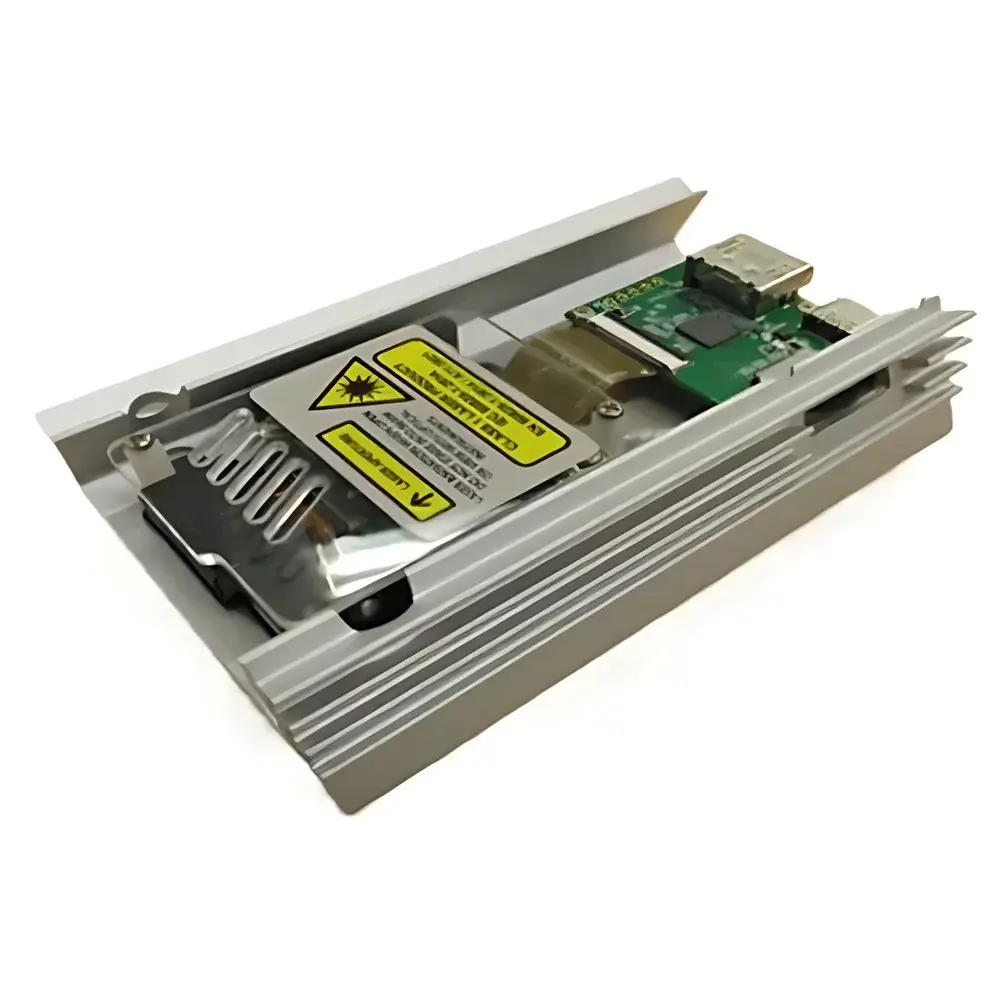
QDLaser QVFM Series Laser Scanning Projection (LSP) Module
| Brand | QDLaser |
|---|---|
| Origin | Japan |
| Manufacturer Status | Authorized Distributor |
| Origin Category | Imported |
| Model | QVFM Series |
| Pricing | Upon Request |
| Laser Wavelength Options | 405–1064 nm (1–3 wavelengths selectable) |
| Resolution | 720p @ 60 fps (input source) |
| Field of View | 39° (H) × 23° (V) |
| Focus | Autofocus-free (fixed-focus optical design) |
| Scan Modes | Raster and vector scanning |
| Power Consumption | Peak 6.5 W, typical <5.5 W |
| Dimensions | 52.00 × 38.40 × 16.75 mm |
| Laser Packaging | TO-38 or TO-56 hermetic can |
| Output Power Range | 7–220 mW (model-dependent, CW) |
| Primary Applications | 3D machine vision, LiDAR sensing, retinal projection, industrial defect detection, biomedical instrumentation, automotive ADAS components, micro-display systems |
Overview
The QDLaser QVFM Series Laser Scanning Projection (LSP) Module is a compact, integrated optoelectronic subsystem engineered for high-precision spatial light modulation in demanding industrial and scientific environments. Built around a monolithic architecture combining semiconductor laser diodes, high-speed MEMS micromirrors, proprietary driver electronics, and real-time control firmware, the QVFM module operates on the principle of resonant or electrostatic beam steering to project calibrated light patterns onto surfaces or directly into optical receivers. Unlike conventional LED-based or DLP-based projection units, the QVFM leverages coherent laser illumination and diffraction-limited spot formation—enabling sub-microradian angular resolution and nanosecond-level temporal synchronization. Its fixed-focus optical path eliminates mechanical focus adjustment, ensuring stable performance across temperature fluctuations (−10 °C to +60 °C operating range) and vibration-prone settings such as automotive test benches or robotic inspection cells. The module is designed for OEM integration into larger systems requiring deterministic light delivery, including structured-light 3D reconstruction engines, time-of-flight (ToF) sensors, and laser-based retinal stimulation platforms compliant with ISO 15004-2 and IEC 60825-1 safety standards.
Key Features
- Modular multi-wavelength configuration: Supports simultaneous or sequential operation of up to three discrete laser sources (405 nm, 450 nm, 520 nm, 640 nm, 852 nm, or 1064 nm), enabling spectral multiplexing for fluorescence excitation, color-accurate projection, or multi-band sensing.
- Dual-scan mode flexibility: Hardware-selectable raster scanning (for uniform illumination or line-by-line imaging) and vector scanning (for arbitrary pattern generation, point-cloud mapping, or dynamic ROI targeting).
- Compact form factor: 52.00 × 38.40 × 16.75 mm footprint with TO-38 or TO-56 laser packaging—optimized for space-constrained embedded applications including endoscopic probes and wearable display interfaces.
- Low-power architecture: Typical power draw under 5.5 W during continuous operation; peak consumption capped at 6.5 W—compatible with PoE+ (IEEE 802.3at) or battery-backed industrial controllers.
- Real-time synchronization interface: LVDS or CMOS-compatible trigger I/O supports hardware-level frame locking with external cameras, motion stages, or data acquisition systems—critical for synchronized 3D profilometry and motion-compensated scanning.
- Embedded thermal management: Integrated thermistor network and PID-controlled TEC driver ensure wavelength stability and output power repeatability within ±3% over extended duty cycles.
Sample Compatibility & Compliance
The QVFM Series is compatible with reflective, diffuse, and semi-transparent targets ranging from polished metal surfaces to biological tissue phantoms. Its laser output classes (Class 3R or Class 4, depending on configured wavelength and power) conform to IEC 60825-1:2014 and FDA 21 CFR Part 1040.10/1040.11 requirements. For medical device integration, the module meets essential requirements of ISO 13485:2016 (quality management) and supports traceable calibration logs required under FDA 21 CFR Part 11 for electronic records and signatures. When deployed in automotive LiDAR subsystems, it satisfies AEC-Q200 stress test profiles for temperature cycling, mechanical shock, and humidity exposure. All variants are RoHS 3 (2015/863/EU) and REACH SVHC-compliant.
Software & Data Management
QDLaser provides the QVFM Control SDK—a cross-platform C/C++ API supporting Windows, Linux (x86_64 and ARM64), and real-time OSes (VxWorks, QNX). The SDK includes pre-verified drivers for USB 2.0 and SPI interfaces, along with MATLAB and Python bindings for rapid prototyping. Configuration parameters—including scan frequency (up to 60 kHz mirror resonance), dwell time per pixel, grayscale LUT mapping, and inter-frame delay—are programmable via non-volatile registers. Audit-trail logging is enabled by default, recording all parameter changes with timestamps and user identifiers—supporting GLP/GMP validation workflows. Firmware updates are delivered via signed binary packages with SHA-256 verification and rollback capability.
Applications
- 3D Machine Vision: Enables structured-light triangulation for micron-level surface metrology in PCB solder-joint inspection, turbine blade profiling, and additive manufacturing in-process monitoring.
- Automotive Sensing: Serves as the illumination engine in short-range ToF sensors for occupant detection, gesture recognition, and interior monitoring systems meeting UNECE R151 and ISO 26262 ASIL-B functional safety requirements.
- Biomedical Instrumentation: Powers confocal microendoscopes and optogenetic stimulation arrays where precise spatiotemporal light delivery is essential for neural circuit mapping.
- Retinal Projection Displays: Delivers collimated, eye-safe laser beams directly onto the retina for augmented reality wearables—leveraging inherent depth-of-field independence and high contrast (>100,000:1).
- Industrial Defect Detection: Generates high-contrast shadow moiré or digital shearography patterns for detecting subsurface delamination in composites and micro-cracks in castings.
FAQ
What safety certifications does the QVFM Series hold?
All models comply with IEC 60825-1:2014 for laser product safety and carry CE, UKCA, and FCC marks. Class 3R configurations are available for open-beam applications; Class 4 variants require interlocked enclosures per EN 60825-1 Annex B.
Can the QVFM be synchronized with external cameras?
Yes—via TTL or LVDS trigger inputs/outputs, supporting genlock, frame-start, and line-sync modes with jitter <100 ns.
Is custom firmware development supported?
QDLaser offers NDA-protected access to low-level register maps and bootloader interfaces for qualified OEM partners engaged in co-development programs.
What is the expected lifetime of the MEMS mirror under continuous operation?
Accelerated life testing shows >20,000 hours MTBF at 25 °C ambient, validated per JEDEC JESD22-A108F high-temperature operating life protocols.
Do you provide optical design support for system integration?
Yes—QDLaser’s application engineering team delivers Zemax OpticStudio-compatible ray files, PSF data, and stray-light analysis reports upon request for optical path modeling.



