
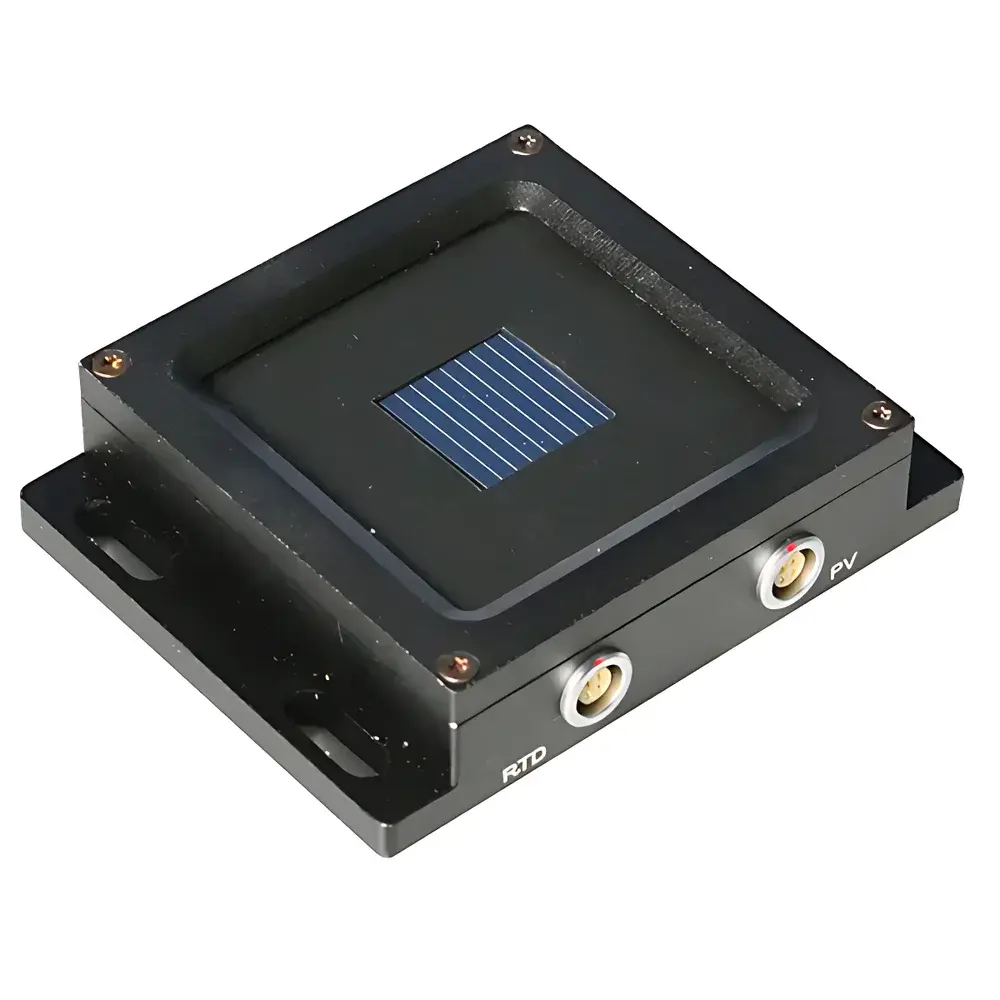
QE-B1 Standard Reference Solar Cell
| Brand | ZOLIX |
|---|---|
| Origin | Beijing, China |
| Manufacturer Type | Original Equipment Manufacturer (OEM) |
| Product Category | Reference Photovoltaic Device |
| Model | QE-B1 |
| Calibration Traceability | NIST |
| Compliance | IEC 60904-2, WPVS Class A |
| Filter Options | Optional AM1.5G, AM0, or custom spectral filters |
| Output Type | Short-circuit current (Isc) calibrated under standard test conditions (STC) |
Overview
The QE-B1 Standard Reference Solar Cell is a primary calibration device engineered for absolute irradiance measurement and spectral responsivity validation in photovoltaic (PV) characterization laboratories. Designed in strict accordance with IEC 60904-2 (Photovoltaic devices — Part 2: Requirements for reference solar cells) and the World Photovoltaic Scale (WPVS) Class A specifications, the QE-B1 serves as a traceable metrological anchor for solar simulator irradiance calibration—particularly during current–voltage (I–V) curve acquisition of test PV devices. Its core function is to provide a stable, repeatable short-circuit current (Isc) output under defined illumination conditions (e.g., AM1.5G, 1000 W/m², 25 °C), enabling precise determination of incident photon flux and subsequent calculation of external quantum efficiency (EQE) and power conversion efficiency (PCE). Unlike generic photodiodes, the QE-B1 incorporates a monocrystalline silicon p–n junction with certified spatial uniformity, low temperature coefficient, and long-term stability—ensuring measurement integrity across multi-year laboratory deployment cycles.
Key Features
- Primary reference cell certified to IEC 60904-2 and WPVS Class A requirements for spectral mismatch correction and irradiance scaling
- NIST-traceable calibration certificate supplied with each unit, including measured Isc, uncertainty budget, and spectral responsivity data from 300 nm to 1100 nm
- Monocrystalline silicon active area with anti-reflective coating optimized for AM1.5G spectrum; active area diameter: 20 mm (standard)
- Integrated temperature sensor (PT1000) for real-time thermal correction of Isc during operation
- Optional spectral filtering: AM1.5G (standard), AM0 (space applications), or user-defined bandpass filters for specialized spectral responsivity mapping
- Hermetically sealed TO-8 package with quartz window and integrated signal conditioning circuitry for low-noise analog output
- Calibration validity period: 12 months from date of issuance; recommended recalibration interval aligned with ISO/IEC 17025-accredited labs
Sample Compatibility & Compliance
The QE-B1 is compatible with all Class AAA solar simulators meeting IEC 60904-9 requirements and supports integration into automated IV testing platforms via analog voltage output (0–10 V proportional to Isc). It is routinely deployed in accredited PV testing facilities operating under ISO/IEC 17025, IEC 61215, and IEC 61646 quality management frameworks. Its calibration chain—extending directly to NIST’s Spectral Irradiance and Radiance Calibration Facility (SIRC)—satisfies audit requirements for GLP-compliant R&D environments and regulatory submissions to bodies such as UL, TÜV Rheinland, and JET. The device complies with RoHS directives and features laser-etched serial numbering for full asset traceability in laboratory information management systems (LIMS).
Software & Data Management
While the QE-B1 operates as a passive reference transducer, its calibration dataset—including spectral responsivity curves, temperature coefficients (αIsc), and expanded uncertainties (k=2)—is delivered in standardized ASCII and CSV formats compatible with PV analysis software suites (e.g., PVsyst, SAM, QSun, and LabVIEW-based IV acquisition modules). Integration with LIMS or ELN platforms supports automatic import of calibration metadata, expiration alerts, and version-controlled documentation per 21 CFR Part 11 compliance. All certificates include digital signatures and QR-coded access to archived calibration records hosted on ZOLIX’s secure cloud portal (accessible only to registered end-users).
Applications
- Absolute irradiance calibration of solar simulators prior to I–V measurement of c-Si, perovskite, CIGS, and organic PV devices
- Spectral mismatch correction in EQE systems using dual-reference configuration (e.g., QE-B1 + secondary reference cell)
- Validation of spectroradiometer output in PV metrology labs performing spectral irradiance mapping
- Reference standard in inter-laboratory round-robin studies coordinated by IEA-PVPS Task 12 or ASTM E424
- Baseline verification for accelerated aging tests where light source drift must be decoupled from device degradation
- Traceable calibration transfer between national metrology institutes (NMIs) and commercial PV testing service providers
FAQ
What is the recommended recalibration interval for the QE-B1?
Annual recalibration is recommended under routine use; however, frequency may increase to every 6 months in high-throughput production QA environments or after exposure to >5000 kWh/m² cumulative irradiation.
Does the QE-B1 require external bias or power supply?
No—it operates passively as a photovoltaic transducer and requires no external excitation; only a high-impedance voltmeter or calibrated current amplifier is needed to measure its short-circuit current output.
Can the QE-B1 be used under concentrated sunlight (CPV)?
Not without modification—the standard QE-B1 is rated for 1-sun operation (1000 W/m²); CPV applications require custom packaging with heat-sink integration and thermal derating protocols, available upon request.
How is spectral mismatch correction applied when using the QE-B1?
Mismatch factors are calculated using the QE-B1’s published spectral responsivity curve and the test device’s external quantum efficiency (EQE) data, following the methodology outlined in IEC 60904-7 and ASTM E2527.
Is the calibration certificate valid internationally?
Yes—NIST traceability ensures global recognition; supplementary EU-recognized calibration via PTB (Physikalisch-Technische Bundesanstalt) or NPL (National Physical Laboratory) can be arranged upon order confirmation.



