
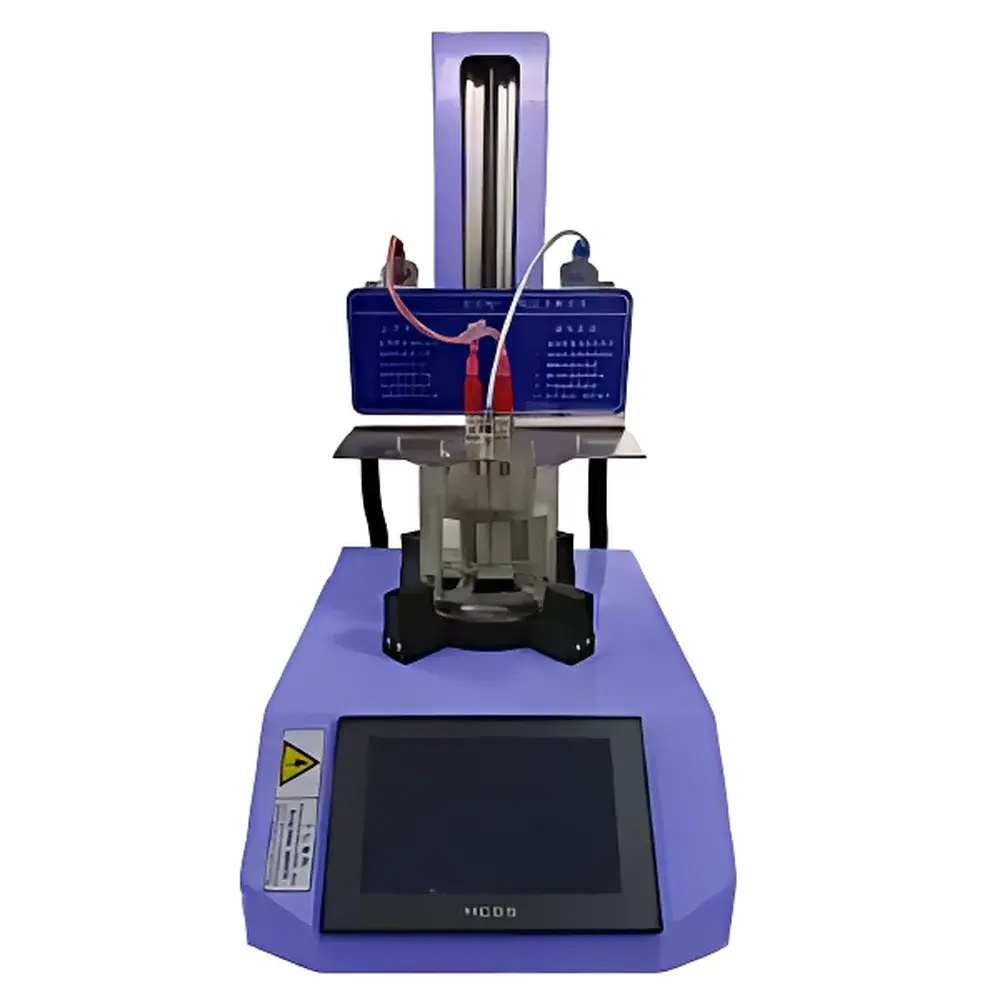
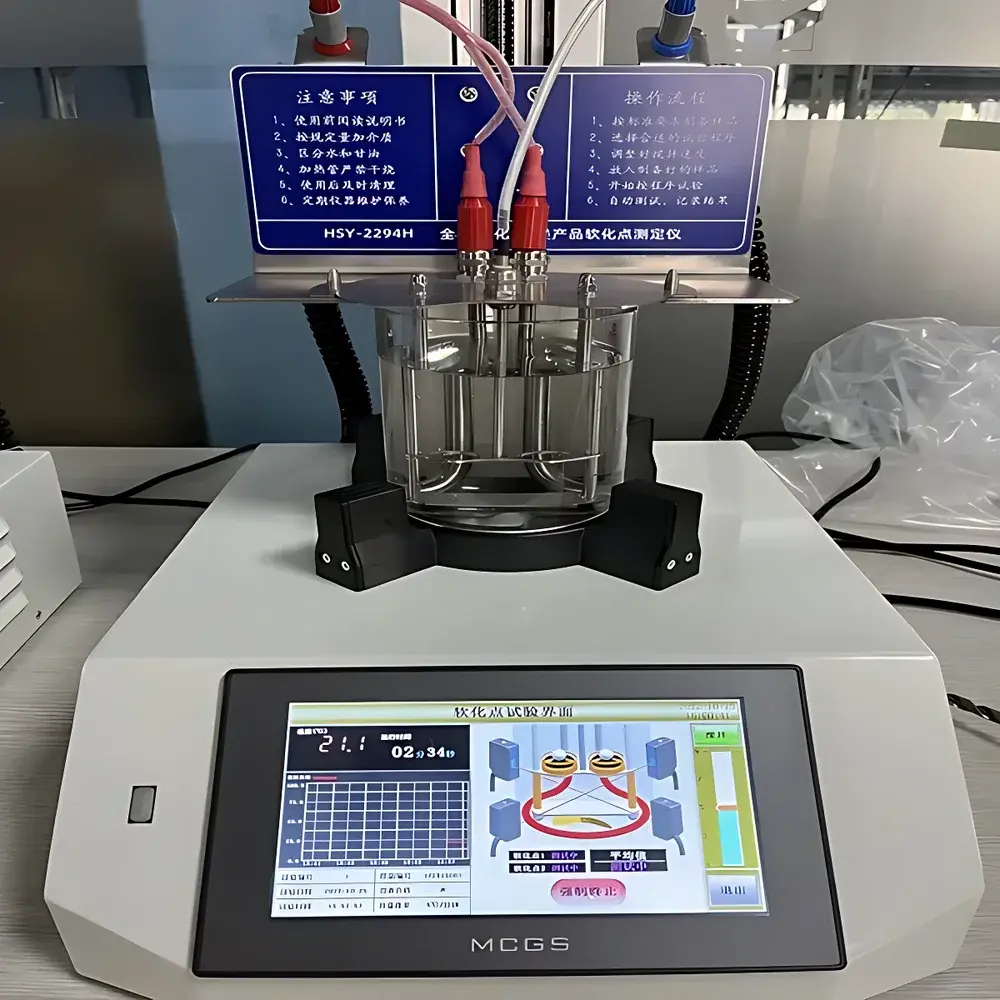
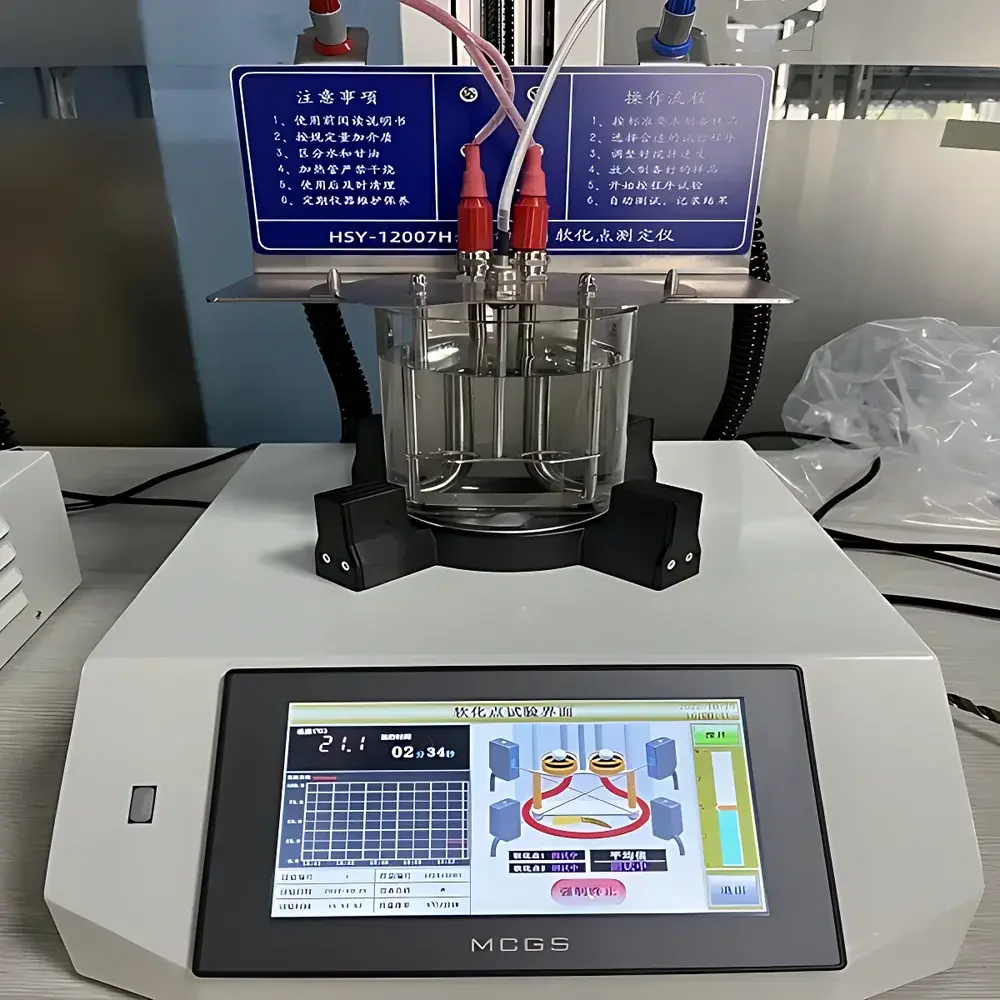
Qigao HSY-8146H Fully Automated Rosin Softening Point Tester
| Brand | Qigao Instruments |
|---|---|
| Origin | Shanghai, China |
| Manufacturer Type | Direct Manufacturer |
| Product Category | Domestic |
| Model | HSY-8146H |
| Temperature Range | Ambient to 162 °C |
| Temperature Resolution | 0.1 °C |
Overview
The Qigao HSY-8146H Fully Automated Rosin Softening Point Tester is a precision thermal analysis instrument engineered for compliance with pharmacopeial and industrial standards governing the determination of softening behavior in rosin and related thermoplastic resins. It operates on the principle of the ring-and-ball method—defined in Chinese Pharmacopoeia (2020 Edition) General Chapter 2102 (Ointment Softening Point Test) and GB/T 8146–2003 “Test Methods for Rosin”—where softened material deforms under standardized gravitational load (a 3.5 g steel ball) as temperature increases at a controlled linear rate of (5.0 ± 0.5) °C/min. The instrument detects the moment both test specimens—held in calibrated brass rings—deform sufficiently to allow the ball to descend and contact a lower reference plate. The arithmetic mean of the two recorded temperatures is reported as the softening point. Designed for reproducible, operator-independent measurements, the HSY-8146H integrates closed-loop thermal control, optical position sensing, and mechanical actuation to eliminate manual timing errors and subjective endpoint interpretation.
Key Features
- Fully automated detection via dual-channel laser beam interruption sensing—high immunity to ambient light, vapor condensation, or bath turbulence.
- Intelligent temperature control using slope interpolation algorithm ensures stable (5.0 ± 0.5) °C/min ramp rate after 3-minute stabilization; real-time PID correction maintains thermal linearity across full range (5–160 °C).
- Motorized vertical positioning system with precision lead-screw drive enables repeatable, vibration-free descent of sample assembly to align laser path within ±0.1 mm tolerance relative to lower reference plate.
- Separate magnetic stirrer with continuously variable speed control ensures uniform thermal distribution in 110 mm × 130 mm glass beaker—critical for minimizing axial temperature gradients per ASTM D36 and ISO 4625 requirements.
- Integrated 7-inch capacitive touch HMI displays live temperature curve, real-time animation of ball descent, and step-by-step test guidance—no external PC required.
- Dual-sample configuration allows concurrent testing of two specimens under identical thermal conditions, supporting statistical validation per GLP data integrity guidelines.
- Onboard data management stores up to 200 test records with timestamp, ambient conditions, and raw sensor timestamps; exportable as CSV via USB flash drive for traceability and audit readiness.
Sample Compatibility & Compliance
The HSY-8146H is validated for rosin, colophony derivatives, and other low-molecular-weight natural resins with softening points between 5 °C and 160 °C. It accommodates standard 15.9 mm inner-diameter brass rings and 9.5 mm diameter steel balls conforming to USP <741>, ASTM D36–22, and ISO 4625:2021 dimensional specifications. When operated with distilled water (5–80 °C) or glycerol (32–160 °C) as heating medium, the system meets thermal uniformity criteria outlined in GB/T 8146–2003 Annex A and Chinese Pharmacopoeia 2020 Section 2102. All firmware logic—including ramp initiation, endpoint detection, and averaging—is locked and version-controlled; software certification includes registered copyright (No. 6089527) and supports 21 CFR Part 11-compliant audit trail generation when connected to compliant LIMS environments.
Software & Data Management
Embedded firmware provides full test lifecycle control: automatic preheat stabilization, ramp initiation upon user confirmation, continuous laser position monitoring, and dual-channel endpoint capture. Each test record includes instrument ID, operator code (optional), ambient temperature/humidity (if external sensors are connected), start/end times, ramp deviation logs, and raw photodiode voltage traces. Data export via USB yields comma-separated values (.csv) files compatible with Excel, MATLAB, or statistical process control (SPC) platforms. Optional RS-485 Modbus RTU interface enables integration into centralized lab automation systems for scheduled calibration logging and remote status polling. Firmware updates are performed offline via USB—no internet dependency ensures cybersecurity compliance in regulated QC labs.
Applications
- Quality control of gum rosin, tall oil rosin, and hydrogenated rosin batches in adhesive, ink, and chewing gum manufacturing.
- Stability assessment of rosin esters during accelerated aging studies under ISO 11344 protocols.
- Raw material release testing per supplier qualification programs aligned with ICH Q5E and ASTM D7064.
- Method transfer verification between QC labs following USP <1225> validation parameters (repeatability, intermediate precision, robustness).
- Regulatory submission support for pharmaceutical excipients where rosin serves as film-coating component or tackifier in transdermal patches.
FAQ
What heating media are supported, and how are temperature ranges selected?
Distilled water is used for samples with softening points ≤80 °C; glycerol is required for higher-range testing (32–160 °C). The instrument automatically configures ramp parameters and safety limits based on selected medium via touchscreen menu.
Does the system meet FDA 21 CFR Part 11 requirements for electronic records?
The HSY-8146H supports Part 11 compliance when deployed with external identity authentication (e.g., LDAP-integrated login) and third-party audit trail software; onboard CSV export includes immutable timestamps and operator metadata.
How is thermal uniformity verified during operation?
Uniformity is maintained via independent magnetic stirring (speed adjustable 0–1200 rpm), optimized bath geometry, and real-time thermal gradient compensation in controller firmware—validated per ASTM D36 Annex B procedures.
Can test methods be customized beyond pharmacopeial protocols?
Yes—user-defined ramp rates (2–10 °C/min), dwell times, and endpoint sensitivity thresholds can be saved as named methods; all modifications are logged with user ID and timestamp.
What maintenance is required for long-term accuracy?
Annual verification using NIST-traceable PT100 probe and certified reference materials (e.g., pure indium, camphor) is recommended; optical alignment check is performed automatically during startup self-test.






