
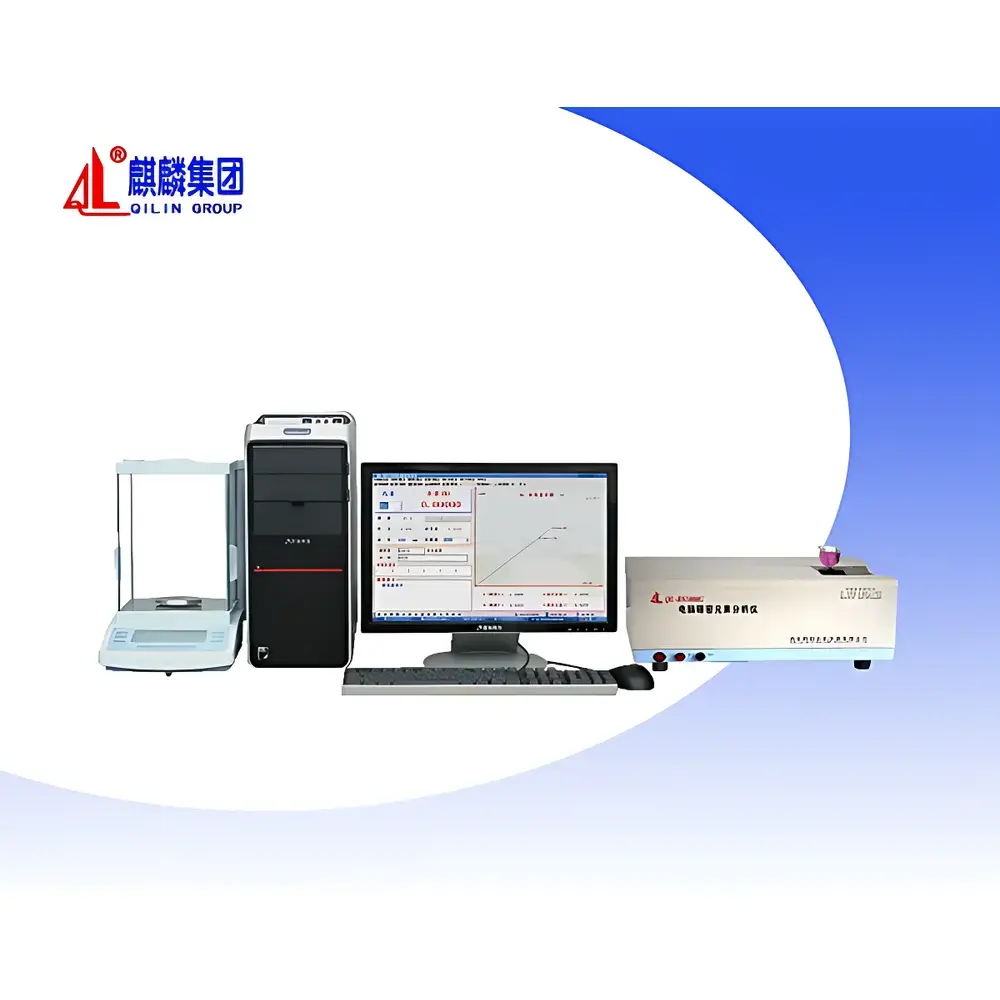
Qilin BS1000G Desktop Multi-Element Spectrophotometric Analyzer for Carbon Steel and Alloy Cast Iron
| Brand | Qilin (QL) |
|---|---|
| Model | BS1000G |
| Origin | Jiangsu, China |
| Type | Benchtop Photometric Elemental Analyzer |
| Optical System | Adjustable-Wavelength Self-Collimating Diffraction Grating (Right-Exit) |
| Wavelength Accuracy | ±3 nm |
| Measurable Elements (typical) | Mn (0.10–65.00 wt%), Si (0.10–75.00 wt%), P (0.005–1.00 wt%), Cu (0.02–85.00 wt%), Cr (0.01–45.00 wt%), Ni (0.01–50.00 wt%), Mo (0.101–6.00 wt%), Mg (0.010–0.100 wt%), Rare Earths (0.01–0.100 wt%) |
| Analytical Method | Photometric Colorimetry with Computer-Controlled Wavelength Selection |
| Measurement Time per Sample | ≤5 s |
| Weighing Device | 0.0001 g Precision Electronic Balance (1/10,000 g resolution) |
| Compliance | GB/T 223 series (Chinese national standards for metallurgical analysis) |
| Operating Environment | 10–30 °C, RH <75% |
| Data Output | Integrated thermal printer (Chinese-language interface), PC-based data logging |
Overview
The Qilin BS1000G is a benchtop multi-element photometric analyzer engineered for quantitative determination of major and minor metallic constituents in ferrous alloys—including carbon steels, low-alloy steels, cast irons, and high-strength alloy castings. It operates on the principle of visible/near-UV photometric colorimetry: analyte elements are chemically converted into stable, light-absorbing chromophores via standardized wet-chemical digestion and derivatization protocols (e.g., ammonium molybdate for phosphorus, ammonium persulfate–silver nitrate for manganese). The instrument employs a proprietary right-exit self-collimating diffraction grating optical system, enabling continuous, software-driven wavelength selection across the 340–850 nm spectral range. This architecture eliminates mechanical filter wheels and significantly improves wavelength reproducibility—reducing typical calibration drift from ±20 nm in legacy filter-based systems to ±3 nm—thereby enhancing inter-laboratory comparability and method robustness in routine QC environments.
Key Features
- Computer-controlled adjustable-wavelength optical path using a custom-designed self-collimating diffraction grating, ensuring precise spectral isolation without manual alignment or physical filter changes.
- Integrated 0.0001 g precision electronic balance with tare function and automatic sample mass input into analysis routines—supporting non-fixed sample weights while maintaining stoichiometric calculation integrity.
- Onboard microprocessor with full Chinese-language menu interface; real-time parameter configuration, calibration curve management, and result display.
- Dedicated thermal printer for immediate hardcopy output of sample ID, element concentrations, measurement date/time, operator code, and pass/fail flags against user-defined specification limits.
- Optimized reagent compatibility with standard ASTM E30 and GB/T 223-compliant wet chemistry kits for Mn, Si, P, Cr, Ni, Mo, Cu, and Mg—enabling direct cross-validation with reference methods.
- Rugged industrial-grade chassis with EMI-shielded electronics, designed for continuous operation in foundry labs, heat-treatment QA departments, and third-party metal testing facilities.
Sample Compatibility & Compliance
The BS1000G is validated for solid metallic samples requiring dissolution prior to analysis: drill shavings, lathe turnings, or spark-cut coupons from carbon steel (A36, SAE 1018), low-alloy steel (4140, 4340), gray/ductile cast iron (ASTM A48, A536), and austenitic/martensitic stainless alloys. Sample preparation follows ISO 11573 and GB/T 20066 for representative sub-sampling and acid digestion (HCl–HNO₃–HF mixtures under reflux). All reported concentration ranges comply with tolerance limits defined in GB/T 223.1–223.79 for chemical analysis of iron, steel, and alloys. While not certified to ISO/IEC 17025 for accredited testing, the system supports GLP-aligned documentation practices including audit trails for calibration events, reagent lot tracking, and operator login logs when paired with external LIMS.
Software & Data Management
The embedded firmware supports up to 99 customizable analytical methods, each storing unique wavelength settings, calibration coefficients, dilution factors, and upper/lower specification thresholds. Calibration curves are generated using NIST-traceable certified reference materials (CRMs) such as IRON-1, CRM 129c, or GBW(E)010228 series. Raw absorbance values, corrected for blank subtraction and matrix interference, are stored in non-volatile memory with timestamp and operator ID. Export options include CSV via USB port for integration with Excel-based statistical process control (SPC) dashboards or enterprise quality management systems (QMS). No cloud connectivity or remote access capability is included—data sovereignty remains fully on-site per IEC 62443-3-3 Level 1 requirements.
Applications
- Routine verification of melt composition during ladle metallurgy and continuous casting operations.
- Incoming raw material inspection of scrap, ferroalloys, and master alloys prior to charge blending.
- Final product certification for ASTM A668, EN 10272, or GB/T 699 compliance reporting.
- Failure analysis support—quantifying segregation-induced deviations in critical sections (e.g., rim vs. core in forged shafts).
- Process optimization in heat treatment lines where residual Cu, Sn, or Pb content affects temper embrittlement susceptibility.
- Educational use in metallurgical engineering laboratories for teaching classical wet-chemical spectroscopic analysis principles.
FAQ
Does the BS1000G support ASTM or ISO standard test methods directly?
Yes—the instrument’s optical and procedural specifications align with ASTM E30 Practice for Chemical Analysis of Metals and Alloys and ISO 6429:1982 (Determination of manganese in iron and steel). Users must implement corresponding digestion and color development steps per those standards.
Can it analyze non-ferrous metals such as aluminum or titanium alloys?
Not without method adaptation and validation. The default calibration suite targets Fe-based matrices; analyzing Al, Ti, or Zn requires independent method development, including new CRMs, interference correction algorithms, and acid digestion optimization.
Is the wavelength calibration traceable to NIST?
The grating system is factory-calibrated using holmium oxide and didymium glass filters with NIST-traceable certification reports provided with each unit.
What maintenance is required beyond daily cleaning and reagent replenishment?
Annual optical alignment verification and photodiode response calibration using certified neutral density filters are recommended to maintain ±3 nm wavelength fidelity.
Does the system meet FDA 21 CFR Part 11 requirements for electronic records?
No—the embedded software lacks electronic signature capability, audit trail permanence, or role-based access control. It is intended for internal QC use only, not regulated pharmaceutical or medical device manufacturing environments.




