
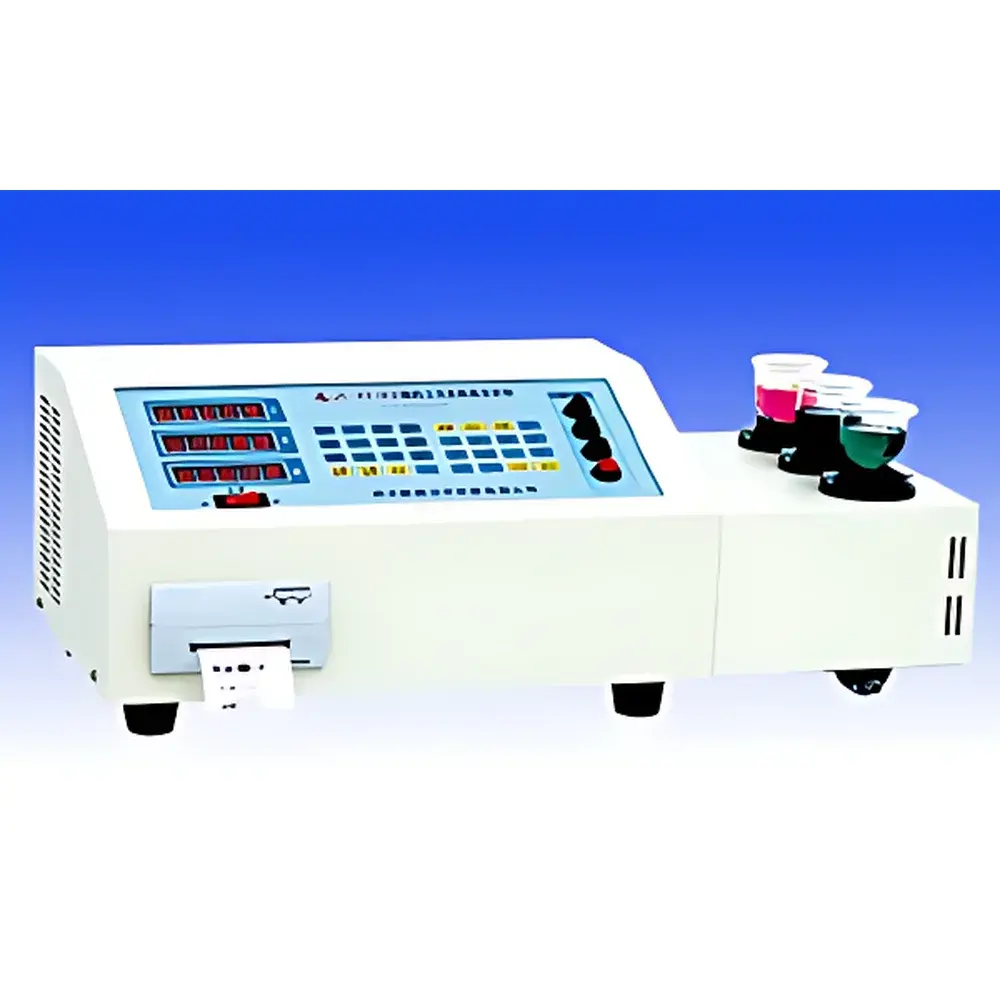
Qilin QL-BS3B Microcomputer-Based Multi-Element Analyzer for Metals
| Brand | Qilin / QL |
|---|---|
| Origin | Jiangsu, China |
| Manufacturer Type | Authorized Distributor |
| Country of Origin | China |
| Model | QL-BS3B |
| Price | USD 1,380 (FOB Nanjing) |
| Measurement Principle | Photometric Colorimetry with Cold Light Sources |
| Elements Measured | Si, Mn, P, Ni, Cr, Cu, Rare Earths, Mg, Fe, Al, V, W, Ti |
| Typical Range (w/w) | Mn 0.10–15.00%, Si 0.10–5.00%, P 0.005–0.80%, Cr 0.010–25.0%, Mo 0.010–6.00%, Mg 0.010–0.99% |
| Detection Method | Dual-beam photometry using imported silicon photodiodes |
| Calibration | Automatic zero & full-scale self-calibration |
| Curve Storage | 15 user-programmable calibration curves |
| Input Interface | Touch-sensitive membrane keypad with audible feedback |
| Sample Preparation | External fusion (crucible-based), valve-free and tubing-free design |
| Optical Source | Interchangeable cold-light sources for spectral adaptability |
Overview
The Qilin QL-BS3B Microcomputer-Based Multi-Element Analyzer for Metals is a dedicated photometric instrument engineered for rapid, on-site quantitative analysis of major and minor metallic elements in ferrous and non-ferrous alloys. It operates on the principle of dual-beam photometric colorimetry: sample solutions—prepared via external crucible fusion—are reacted with selective chromogenic reagents to form colored complexes whose absorbance is measured at optimized wavelengths. The system employs stable cold-light sources (LED or halogen-based, depending on element-specific absorption bands) coupled with high-stability silicon photodiodes to ensure low drift and high photometric reproducibility. Unlike flame photometers or arc/spark OES systems, the QL-BS3B delivers laboratory-grade precision without requiring high-voltage excitation, inert gas purging, or vacuum optics—making it especially suitable for foundry floor, QC lab, and incoming material inspection environments where robustness, operational simplicity, and minimal maintenance are critical.
Key Features
- Cold-light source architecture eliminates thermal drift and extends optical component lifetime; compatible with interchangeable light modules for spectral optimization across Si, Mn, P, Cr, Ni, Cu, and rare earth determinations.
- Automatic zero-point and full-scale calibration before each measurement cycle ensures long-term baseline stability and reduces operator-dependent error.
- Dedicated microcontroller (8-bit MCU platform) manages data acquisition, curve interpolation, and concentration calculation; supports storage of up to 15 independent calibration curves—each editable via front-panel interface.
- Touch-sensitive membrane keyboard with tactile feedback and audible keypress tones enables glove-compatible operation in industrial settings; shortcut keys streamline routine tasks including blanking, standardization, and result recall.
- Valve-free, tubing-free external fusion workflow eliminates common failure points associated with peristaltic pumps, solenoid valves, and capillary clogging—significantly improving mean time between failures (MTBF) and reducing consumable dependency.
- Modular optical path design allows field-upgradable light source and filter sets to expand elemental coverage (e.g., addition of V, W, Ti, or Al channels) without hardware replacement.
Sample Compatibility & Compliance
The QL-BS3B accepts acid-digested or fused sample solutions prepared from solid metal specimens (cast iron, steel, aluminum alloys, copper-base materials) according to standardized dissolution protocols (e.g., ASTM E304, ISO 6429, GB/T 223 series). Its photometric methodology aligns with classical wet-chemical reference methods used in metallurgical QA/QC workflows. While not an ISO/IEC 17025-accredited instrument per se, its performance characteristics—including repeatability ≤1.5% RSD for mid-range concentrations and linearity R² ≥0.999 over calibrated spans—support compliance with internal quality control requirements under ISO 9001 and IATF 16949. Data output formats are compatible with LIMS integration via RS-232 serial export (ASCII text), enabling traceability in GLP- and GMP-aligned environments where audit trails and electronic record retention are mandated.
Software & Data Management
The analyzer operates autonomously without PC dependency; all calibration, measurement, and arithmetic functions are executed onboard. Raw absorbance values, calculated concentrations (wt%), and measurement timestamps are stored in non-volatile memory (EEPROM) with capacity for ≥1,000 records. Data export is supported via RS-232 interface at 9600 baud; no proprietary drivers required—standard terminal emulation software (e.g., Tera Term, PuTTY) suffices for batch retrieval. Optional QL-DataLink utility (Windows-based, provided separately) enables curve library backup, report generation (PDF/CSV), and statistical summary (mean, SD, CV%) across user-defined sample groups. All exported files include instrument ID, model number, firmware version, and operator ID fields—facilitating 21 CFR Part 11–aligned metadata capture when paired with appropriate access controls and electronic signatures.
Applications
- Ladle-to-tap monitoring in electric arc furnace (EAF) and basic oxygen furnace (BOF) operations for real-time Mn, Si, and P adjustment.
- Final product verification of alloy composition in stainless steel, tool steel, and superalloy billets prior to shipment.
- Incoming raw material inspection for scrap metal, ferroalloys, and master alloys against purchase specifications (e.g., ASTM A743, EN 10213).
- Routine QC in automotive casting foundries for Al-Si-Mg and Cu-Zn-Ni systems.
- Research and development labs conducting compositional mapping of prototype alloys where multi-element screening precedes ICP-OES validation.
- Third-party testing laboratories serving SMEs requiring cost-effective, turnkey elemental analysis without capital-intensive instrumentation.
FAQ
Does the QL-BS3B require daily recalibration?
No—its automatic zero/full-scale self-calibration routine executes prior to each sample measurement, eliminating need for daily standardization if ambient conditions remain stable. Weekly verification with certified reference materials (CRMs) is recommended for ISO-compliant use.
Can it analyze dissolved samples prepared by microwave digestion?
Yes—provided the digestate is diluted to fit within the instrument’s linear absorbance range and free of suspended particulates or turbidity that could scatter incident light.
Is method validation support available?
Qilin provides application notes detailing digestion protocols, reagent formulations, and CRM correlation data for common matrices (e.g., low-alloy steel, gray cast iron); method transfer documentation follows ISO 17025 Annex B guidelines.
What is the typical analysis time per element?
Approximately 30–45 seconds per element, including reagent addition, color development (where applicable), and photometric readout—total multi-element cycle time depends on number of channels activated and sample preparation speed.
Are consumables proprietary?
No—reagents (e.g., ammonium molybdate for phosphorus, periodate for manganese) and crucibles follow open ASTM/ISO formulations; only cold-light modules are manufacturer-specified for optical alignment integrity.



