
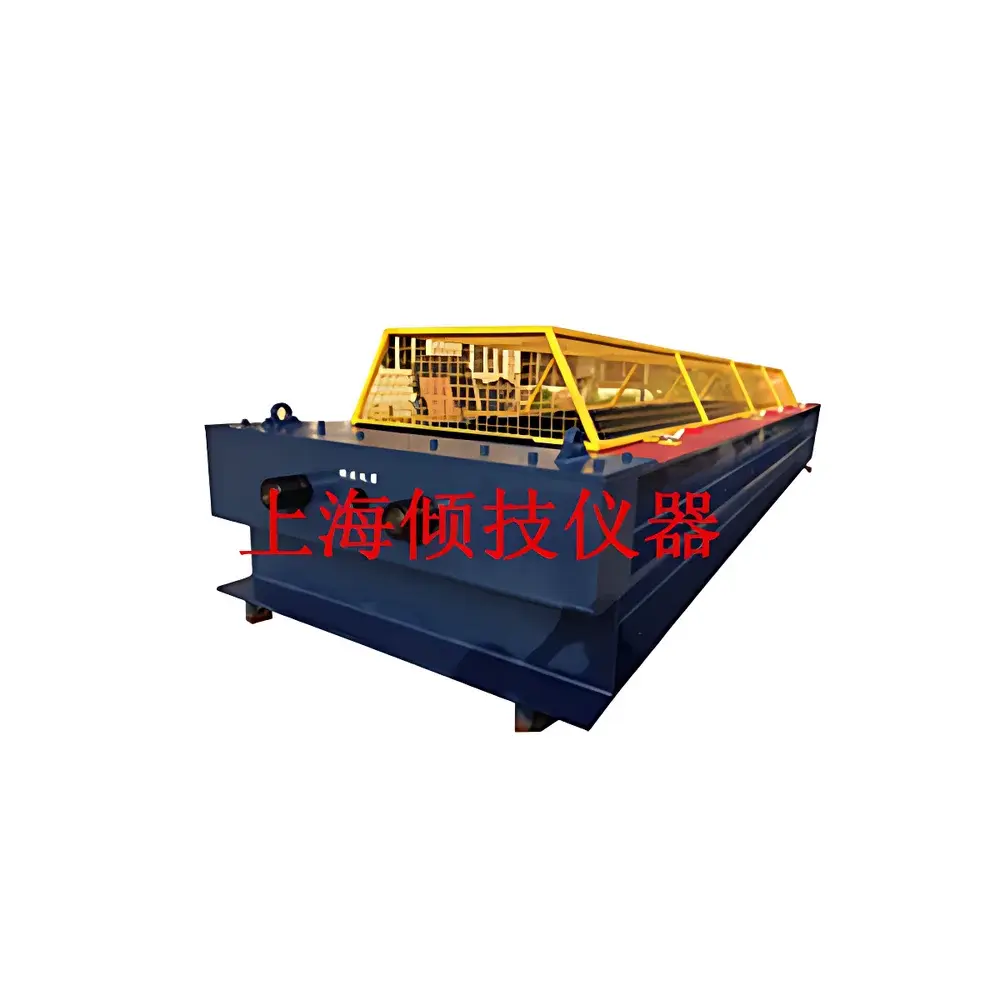
Qingji QJ-DT Series High-Capacity Horizontal Tensile Testing Machine
| Brand | Qingji |
|---|---|
| Origin | Shanghai, China |
| Manufacturer Type | Authorized Distributor |
| Country of Origin | China |
| Model | QJ-DT Series |
| Load Capacity | 10,000 kN |
| Load Cell Accuracy | ±0.01% FS |
| Test Accuracy | ±0.5% of reading |
| Speed Range | 0.001–300 mm/min |
| Test Stroke | ≥200 mm |
| Power Supply | AC 220 V, 50/60 Hz |
| Dimensions (W×D×H) | 600 × 300 × 300 mm |
| Weight | ~40 kg |
Overview
The Qingji QJ-DT Series High-Capacity Horizontal Tensile Testing Machine is an electromechanical static testing system engineered for high-force tensile, peel, and pull-off evaluation of structural and electrical components under controlled displacement conditions. Unlike vertical configurations, its horizontal architecture accommodates extended test specimens—such as automotive wiring harnesses, heavy-duty connectors, industrial fasteners, and large-diameter cables—while maintaining mechanical stability during high-load application up to 10,000 kN. The system operates on a precision ball-screw actuation principle coupled with closed-loop servo control, enabling consistent force ramping, dwell control, and displacement tracking. It complies with fundamental mechanical testing principles defined in ISO 7500-1 (static calibration of force-proving instruments) and ASTM E4 (load verification of testing machines), forming the foundational metrological basis for traceable mechanical characterization in R&D labs and quality assurance environments.
Key Features
- High-rigidity horizontal frame constructed from reinforced steel with baked enamel finish for long-term dimensional stability and corrosion resistance.
- High-resolution load cell calibrated to ±0.01% full scale, certified per ISO 376 Class 0.5 requirements.
- Dynamic real-time display of force–displacement curves, peak load, yield point, and elongation on integrated 7-inch TFT LCD interface.
- Adjustable crosshead speed range (0.001–300 mm/min) with programmable multi-step profiles for creep, stress-relaxation, and cyclic loading sequences.
- Modular grip interface supporting interchangeable jaw types—including pneumatic, wedge, and custom fixture mounts—for secure clamping of metallic, polymeric, and composite specimens.
- RS-232 and USB 2.0 ports for bidirectional communication with Windows-based control software; supports data export in CSV, XLSX, and PDF report formats.
Sample Compatibility & Compliance
The QJ-DT series is validated for testing specimens with minimum gauge lengths of 50 mm and maximum effective test stroke exceeding 200 mm. It accommodates rigid and semi-rigid samples including crimped terminals, molded lamp bases, PCB-mounted connectors, elastomeric gaskets, and adhesive-bonded assemblies. All mechanical and electrical subsystems conform to IEC 61000-6-2 (immunity) and IEC 61000-6-4 (emission) standards. Software operation supports audit trail logging and user-level access control, facilitating alignment with GLP and internal QA documentation requirements. While not pre-certified for FDA 21 CFR Part 11, the system’s data integrity framework—including timestamped raw data storage and non-editable report generation—enables customer-led validation for regulated environments.
Software & Data Management
The included PC-based control suite provides intuitive test method setup, real-time curve overlay, statistical post-processing (mean, SD, CV%), and comparative pass/fail thresholding against predefined specification limits. Raw force and displacement data are recorded at ≥100 Hz sampling rate and stored in encrypted local databases. Export functions support automated report generation with customizable headers, logos, and compliance statements. Version-controlled firmware updates are delivered via secure download portal, with change logs documenting all functional and calibration-related modifications per ISO/IEC 17025 clause 5.9.2.
Applications
- Quantitative assessment of crimp retention strength in automotive and aerospace wire harness assemblies (per SAE AS7928 and USCAR-21).
- Evaluation of peel adhesion performance for pressure-sensitive tapes, laminated films, and medical device packaging (aligned with ASTM D903 and ISO 8510-2).
- Mechanical validation of LED housing retention forces and thermal interface material bond integrity.
- Verification of mechanical robustness in industrial plug-and-socket systems subjected to repeated mating cycles.
- Supporting failure mode analysis (FMA) through synchronized video capture integration (optional accessory).
FAQ
What is the maximum allowable specimen length for horizontal configuration testing?
Specimens up to 1,200 mm in total length can be accommodated with optional extended base rails; standard configuration supports up to 800 mm.
Does the system include calibration certification?
Yes—a factory-issued certificate of conformance (CoC) with traceability to NIM (National Institute of Metrology, China) is provided upon shipment.
Can test methods be password-protected or locked for operator use?
Yes. User roles (Administrator, Technician, Viewer) support method locking, parameter masking, and electronic signature enforcement.
Is third-party ISO 17025 calibration service available?
Qingji partners with CNAS-accredited laboratories for on-site or return-to-facility calibration; annual recalibration intervals are recommended per ISO/IEC 17025 clause 6.5.



