
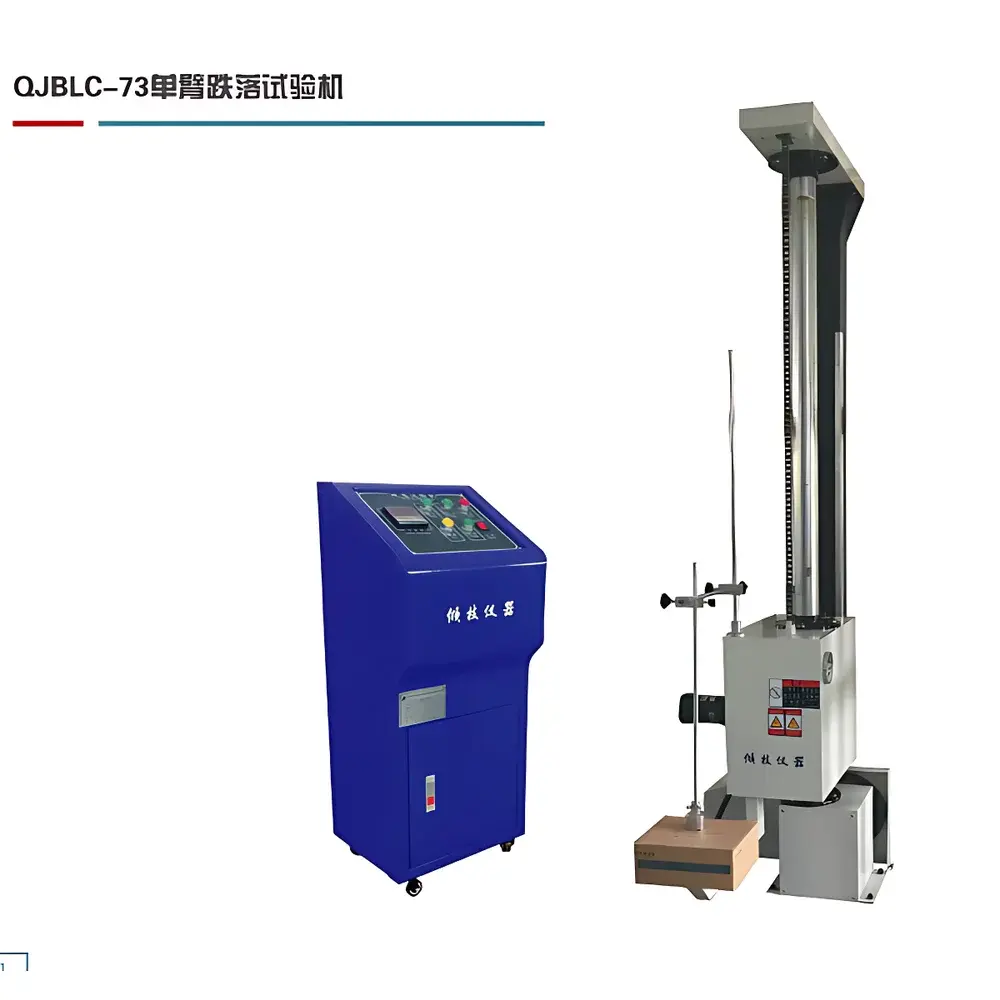
Qingji QJBLC-73 Single-Arm Drop Testing Machine
| Brand | Qingji |
|---|---|
| Origin | Shanghai, China |
| Model | QJBLC-73 |
| Drop Height Range | 300–2000 mm |
| Maximum Specimen Weight | 60 kg |
| Maximum Specimen Dimensions | 1000 × 800 × 800 mm |
| Drop Surface Dimensions | 1700 × 1200 × 3015 mm |
| Height Display Accuracy | ≤ ±2% of set value |
| Drop Angle Tolerance | ≤ ±5° |
| Motor Power | 0.5 HP |
| Power Supply | AC 380 V, 50 Hz, 10 A |
| Machine Weight | 435 kg |
| Compliance Standards | ISO 2248, JIS Z0202-87, GB/T 4857.5–1992 |
Overview
The Qingji QJBLC-73 Single-Arm Drop Testing Machine is an electromechanically actuated impact simulation system engineered for standardized evaluation of packaging integrity under free-fall conditions. It operates on the principle of controlled gravitational acceleration to replicate real-world handling hazards—specifically, uncontrolled drops during logistics, warehousing, and manual transport. Designed in accordance with internationally recognized test methodologies, the machine enables repeatable, traceable assessment of structural resilience in corrugated boxes, cartons, palletized unit loads, and other primary or secondary shipping containers. Its single-arm lifting mechanism ensures stable specimen elevation and precise release timing, minimizing kinetic interference and supporting high reproducibility across sequential drop cycles.
Key Features
- Single-arm vertical lift architecture with reinforced steel frame for torsional rigidity and long-term dimensional stability
- Adjustable drop height range from 300 mm to 2000 mm, calibrated via LED digital height indicator with resolution of 1 mm
- Height display accuracy maintained within ±2% of the preset value, verified per internal metrological procedure
- Three-mode drop configuration: face drop, edge drop, and corner drop—each executed with angular deviation ≤ ±5° relative to nominal orientation
- Robust base platform (1700 × 1200 × 3015 mm overall footprint) incorporating hardened steel impact surface and optional replaceable anvil inserts
- Motor-driven lifting system powered by a 0.5 HP induction motor, compliant with IEC 60034 efficiency class IE2
- Integrated safety interlocks including emergency stop circuit, door position sensors, and overload protection on the lifting drive train
- AC 380 V, 50 Hz, 10 A three-phase power input with industrial-grade circuit breaker and EMI-filtered supply line
Sample Compatibility & Compliance
The QJBLC-73 accommodates specimens up to 60 kg mass and 1000 × 800 × 800 mm in external dimensions—covering standard RSC, HSC, and die-cut retail packaging configurations. Test specimens are secured using non-marring clamping fixtures or custom cradles to prevent pre-drop deformation. The system conforms to the mechanical and procedural requirements of ISO 2248 (Packaging — Full immersion drop test), JIS Z0202-87 (Methods of test for transport packages — Vertical impact test), and GB/T 4857.5–1992 (Packaging—Basic tests for transport packages—Vertically dropped load test). While not inherently certified to ISO/IEC 17025, the instrument supports GLP-compliant operation when integrated into validated laboratory workflows—including documented calibration records, operator training logs, and maintenance history tracking.
Software & Data Management
This model operates as a standalone hardware platform without embedded microprocessor-based control software. All operational parameters—including target drop height, drop mode (face/edge/corner), and cycle count—are manually configured via front-panel controls and confirmed visually through the LED height display. Users are expected to maintain external test records in accordance with internal quality management systems (e.g., ISO 9001:2015 Clause 8.5.2). For regulated environments requiring audit trails, integration with third-party LIMS or electronic lab notebooks (ELN) is supported via manual data entry or barcode-assisted logging. No firmware or proprietary software is installed; therefore, no cybersecurity or 21 CFR Part 11 compliance features are applicable.
Applications
- Validation of corrugated fiberboard box design against ISTA 1A, 2A, and 3A transport simulation protocols
- Comparative strength analysis of alternative packaging materials (e.g., molded pulp vs. EPS vs. corrugated)
- Pre-shipment qualification testing for e-commerce fulfillment centers handling fragile electronics, pharmaceuticals, or precision instruments
- Root cause investigation of field damage reports—correlating observed failure modes (e.g., seam burst, corner crush, lid separation) with specific drop orientations
- Supporting supplier qualification audits where physical drop performance is a contractual acceptance criterion
- Academic research in packaging engineering programs focused on energy absorption characteristics and failure mechanics of laminated substrates
FAQ
What standards does the QJBLC-73 comply with?
It is mechanically and procedurally aligned with ISO 2248, JIS Z0202-87, and GB/T 4857.5–1992. Compliance verification requires user-performed calibration and documented test execution.
Can the machine perform sequential multi-drop tests without manual repositioning?
No—it is a manual setup system; each drop orientation (face, edge, corner) requires operator intervention to reorient and secure the specimen.
Is calibration certification included with purchase?
Factory calibration data is provided; however, accredited third-party calibration per ISO/IEC 17025 must be arranged separately by the end user.
What maintenance intervals are recommended?
Lubrication of guide rails and inspection of lifting cable tension every 200 operating hours; annual verification of height sensor linearity and mechanical squareness.
Does the system support automated data capture or USB export?
No—this is a purely electromechanical tester with no digital interface, memory, or connectivity options.



