
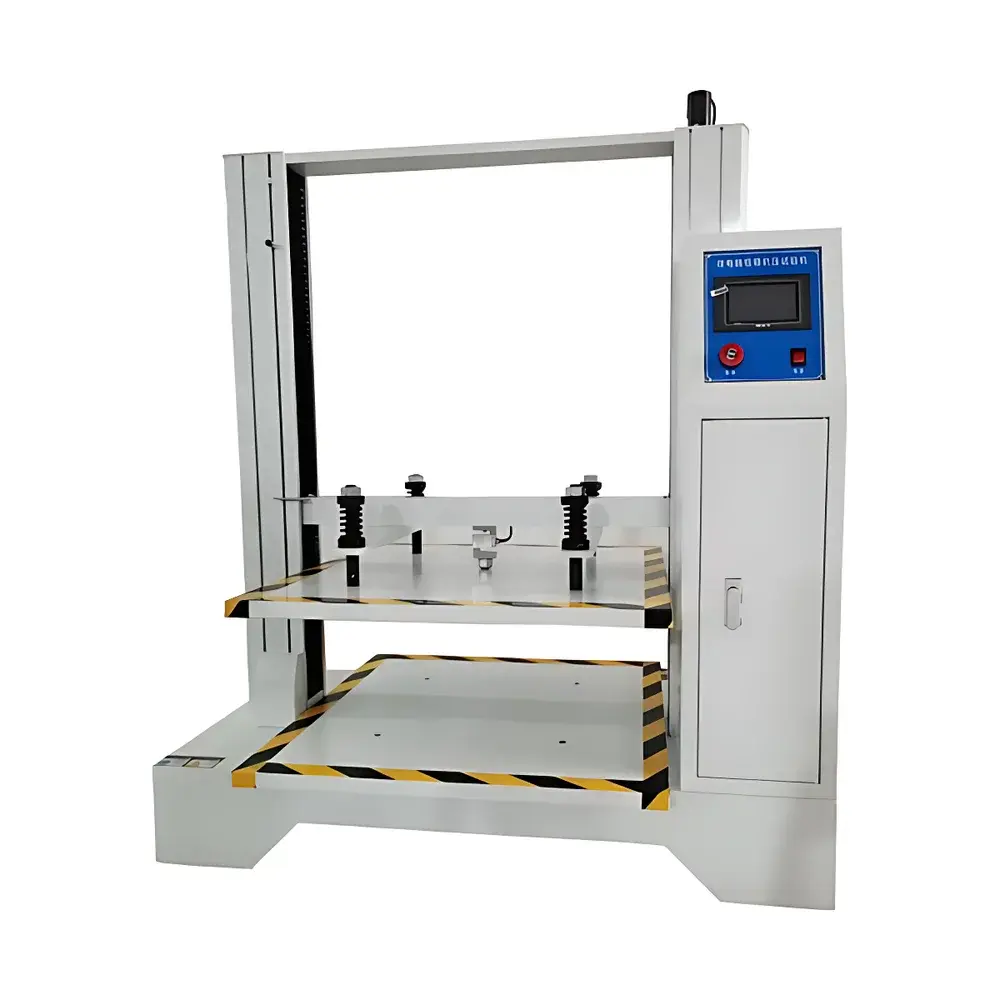
QINGTAO QT-KY01 Corrugated Box Compression Tester
| Brand | QINGTAO |
|---|---|
| Origin | Zhejiang, China |
| Manufacturer Type | Direct Manufacturer |
| Model | QT-KY01 |
| Max Test Load | 2000 kgf |
| Accuracy Class | Class 1 (per GB/T 16491 / ISO 7500-1) |
| Force Measurement Range | 0.4–100% FS |
| Force Accuracy | ±1% of reading |
| Force Resolution | 1/200,000 |
| Displacement Accuracy | ±1% of reading |
| Displacement Resolution | 0.05 mm |
| Test Speed Range | 10–300 mm/min |
| Speed Accuracy | ±1% of set value |
| Test Chamber Dimensions (optional) | 600×600×600 mm, 800×800×800 mm, 1000×1000×1000 mm, 1200×1200×1200 mm, or 1500×1500×1500 mm |
| Control System | Embedded microcomputer with optional industrial touchscreen interface |
| Drive System | Gearmotor + frequency inverter |
| Motor Power | 0.75 kW |
| Compliance Standards | ISO 2872, ISO 2874, TAPPI T 804, JIS Z 0212, NF H3 001, CNS 2236 / 3511, QB/T 1048 |
Overview
The QINGTAO QT-KY01 Corrugated Box Compression Tester is an electromechanical compression testing system engineered for precise evaluation of compressive performance in corrugated fiberboard packaging—specifically designed to quantify maximum crush resistance (peak load), deformation behavior under static and quasi-static loading, and long-term stacking stability. It operates on the principle of controlled axial compression between two parallel platens, applying calibrated force while continuously monitoring load-displacement response via high-fidelity transduction. The system complies with internationally recognized standards for packaging mechanical testing, including ISO 2872 (compression testing of complete boxes), ISO 2874 (stacking strength determination), TAPPI T 804 (ring crush test for linerboard and medium), and JIS Z 0212 (compressive strength of corrugated boxes). Its architecture integrates a Class 1 accuracy load cell (0.5-class sensor per GB/T 16491), full-range automatic gain amplification, and closed-loop speed regulation—enabling repeatable, traceable, and auditable test execution suitable for QC laboratories operating under GLP or internal quality management systems.
Key Features
- High-stability dual-column frame with reinforced steel construction ensures minimal deflection during high-load compression (up to 2000 kgf), maintaining platen parallelism within <0.05 mm/m across full travel.
- Intel-based embedded controller with real-time firmware enables deterministic test sequencing, eliminating latency in trigger response and data capture.
- Four standardized test modes: constant-rate compression, constant-force deformation tracking, peak crush force measurement, and simulated stack-load endurance testing with programmable dwell time and load ramp profiles.
- Industrial-grade gearmotor drive coupled with vector-controlled frequency inverter delivers smooth, low-noise motion across the full speed range (10–300 mm/min), with speed stability maintained within ±1% of setpoint.
- Optional 10.1-inch resistive touchscreen HMI provides intuitive operator interface, local test parameter configuration, real-time curve visualization, and on-device report generation (PDF/CSV).
- Dual-layer safety architecture includes mechanical limit switches, electronic overload cutoff (>110% FS), and integrated RCD protection—fully compliant with IEC 61000-6-2 EMC and IEC 61000-6-4 emission requirements.
Sample Compatibility & Compliance
The QT-KY01 accommodates standard and custom-sized corrugated containers—including regular slotted containers (RSC), half-slotted containers (HSC), die-cut displays, and honeycomb board assemblies—within configurable test chamber volumes (600 mm to 1500 mm cubed). Its platen surface (standard 300 × 300 mm, optional up to 1600 × 1600 mm) features replaceable wear-resistant stainless-steel inserts to prevent indentation-induced measurement drift. All calibration and verification procedures align with ISO/IEC 17025 technical requirements for mechanical testing laboratories. The system supports traceable calibration using NIST-traceable deadweight standards, and its force channel meets ISO 7500-1 Class 1 verification criteria. Test reports include metadata required for regulatory submissions under FDA 21 CFR Part 11 when paired with validated software add-ons (available upon request).
Software & Data Management
The proprietary QINGTAO TestSuite™ software (v4.2+) runs on Windows OS and provides full control over test setup, real-time acquisition at ≥100 Hz sampling rate, and post-test analysis including elastic modulus calculation, yield point detection, and creep compliance modeling. Data export conforms to ASTM E1434-22 formatting guidelines and supports direct integration into LIMS platforms via ODBC drivers. Audit trail functionality records all user actions—including method edits, calibration events, and result approvals—with timestamped digital signatures. Raw data files (.qtd) are encrypted and retain native resolution (24-bit ADC), ensuring integrity for reanalysis or third-party validation.
Applications
- Validation of box design performance against distribution environment simulations (e.g., warehouse stacking, palletized transport).
- Quality conformance testing of incoming corrugated board stock per TAPPI T 810 (edge crush test) and TAPPI T 825 (flat crush test) correlation protocols.
- Supplier qualification audits requiring documented evidence of compression strength consistency across production lots.
- Root cause analysis of field failures related to compression collapse, corner buckling, or flute deformation under sustained load.
- Development of predictive models linking raw material properties (e.g., ring crush index, burst strength) to finished-box performance.
FAQ
Does the QT-KY01 support automated calibration verification?
Yes—the system includes built-in self-diagnostic routines for zero-point drift detection and linearity verification using internal reference signals; external calibration with certified weights remains required annually per ISO/IEC 17025.
Can test methods be password-protected to prevent unauthorized modification?
Yes—software supports multi-level user roles (Operator, Technician, Administrator) with granular permissions for method editing, report approval, and system configuration.
Is the displacement measurement traceable to national metrology institutes?
Displacement sensors are factory-calibrated against laser interferometer references; certificate of calibration includes uncertainty budget per GUM (JCGM 100:2008).
What maintenance intervals are recommended for long-term accuracy retention?
Gearmotor lubrication every 2,000 operational hours; load cell and encoder recalibration every 12 months or after 10,000 test cycles—whichever occurs first.
Are custom platen geometries available for non-rectangular samples?
Yes—custom contoured platens, vacuum-assisted fixtures, and edge-support jigs can be supplied under engineering consultation (lead time: 6–8 weeks).






