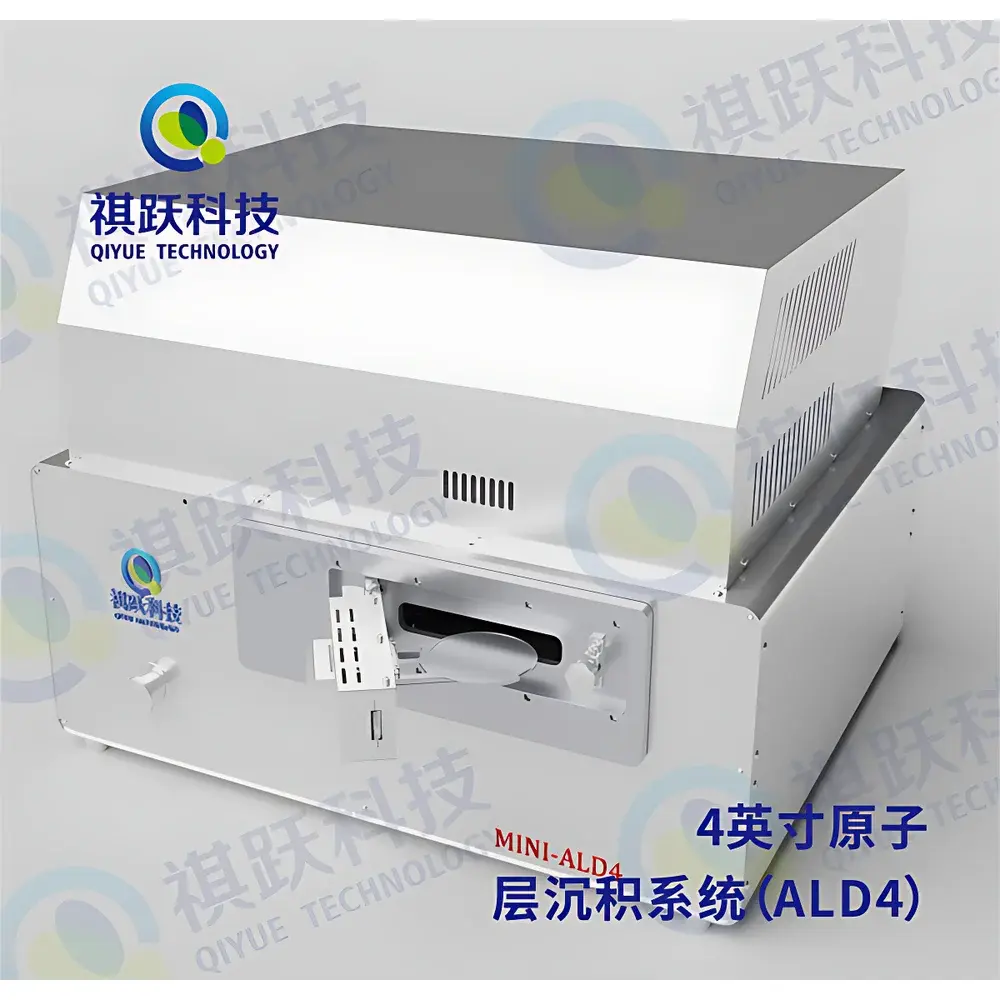
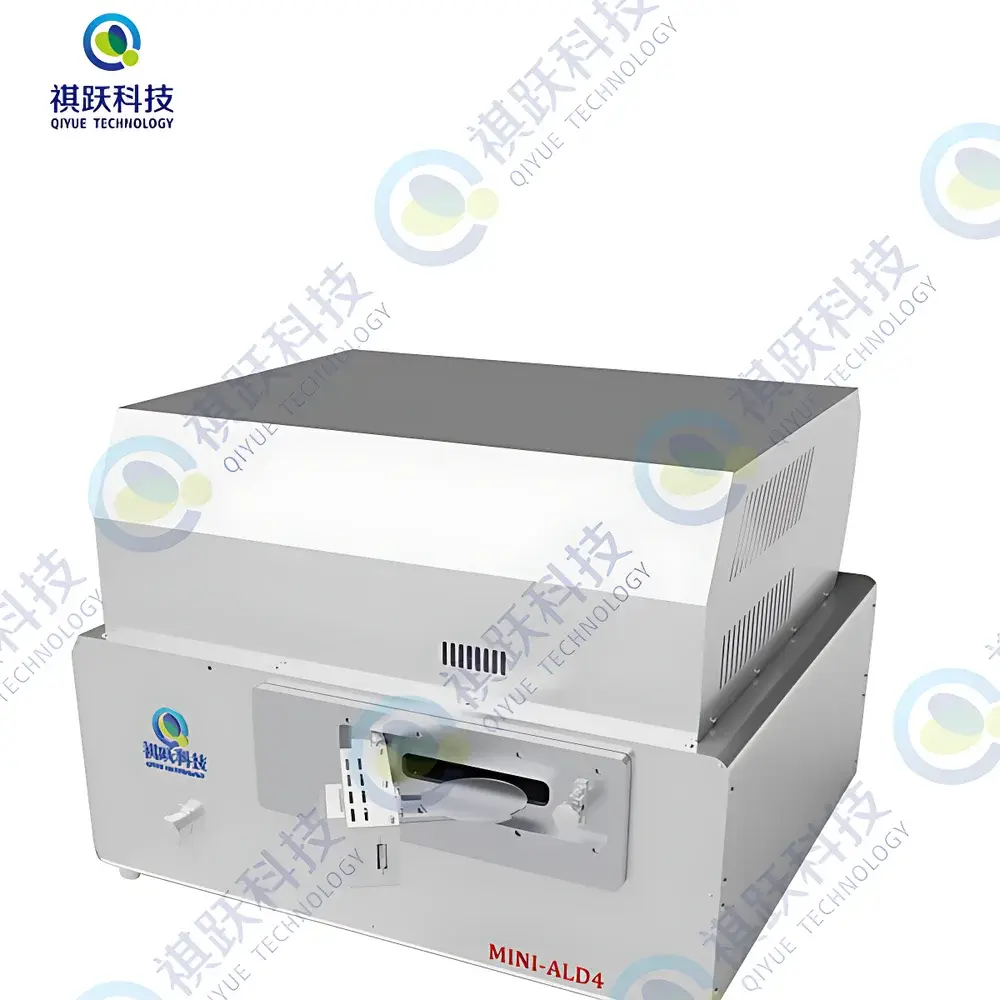
Qiyue Technology MINI-ALD4 4-Inch Atomic Layer Deposition System
| Brand | Qiyue Technology |
|---|---|
| Origin | Zhejiang, China |
| Manufacturer Type | Authorized Distributor |
| Country of Origin | China |
| Model | MINI-ALD4 |
| Substrate Size | Up to 100 mm (4-inch) wafers |
| Chamber Architecture | Dual-chamber (reaction + load-lock) |
| Heating System | Radiant heating with high temperature uniformity |
| Gas Delivery | Optimized laminar flow path with precursor bottle heating, heated transfer lines, and adjustable pulsing sequence |
| Optional Modules | Plasma source, powder ALD module, ozone generator |
| Film Compatibility | Metal oxides (e.g., Al₂O₃, HfO₂, TiO₂), nitrides (e.g., TiN, TaN), pure metals (e.g., Pt, Ru), and doped compounds |
Overview
The Qiyue Technology MINI-ALD4 is a compact, research-grade atomic layer deposition (ALD) system engineered for precise, self-limiting thin-film synthesis on substrates up to 100 mm (4-inch) in diameter. Based on the fundamental principles of sequential surface reaction chemistry—where gaseous precursors are introduced in alternating, non-overlapping pulses—the MINI-ALD4 enables sub-nanometer thickness control, exceptional conformality, and atomic-scale uniformity across complex topographies. Its dual-chamber architecture separates the reaction zone from the load-lock environment, minimizing contamination risk and enabling rapid sample exchange without breaking vacuum. The system employs radiant heating with active thermal zoning to achieve ±1.5 °C temperature uniformity across the substrate holder—a critical requirement for reproducible nucleation kinetics and stoichiometric film growth. Designed for academic labs, R&D centers, and pilot-line process development, the MINI-ALD4 bridges the gap between benchtop feasibility studies and scalable thin-film fabrication.
Key Features
- Dual-chamber configuration with independent pressure control: reaction chamber (base pressure ≤5×10⁻⁷ mbar) and load-lock chamber (pump-down time <90 s)
- Radiant heating system with real-time thermocouple feedback and PID-controlled zoning for uniform thermal distribution (operating range: 50–400 °C)
- Optimized gas delivery manifold featuring heated precursor bottles (up to 120 °C), fully heated stainless-steel transfer lines (up to 150 °C), and programmable pulse/purge timing (pulse duration: 0.1–10 s; purge time: 1–60 s)
- Integrated mass flow controllers (MFCs) with ±1% full-scale accuracy for precise precursor dosing
- Modular expansion capability: optional RF plasma source (13.56 MHz, up to 300 W), fluidized-bed powder ALD adapter, and ozone generator (10–20 wt% O₃ in O₂) for low-temperature oxidation
- Full automation via touchscreen HMI and Ethernet-enabled PLC, supporting recipe-based operation with event logging and interlock monitoring
Sample Compatibility & Compliance
The MINI-ALD4 accommodates standard 100 mm silicon, quartz, sapphire, or SOI wafers, as well as diced chips, TEM grids, and custom-shaped substrates up to 110 mm in diagonal dimension. Its laminar-flow-enhanced precursor transport ensures >95% step coverage on trench structures with aspect ratios exceeding 20:1—validated using cross-sectional SEM and XRF depth profiling. The system complies with CE machinery directives (2006/42/EC) and electromagnetic compatibility standards (2014/30/EU). All software operations adhere to ALD-specific GLP documentation requirements, including electronic signature support, audit trail generation (per FDA 21 CFR Part 11), and user-access-level management (admin/operator/guest). Process logs—including temperature ramp profiles, pulse sequences, chamber pressures, and MFC setpoints—are timestamped and exportable in CSV/JSON formats for traceability.
Software & Data Management
Control is managed through Qiyue’s proprietary ALDStudio™ v3.2 software, a Windows-based platform offering graphical recipe builder, real-time parameter visualization (including chamber pressure transients and heater power draw), and automated endpoint detection via in-situ quartz crystal microbalance (QCM) integration (optional). The software supports batch processing of multi-step recipes, conditional branching (e.g., “if pressure >5×10⁻⁵ mbar, extend purge time by 2 s”), and remote monitoring via secure HTTPS interface. All operational data—including alarm history, maintenance intervals, and calibration records—are stored in an embedded SQLite database with automatic daily backup to network-attached storage (NAS). Export functions comply with ASTM E1447-21 (Standard Practice for Data Exchange in Thin-Film Characterization) and enable direct import into MATLAB, Python (via Pandas), or JMP for statistical process control (SPC) analysis.
Applications
The MINI-ALD4 serves as a foundational tool for exploratory and applied research in semiconductor process integration, MEMS packaging, solid-state battery interface engineering, and heterogeneous catalysis. Typical use cases include: atomic-scale passivation of GaN HEMT gate recesses; conformal Al₂O₃ encapsulation of perovskite solar cell stacks; ultrathin LiPON electrolyte layers for microbatteries; functionalized metal–organic framework (MOF) coatings on nanoporous membranes; and graded dielectric stacks for ferroelectric memory capacitors. Its compatibility with in-situ ellipsometry (via viewport integration) and ex-situ XPS/XRD correlation makes it suitable for kinetic studies of nucleation delay, island coalescence, and interfacial interdiffusion under controlled thermal budgets.
FAQ
What vacuum level does the MINI-ALD4 achieve in the reaction chamber?
Base pressure is ≤5×10⁻⁷ mbar with turbomolecular pumping; typical operating pressure during precursor pulses is 1–10×10⁻³ mbar.
Can the system deposit films on high-aspect-ratio nanostructures such as vertical nanowires or deep trenches?
Yes—validated conformality exceeds 92% on Si trenches with 15:1 aspect ratio and 500 nm pitch, measured by TEM cross-section and energy-dispersive X-ray line scans.
Is remote operation supported, and what cybersecurity protocols are implemented?
Remote access is enabled via TLS 1.2-encrypted web interface with role-based authentication; no default credentials, mandatory password rotation every 90 days, and disabled FTP/Telnet services.
Does the system meet ISO/IEC 17025 requirements for accredited calibration laboratories?
While not certified out-of-box, the MINI-ALD4 provides full metrological traceability paths for temperature (NIST-traceable thermocouples), pressure (EN 61241-0 compliant gauges), and flow (ISO 6358-compliant MFCs), facilitating third-party accreditation.
What is the mean time between failures (MTBF) for critical subsystems?
Reported MTBF exceeds 12,000 hours for heating zones, 8,500 hours for vacuum valves, and 6,000 hours for MFC assemblies—based on field data from 32 installed units across 14 institutions (2021–2024).