
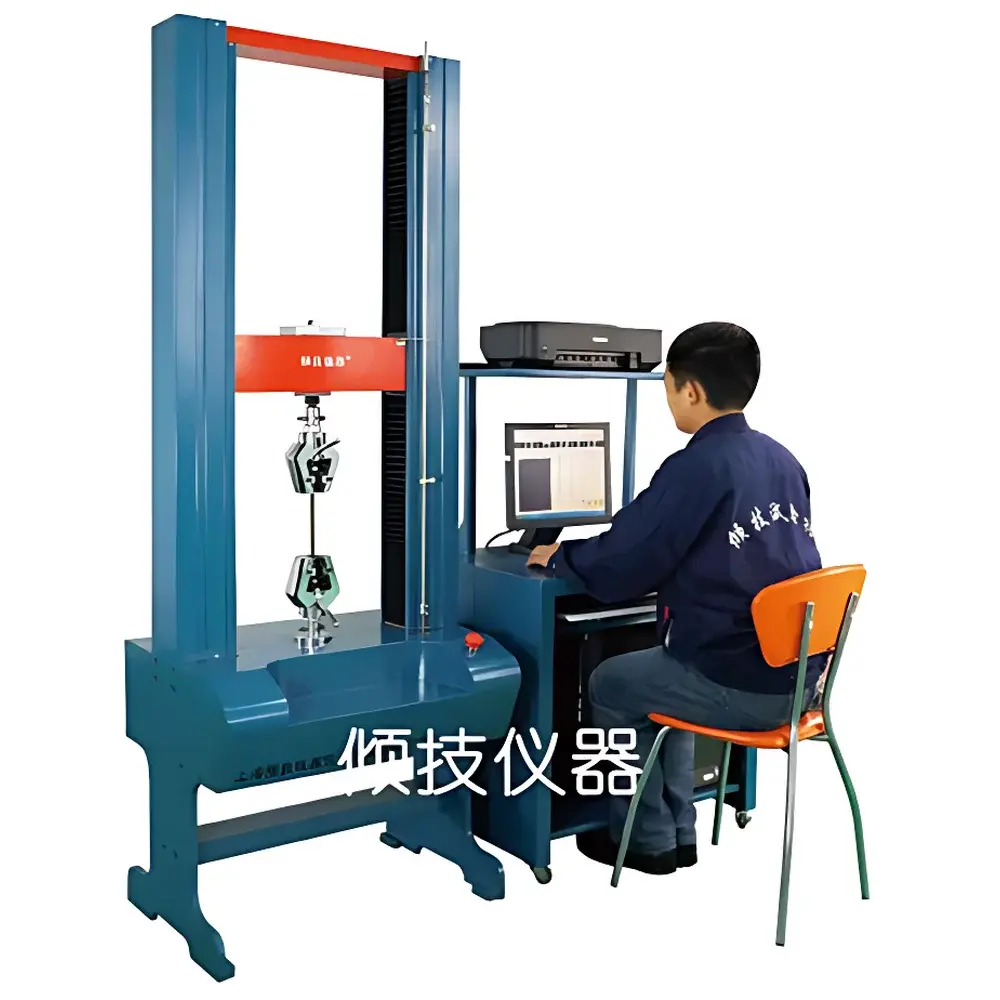
QJ210F Qingji Fully Automated Connector Insertion and Extraction Tester
| Brand | Qingji |
|---|---|
| Origin | Shanghai, China |
| Manufacturer Type | Authorized Distributor |
| Country of Origin | China |
| Model | QJ210F |
| Price | USD 9,450 (FOB Shanghai) |
| Test Speed | 0–500 mm/min |
| Max Test Height | 150 mm |
| Displacement Measurement Accuracy | ±1% of reading |
| Minimum Micrometer Adjustment | 0.01 mm |
Overview
The QJ210F Qingji Fully Automated Connector Insertion and Extraction Tester is an electromechanical precision testing system engineered for quantitative evaluation of mechanical engagement and disengagement forces in electrical and electronic connectors. It operates on a servo-controlled linear actuation principle, applying controlled axial displacement to simulate real-world mating and unmating cycles under programmable speed, load, and positional constraints. Designed for R&D labs, quality assurance departments, and connector manufacturing facilities, the system complies with fundamental mechanical test methodologies referenced in IEC 60512-2-1 (electrical testing of connectors), IPC-TM-650 2.5.3 (insertion/extraction force measurement), and ISO/IEC 17025-accredited laboratory practice requirements. Its closed-loop force-displacement acquisition architecture enables traceable, repeatable characterization of insertion peak force, steady-state retention force, extraction hysteresis, and cycle-to-cycle degradation trends—critical parameters for validating connector reliability, durability, and compliance with OEM design specifications.
Key Features
- Fully automated bidirectional testing sequence: programmable insertion → dwell → extraction → return, with user-defined dwell time and endpoint criteria
- Integrated self-centering alignment mechanism ensures coaxial loading during plug-in/out operations, minimizing lateral torque and preventing skew-induced measurement error
- High-resolution load cell with overload protection (±0.5% FS linearity, 1/10,000 internal resolution) coupled with optical encoder-based displacement feedback (0.01 mm minimum step resolution)
- Windows-based control software with native Chinese/English bilingual UI, supporting multi-language report generation and audit-ready data export (CSV, PDF, XML)
- Real-time synchronized force–displacement curve visualization with dynamic zoom, annotation, and overlay comparison across up to 8 test records
- Modular fixture interface compliant with ISO 2768-mK general tolerances, enabling rapid adaptation to USB-C, HDMI, PCIe, M.2, FPC, and custom board-to-board connector geometries
Sample Compatibility & Compliance
The QJ210F accommodates standard and custom connector housings with maximum height ≤150 mm and width ≤80 mm. Fixture adaptability supports vertical, horizontal, and angled insertion orientations via adjustable mounting plates and kinematic clamping. All test protocols are configurable to meet functional verification requirements outlined in USCAR-2, GMW3172, and MIL-STD-883H Method 2011. The system’s data acquisition firmware implements timestamped event logging with embedded metadata (operator ID, environmental temperature/humidity if externally linked, calibration certificate expiry), satisfying documentation traceability expectations under ISO 9001:2015 Clause 8.5.2 and FDA 21 CFR Part 11 (when deployed with optional electronic signature module and secure user role management).
Software & Data Management
The proprietary Qingji TestMaster v4.2 software provides full lifecycle test management: from condition setup (speed ramp profiles, force thresholds, pass/fail logic trees) to post-test analytics (cycle count vs. peak force regression, statistical process control charts, Weibull life distribution fitting). Raw datasets retain full 1 kHz sampling fidelity and are stored in encrypted SQLite databases with SHA-256 checksums. Export options include GLP-compliant PDF reports with embedded digital signatures, CSV files compatible with JMP or Minitab, and XML schemas aligned with ASTM E1447-22 for inter-laboratory data exchange. Audit trail functionality logs all parameter modifications, user logins, and report generations with immutable timestamps—fully auditable during GMP or ISO/IEC 17025 assessments.
Applications
- Validation of insertion force limits per IPC-2221B Class A/B/C design rules for high-density PCB assemblies
- Accelerated wear-life testing of automotive FAKRA and HSD connectors under thermal cycling (when integrated with environmental chamber)
- Comparative analysis of lubricant efficacy on nano-coated contact surfaces using force hysteresis metrics
- Design verification of latch mechanisms in consumer electronics enclosures (e.g., SIM card trays, battery compartments)
- Supplier qualification testing against contractual insertion/extraction force envelopes defined in APQP Stage 3 deliverables
- Root cause analysis of field failures linked to excessive mating resistance or premature contact separation
FAQ
Does the QJ210F support third-party calibration certificate traceability to NIM or NIST standards?
Yes—each unit ships with a factory calibration certificate traceable to China National Institute of Metrology (NIM), and optional UKAS-accredited recalibration services are available through authorized Qingji service partners.
Can the system perform continuous cyclic testing beyond 100,000 insertions?
Yes—the mechanical drivetrain and load cell are rated for ≥500,000 cycles at rated load; extended-life validation requires periodic verification of micrometer backlash and encoder linearity per maintenance schedule.
Is remote operation supported over Ethernet or industrial TCP/IP protocols?
Yes—TestMaster v4.2 includes OPC UA server capability for integration into MES/SCADA environments and supports secure remote desktop access via TLS-encrypted VNC for off-site technical support.
What safety certifications does the instrument carry?
The QJ210F complies with IEC 61010-1:2010 (Safety Requirements for Electrical Equipment for Measurement, Control, and Laboratory Use) and carries CE marking under the EU Low Voltage Directive 2014/35/EU.
How is firmware updated, and is version history maintained?
Firmware updates are delivered via signed .bin packages through the software’s built-in updater; all versions are archived in the local database with MD5 hash verification and rollback capability.



