
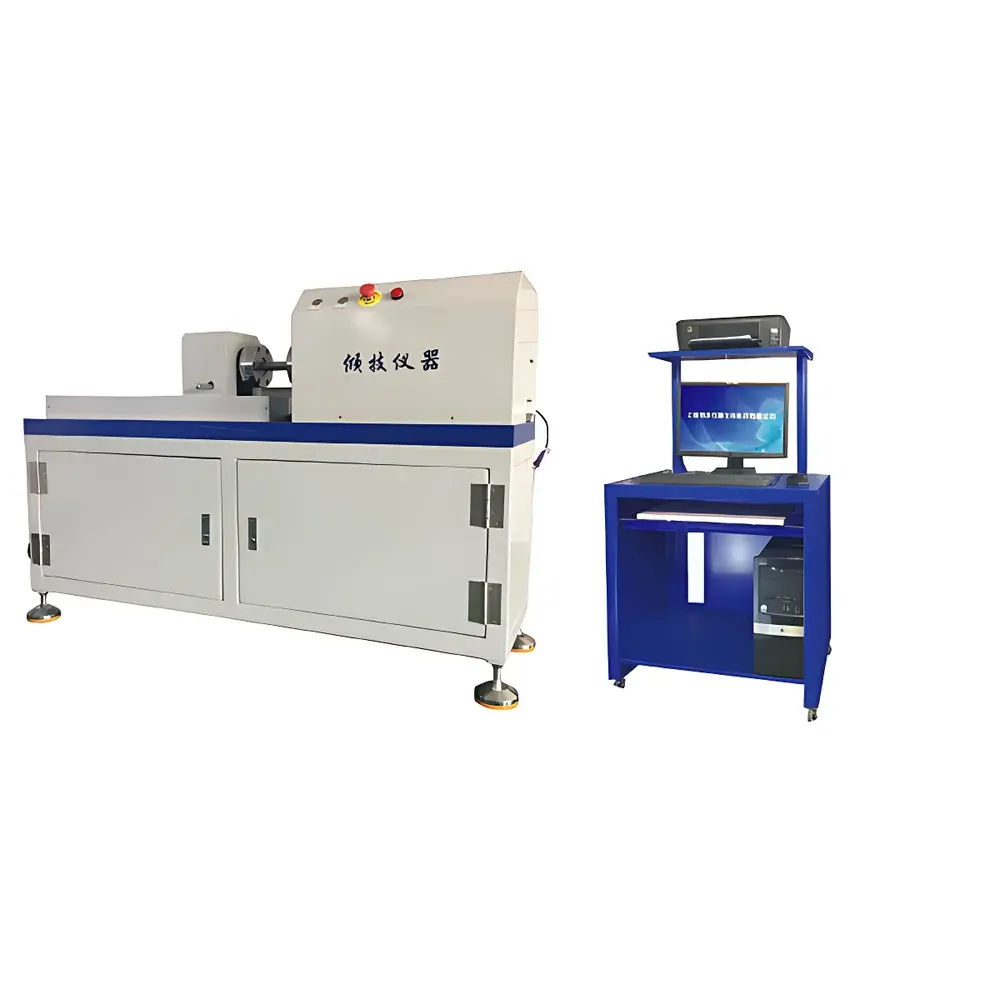
QJNZ Microcomputer-Controlled Torsion Testing Machine
| Origin | Shanghai, China |
|---|---|
| Manufacturer Type | Authorized Distributor |
| Origin Category | Domestic (PRC) |
| Model | QJNZ |
| Price | USD 9,400 (FOB Shanghai) |
| Max Torque Capacity | 0–10,000 N·m |
| Torque Measurement Range | 50–5,000 N·m |
| Torque Resolution | 1/350,000 full scale (no range switching) |
| Torsion Angle Measurement Range | 0° to ±100,000° (4-digit digital display) |
| Angular Resolution | ±0.001° |
| Angular Accuracy | ±0.009° |
| Torsion Speed Range | 0.01–1,000 °/min (infinitely variable) |
| Speed Accuracy | ±0.2% of indicated value |
| Torque Measurement Uncertainty | ±0.5% FS |
| Angular Measurement Uncertainty | ±0.5% FS |
| Gauge Length Adjustment | 1,500 mm (adjustable) |
| Specimen Clamping Diameter Range | Φ8–Φ40 mm (expandable with optional fixtures) |
| Motor Power | 150 kW |
| Overall Dimensions (L×W×H) | 2800 × 4700 × 1250 mm |
| Net Weight | 1,500 kg |
Overview
The QJNZ Microcomputer-Controlled Torsion Testing Machine is a high-capacity, precision-engineered electromechanical system designed for static and quasi-static torsional characterization of metallic and non-metallic materials, structural components, and engineered fasteners. It operates on the principle of controlled angular displacement under applied torque, enabling direct determination of torsional yield strength, ultimate torsional strength, shear modulus (G), non-proportional torque (Tp), and torsional stiffness. The machine complies with core national and metrological standards including GB/T 9370–1999 (Methods for Torsion Testing of Metallic Materials), JJG 269–1981 (Verification Regulation for Torque Measuring Instruments), and GB/T 239–1999 (Torsion Testing Methods for Wires). Its architecture integrates a high-inertia servo-motor drive, dual-channel high-resolution optical encoders, and a load-cell-based torque transducer calibrated traceably to national metrology institutes—ensuring long-term measurement stability and repeatability in compliance with ISO/IEC 17025 requirements for testing laboratories.
Key Features
- Full-scale torque capacity up to 10,000 N·m with resolution of 1/350,000 — maintained uniformly across the entire measurement range without manual range switching.
- Precision angular measurement system featuring ±0.001° resolution and ±0.009° absolute accuracy over a dynamic range of ±100,000°, supported by quadrature-encoded rotary encoders.
- Infinitely variable torsion speed control from 0.01 to 1,000 °/min, with speed regulation accuracy within ±0.2% of setpoint — critical for creep, stress-relaxation, and rate-dependent material studies.
- Rigid C-frame structural design with 1,500 mm adjustable gauge length and interchangeable hydraulic or mechanical wedge-type chucks accommodating specimens from Φ8 mm to Φ40 mm (extendable via custom fixtures).
- Integrated 150 kW servo drive system delivering high torque density and low-speed stability, minimizing thermal drift during extended dwell tests.
- Real-time closed-loop control architecture supporting torque-, angle-, and speed-controlled test modes with automatic mode switching and seamless transition between control variables.
Sample Compatibility & Compliance
The QJNZ system accommodates solid rods, hollow tubes, shafts, bolts, weldments, composite laminates, and polymer extrusions. Standard clamping fixtures support cylindrical cross-sections; optional flat-grip, spline, or threaded-end adapters enable testing of non-circular or asymmetric geometries. All mechanical and electrical subsystems conform to IEC 61000-6-2 (EMC immunity) and IEC 61000-6-4 (EMC emissions). Calibration documentation includes as-found/as-left reports traceable to CNAS-accredited standards. The system supports GLP-compliant operation when configured with audit-trail-enabled software and user-access controls — meeting foundational requirements for ISO 17025, ASTM E251, and EN 10002-3 environments.
Software & Data Management
The proprietary torsion test software implements virtual instrumentation principles using LabVIEW-based real-time acquisition and deterministic control loops. It provides synchronized acquisition of torque, angular displacement, rotational speed, and elapsed time at up to 1 kHz sampling rate. Data processing modules compute shear modulus (G), proportional limit torque, torsional yield point (via 0.2% offset method), and energy absorption (area under torque-angle curve). Reports are exportable in PDF, Excel, and XML formats with embedded metadata (operator ID, calibration date, environmental conditions). Optional 21 CFR Part 11 compliance package includes electronic signatures, role-based access, and immutable audit trails for regulated QA/QC labs.
Applications
- Determination of torsional yield and ultimate strength per ASTM A938 and ISO 7800 for automotive axles, drive shafts, and transmission components.
- Shear modulus (G) evaluation of metallic alloys, titanium grades, and high-strength steels used in aerospace structures.
- Quality assurance testing of threaded fasteners (bolts, studs) per ISO 898-1 and SAE J429, including proof torque and prevailing torque analysis.
- Mechanical characterization of biomedical implants (e.g., spinal rods, intramedullary nails) under torsional loading per ISO 5832-3 and ASTM F2503.
- Validation of torsional fatigue pre-characterization data for subsequent servo-hydraulic spectrum testing.
- Educational use in university materials science laboratories for hands-on demonstration of Hooke’s law in shear and Saint-Venant’s torsion theory.
FAQ
What standards does the QJNZ torsion tester comply with?
It meets GB/T 9370–1999, GB/T 239–1999, JJG 269–1981, and is compatible with ASTM A938, ISO 7800, ISO 898-1, and EN 10002-3 test protocols.
Can the system perform torsional fatigue testing?
No — this is a static/quasi-static torsion tester. For cyclic torsion, a dedicated servo-hydraulic torsional fatigue system is required.
Is torque calibration traceable to national standards?
Yes — factory calibration certificates include uncertainty budgets and traceability to CNAS-accredited torque standards (NIM reference standards).
What is the recommended maintenance interval?
Preventive maintenance is advised every 1,000 operational hours or annually, whichever occurs first; includes encoder alignment verification, chuck lubrication, and drive system thermal inspection.
Does the system support third-party software integration?
Yes — DLL-based API and TCP/IP communication protocol allow integration with MATLAB, Python (via PySerial), or enterprise LIMS platforms.



