
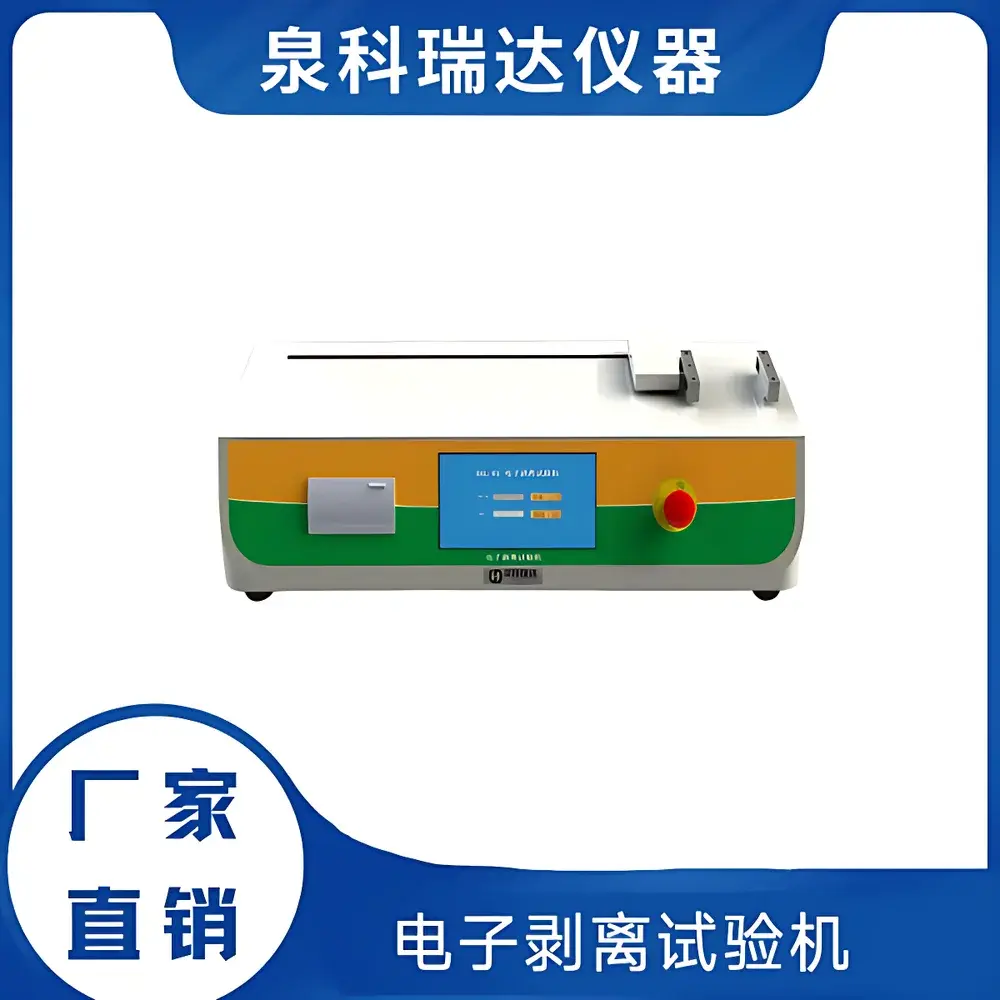
QKtester BLD-200N Digital Peel Adhesion Tester
| Brand | QKtester |
|---|---|
| Origin | Shandong, China |
| Manufacturer Type | Direct Manufacturer |
| Model | BLD-200N |
| Test Force Range | 0–200 N (full scale) |
| Force Accuracy | ±0.1% FS |
| Peel Speed | 10–500 mm/min (adjustable) |
| Displacement Resolution | 0.01 mm |
| Display | 7-inch color TFT touchscreen |
| Compliance | ASTM D3330, ASTM D903, ISO 8510-2, ISO 298-2, GB/T 2792 |
| Safety Features | Emergency stop, overload protection, mechanical limit switches |
| Data Output | USB, RS232, optional Ethernet |
| Software | QK-Adhesion v3.2 (GLP-compliant audit trail, report export to PDF/Excel) |
Overview
The QKtester BLD-200N Digital Peel Adhesion Tester is an electromechanical testing system engineered for precise quantification of interfacial adhesion strength in pressure-sensitive adhesives, labels, tapes, laminates, and coated films. It operates on the fundamental principle of controlled tensile separation—applying a defined peel angle (180°, 90°, or T-peel) at a constant velocity while measuring the instantaneous force required to progressively separate two bonded substrates. The instrument conforms to standardized peel geometry and kinematic constraints specified in ASTM D3330 (peel adhesion of pressure-sensitive tape), ASTM D903 (peel resistance of adhesive bonds), ISO 8510-2 (adhesion of flexible materials—T-peel test), and ISO 298-2 (adhesive tape—determination of peel adhesion). Its modular load frame, high-stiffness crosshead guidance, and closed-loop servo control ensure minimal deflection and high reproducibility across repeated tests—critical for QC laboratories operating under ISO/IEC 17025 or pharmaceutical GMP environments.
Key Features
- High-fidelity load cell with ±0.1% full-scale accuracy and 1/10,000 internal resolution, calibrated traceable to NIST-equivalent national standards.
- Programmable peel speed range from 10 to 500 mm/min, adjustable in 1 mm/min increments; speed stability maintained within ±0.5% of setpoint during dynamic loading.
- Integrated 7-inch capacitive touchscreen interface with real-time force–displacement curve plotting, zero-point auto-compensation, and on-device statistical summary (max force, average peel force, standard deviation, CV%).
- Modular fixture system supporting interchangeable peel jigs: 180° fixed-angle arm, 90° vertical peel clamp, and dual-grip T-peel configuration—all precision-machined from anodized aluminum with hardened steel contact surfaces.
- Dual-mode operation: standalone mode via touchscreen or PC-controlled mode via QK-Adhesion v3.2 software with multi-user role management and electronic signature support.
- Comprehensive safety architecture including hardware-based emergency stop circuit, automatic motor cutoff at 110% overrange, and mechanical end-of-travel limit switches.
Sample Compatibility & Compliance
The BLD-200N accommodates specimens up to 150 mm wide and 300 mm long, with thicknesses ranging from 0.05 mm (thin PET film) to 3.0 mm (laminated carton board). Standard sample mounting utilizes pneumatic or manual wedge clamps with adjustable grip pressure (0–1.2 MPa), minimizing slippage for low-surface-energy substrates such as silicone-coated release liners or fluoropolymer films. All test methods align with regulatory expectations for adhesive validation: ASTM D3330 is routinely referenced in FDA-regulated labeling verification for medical device packaging; ISO 8510-2 supports automotive interior trim qualification per VW 60306; and GB/T 2792 forms the basis for domestic Chinese food packaging compliance. Instrument validation documentation includes IQ/OQ protocols compliant with Annex 11 and 21 CFR Part 11 requirements when used with the optional audit-trail-enabled software package.
Software & Data Management
QK-Adhesion v3.2 is a Windows-based application designed for regulated environments. It provides full ALCOA+ data integrity: attributable, legible, contemporaneous, original, accurate, complete, consistent, enduring, and available. Each test record includes embedded metadata—operator ID, timestamp, environmental temperature/humidity (via optional external sensor input), calibration certificate ID, and digital signature. Reports are generated in bilingual (English/Chinese) PDF format with customizable templates conforming to ISO 17025 Clause 7.8. Raw data exports support CSV, XLSX, and XML formats; historical datasets can be archived to network drives or cloud storage (AWS S3 or Azure Blob) via TLS 1.2–encrypted API endpoints. Version-controlled method files (.qkm) allow secure distribution of validated test protocols across multi-site manufacturing networks.
Applications
- Packaging Quality Assurance: Quantifying label-to-container adhesion on HDPE bottles, aluminum foil pouches, and corrugated shipping boxes under accelerated aging conditions (40°C/75% RH).
- Pharmaceutical Labeling: Verifying tamper-evident seal integrity and child-resistant label retention per USP <661> and EU Annex 15 guidelines.
- Electronics Assembly: Measuring peel resistance of thermal interface pads, EMI shielding tapes, and flex-circuit bonding films on FR-4 and polyimide substrates.
- Automotive Trim Validation: Assessing durability of decorative vinyl overlays and acoustic damping laminates after thermal cycling (-40°C to +85°C) and UV exposure.
- R&D Material Screening: Comparative evaluation of acrylic vs. rubber-based PSA formulations under variable peel angles and rates to model real-world delamination kinetics.
FAQ
What peel angles does the BLD-200N support?
The system natively supports 180°, 90°, and T-peel configurations via interchangeable mechanical fixtures—each aligned to within ±0.3° tolerance per ISO 298-2 Annex A.
Is the instrument suitable for GLP-compliant laboratories?
Yes—when equipped with QK-Adhesion v3.2 and enabled audit-trail functionality, it meets OECD GLP Principles (Section 5.2.2) and supports full traceability of raw data, operator actions, and calibration history.
Can the BLD-200N perform tensile or shear tests?
No—the BLD-200N is purpose-built for peel adhesion only. For multi-modal mechanical testing (tensile, compression, bend), QKtester offers the parallel-series QT-5000 universal tester platform.
How often does the load cell require recalibration?
Annual recalibration is recommended; however, daily verification using certified reference weights (included with shipment) satisfies ISO/IEC 17025 Clause 6.5.2 verification requirements.
Does the system comply with FDA 21 CFR Part 11?
Full compliance—including electronic signatures, audit trails, and role-based access control—is activated only when using QK-Adhesion v3.2 with licensed software modules and validated IT infrastructure.
Related Products



