
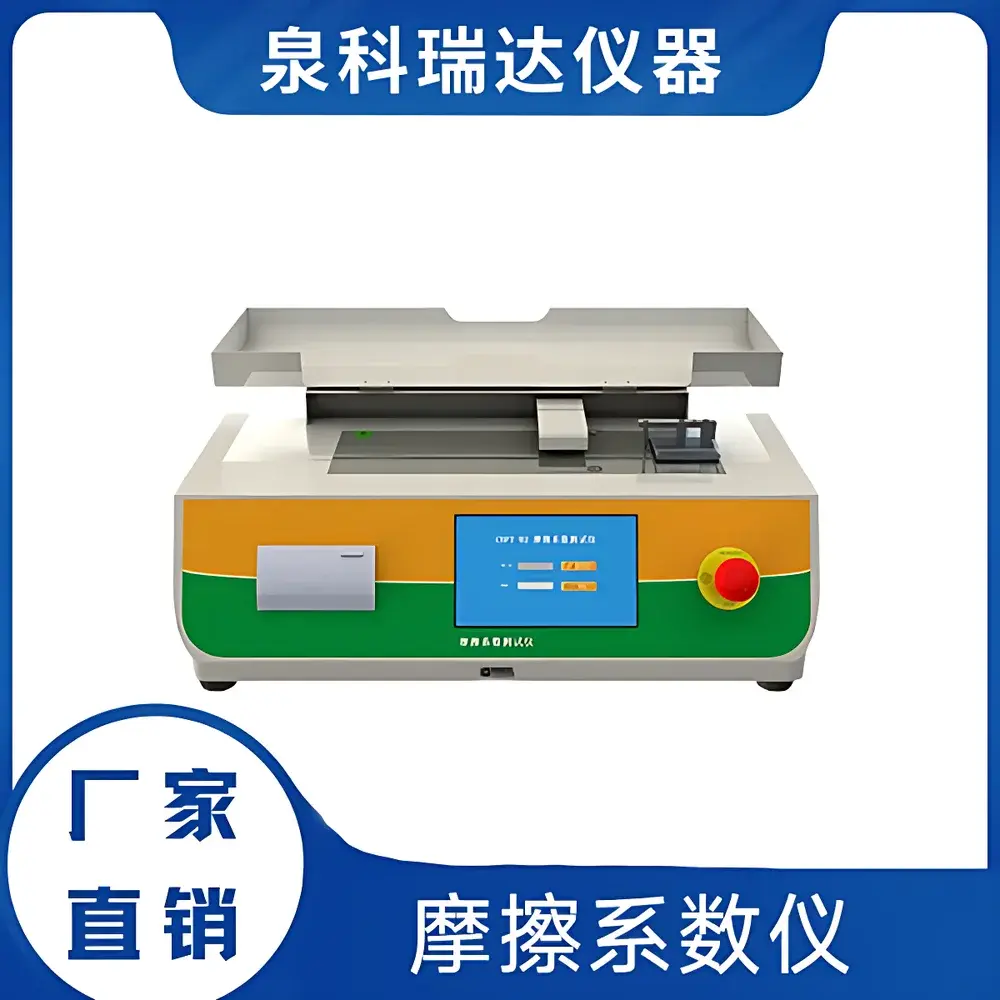
QKTester COFT_02 Coefficient of Friction Tester for Medical Gloves and Screen Protector Films
| Brand | QKTester |
|---|---|
| Model | COFT_02 |
| Origin | Shandong, China |
| Manufacturer Type | Direct Manufacturer |
| Compliance Standards | GB 10006–1988, ISO 8295, ASTM D1894 |
| Test Modes | Static & Kinetic CoF |
| Load Range | 0–50 N (typical) |
| Speed Range | 10–300 mm/min |
| Force Resolution | ≤0.01 N |
| Sample Stage | Horizontal Dual-Surface Fixture |
| Data Output | Real-time force-time curve, CoF values (μs/μk), pass/fail flagging |
| Interface | 7″ TFT LCD touchscreen with embedded test protocol library |
Overview
The QKTester COFT_02 Coefficient of Friction Tester is an engineered precision instrument designed for standardized measurement of static (μs) and kinetic (μk) coefficients of friction in thin, flexible sheet materials—specifically optimized for medical-grade rubber gloves, polymeric screen protector films, packaging laminates, and other planar elastomeric or coated substrates. Based on the horizontal plate–sled principle per ASTM D1894 and ISO 8295, the system applies controlled normal load via pneumatic or spring-loaded actuation while traversing a sled-mounted sample across a conditioned reference surface at defined velocity. The resulting tangential resistance force is captured continuously by a high-stability S-beam load cell, enabling real-time calculation of μ = Ft/Fn. This methodology ensures traceable, reproducible quantification essential for regulatory documentation, process validation, and material specification alignment in GMP-adjacent environments.
Key Features
- Compliant dual-mode operation: Simultaneous acquisition of both static breakaway force and sustained kinetic drag under programmable dwell time and ramp profiles.
- Modular sample fixture system: Interchangeable sled bases accommodate standard 63 × 63 mm glove cutouts (per GB 10006) or 25 × 50 mm film strips; clamping force adjustable to ±0.5 N repeatability.
- Embedded calibration traceability: Factory-calibrated load cell with NIST-traceable certificate; onboard zero-point auto-compensation and linearization algorithm.
- Automated test sequencing: Preloaded protocols for glove inner/outer surface testing, screen protector adhesion screening, and comparative laminate evaluation—reducing operator dependency and inter-lab variability.
- Rugged industrial enclosure: IP54-rated housing with anti-vibration damping base; designed for continuous operation in QC labs and production-floor environments.
Sample Compatibility & Compliance
The COFT_02 accommodates specimens ranging from 0.05 mm thick nitrile/polyisoprene glove membranes to 0.1–0.3 mm PET/TPU screen protectors, provided surface flatness deviation remains ≤5 µm over the contact zone. Reference surfaces include standardized stainless steel (Ra ≤ 0.2 µm), ground glass, and user-supplied counter-materials (e.g., surgical steel trays, smartphone display glass). All test routines adhere strictly to the procedural requirements of ISO 8295 (plastics—determination of coefficient of friction), ASTM D1894 (standard test method for coefficient of friction of plastic film and sheeting), and GB/T 10006–1988 (Chinese national standard for plastic film friction testing). Instrument validation documentation supports GLP audit readiness and aligns with FDA 21 CFR Part 11 data integrity expectations when paired with optional PC-based software logging.
Software & Data Management
The integrated 7-inch capacitive touchscreen runs firmware v3.2 with localized English UI, supporting multi-language label switching (EN/DE/ES/ZH). Test parameters—including normal load (1–30 N), traverse speed (10–300 mm/min), pre-load dwell (0.1–10 s), and data sampling rate (100 Hz)—are configurable per test sequence. Raw force-time datasets are stored internally (≥10,000 tests) with timestamp, operator ID, and environmental metadata (optional external hygrothermograph integration). USB export generates CSV files compatible with Excel, JMP, or Minitab for SPC charting. Optional QKLink PC Suite enables remote calibration management, audit trail generation (user actions, parameter changes, result exports), and automated report templating compliant with ISO/IEC 17025 clause 7.8.2.
Applications
- Medical Device Quality Assurance: Quantifying outer-surface μs ≥ 0.45 and inner-surface μk ≤ 0.25 for sterile surgical gloves—critical for preventing intraoperative slippage and donning-related tearing.
- Consumer Electronics Component Validation: Verifying tactile consistency of oleophobic-coated screen protectors across batch lots; detecting coating degradation after abrasion or alcohol wipe exposure.
- Packaging Development: Optimizing slip additives in PE/PP films used for blister packaging or pouch seals, where excessive friction impedes high-speed filling lines.
- Regulatory Submissions: Generating test evidence for ISO 13485 Clause 7.5.2 (production process validation) and USP <85> biocompatibility support data packages.
FAQ
Does the COFT_02 comply with FDA requirements for medical device testing?
Yes—while the instrument itself is not FDA-cleared, its measurement methodology and output data meet the technical rigor expected for design verification and process validation under 21 CFR Part 820. Full traceability documentation and calibration records support QSR compliance.
Can it test curved or textured glove surfaces?
No—it requires flat, tension-free specimen mounting. Curved glove fingers must be flattened and cut into standardized square sections prior to testing per GB 10006 Annex A.
Is third-party certification available for ISO/IEC 17025 accreditation?
Yes—QKTester provides optional UKAS-accredited calibration services through partner labs, including uncertainty budgeting per GUM guidelines.
What maintenance is required for long-term accuracy?
Biannual load cell verification using certified deadweights and annual mechanical inspection of sled rails and clamping mechanisms are recommended per manufacturer’s service manual.
How does temperature/humidity affect results?
Friction values for elastomers are humidity-sensitive; the COFT_02 does not control ambient conditions, so testing must occur in climate-stabilized labs (23 ± 2°C, 50 ± 5% RH) per ISO 291 conditioning requirements.





