
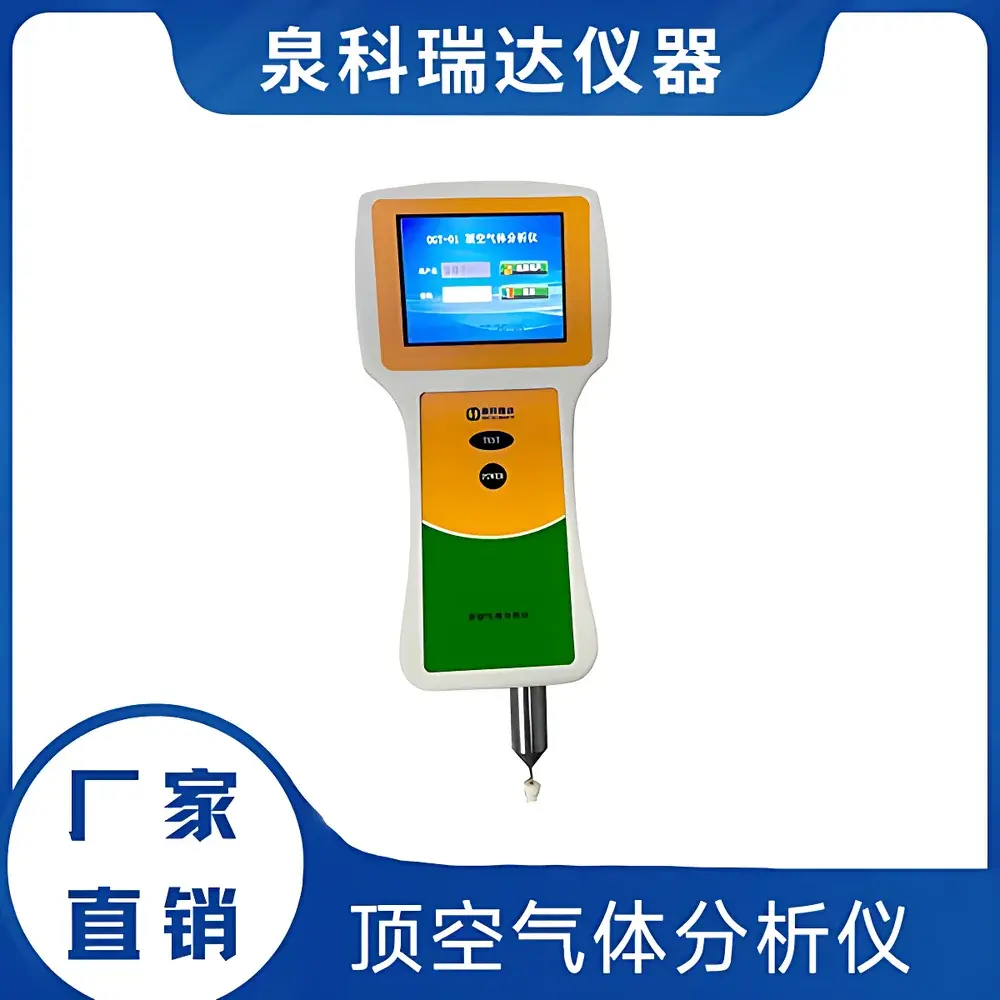
QKTester OGT-01 Portable Headspace Oxygen Analyzer for Lyophilized Vials
| Brand | QKTester |
|---|---|
| Model | OGT-01 |
| Origin | Shandong, China |
| Manufacturer | QKTester Instrument Co., Ltd. |
| Gas Measurement | O₂ (standard), CO₂ (optional) |
| Principle | Electrochemical sensor (O₂), NDIR (CO₂, optional) |
| Range | 0–100% O₂ |
| Resolution | 0.01% |
| Accuracy | ±0.2% O₂ |
| Sample Volume | <3 mL |
| Dimensions | 230 × 120 × 82 mm |
| Weight | 1 kg |
| Power | 220 VAC ±10%, 50 Hz / 120 VAC ±10%, 60 Hz |
| Data Storage | 1500 records |
| Display | Backlit LCD, bilingual (English/Chinese) |
| Interface | Built-in thermal printer |
| Compliance | Designed for ISO 8573-1, USP <1207>, ASTM F2476, and GMP-aligned environmental monitoring workflows |
Overview
The QKTester OGT-01 Portable Headspace Oxygen Analyzer is a dedicated laboratory and production-floor instrument engineered for quantitative determination of residual oxygen concentration in the headspace of sealed pharmaceutical vials—particularly lyophilized (freeze-dried) drug products packaged in borosilicate glass Westergren-type vials. Its operation relies on direct gas-phase sampling via vacuum-assisted needle puncture, followed by real-time electrochemical detection of molecular oxygen. For optional CO₂ analysis, a non-dispersive infrared (NDIR) sensor module is integrated, enabling dual-gas profiling under controlled sample draw conditions. This measurement principle conforms to the fundamental requirements of headspace gas analysis defined in USP <1207> “Packaging Integrity Evaluation” and supports risk-based assessment of container closure integrity (CCI) in sterile product manufacturing. The OGT-01 is not intended for continuous process monitoring but serves as a validated endpoint verification tool during stability studies, batch release testing, and packaging line qualification.
Key Features
- Handheld, compact architecture (230 × 120 × 82 mm; 1 kg) enables mobility across cleanroom zones, QC labs, and packaging lines without requiring fixed benchtop installation.
- Electrochemical O₂ sensor with 0–100% range, 0.01% resolution, and ±0.2% full-scale accuracy—calibrated per ISO 17025-accredited procedures using traceable NIST-certified gas standards.
- Optional NDIR-based CO₂ sensor module (order separately) provides orthogonal validation of inert gas flush efficiency in nitrogen-purged vials.
- Integrated micro-vacuum pump delivers consistent sub-3 mL headspace extraction at regulated flow rate, minimizing vial over-pressurization or membrane deformation.
- One-touch auto-calibration function reduces operator dependency; built-in zero and span verification routines support daily system suitability checks.
- Backlit 3.5-inch LCD interface with English/Chinese language toggle and intuitive icon-driven navigation—designed for use with nitrile gloves in ISO Class 5–7 environments.
- Quick-connect protective sleeve for sampling needle ensures operator safety and prevents accidental needlestick injuries during repeated vial punctures.
Sample Compatibility & Compliance
The OGT-01 is validated for use with standard 2R–30R serum vials (ISO 8362-1), including rubber stopper-sealed formats containing lyophilized biologics, antibiotics, and oncology injectables. It accommodates both aluminum-crimp and flip-off cap closures without modification. The instrument meets functional requirements outlined in ASTM F2476 (“Standard Test Method for Determination of Oxygen in the Headspace of Pharmaceutical Containers”) and aligns with data integrity expectations of FDA 21 CFR Part 11 when paired with optional PC-based software (QKSoft v3.2). All firmware logs include timestamped audit trails for test initiation, calibration events, and result export—supporting GLP/GMP documentation practices. Sensor modules are CE-marked and RoHS-compliant; device construction adheres to IEC 61010-1 for electrical safety in laboratory instrumentation.
Software & Data Management
Internal memory retains up to 1500 test records with full metadata: date/time stamp, vial ID (manually entered), O₂ %, CO₂ % (if enabled), operator code, and calibration status. Data export is supported via USB-C interface to CSV files compatible with LIMS integration. Optional QKSoft v3.2 software provides advanced features including trend charting across batches, statistical process control (SPC) limits definition, automated PDF report generation compliant with Annex 11 expectations, and electronic signature capture for release sign-off. All stored data are write-protected post-acquisition and cannot be edited without administrator-level authentication.
Applications
- Pharmaceutical Quality Control: Final batch release testing of lyophilized products to verify O₂ ≤ 1.0% (typical specification for oxidation-sensitive biologics).
- Stability Program Support: Monitoring headspace O₂ drift over accelerated and real-time storage conditions per ICH Q1 guidelines.
- Packaging Line Qualification: Correlating nitrogen purge parameters (flow rate, duration, pressure) with measured residual O₂ to define proven acceptable ranges (PARs).
- Container Closure Integrity (CCI) Screening: Detecting compromised seals via anomalous O₂ ingress during shelf-life studies.
- Food & Nutraceutical Packaging: Quantifying residual O₂ in modified atmosphere packaging (MAP) trays and pouches containing sensitive ingredients (e.g., omega-3 oils, probiotics).
- Biotech Process Development: Evaluating stopper selection (bromobutyl vs. chlorobutyl) and crimping force impact on headspace gas retention.
FAQ
What gases can the OGT-01 measure simultaneously?
The base configuration measures O₂ only. A factory-installed CO₂ sensor module may be added at time of order, enabling concurrent O₂ and CO₂ quantification in a single test cycle.
Is sensor recalibration required before each test?
No. The instrument performs automatic zero-point compensation during standby and includes a one-button span calibration routine using certified reference gases—typically performed once per shift or per batch, per internal SOP.
Can the OGT-01 be used with vials containing liquid formulations?
It is optimized for dry-powder or lyophilized cakes. Liquid-filled vials require specialized low-volume aspiration protocols to avoid liquid draw into the sensor chamber; contact QKTester Application Support for validated wet-headspace methodology.
Does the device meet regulatory requirements for audit trails?
Yes—when operated with QKSoft v3.2 and configured with user access controls, it satisfies ALCOA+ principles (Attributable, Legible, Contemporaneous, Original, Accurate) and supports 21 CFR Part 11 compliance for electronic records.
What is the expected service life of the O₂ sensor?
Under normal ambient storage and usage conditions (≤8 h/day exposure to air), the electrochemical sensor maintains specified accuracy for ≥24 months. QKTester recommends annual performance verification using certified gas standards.




