
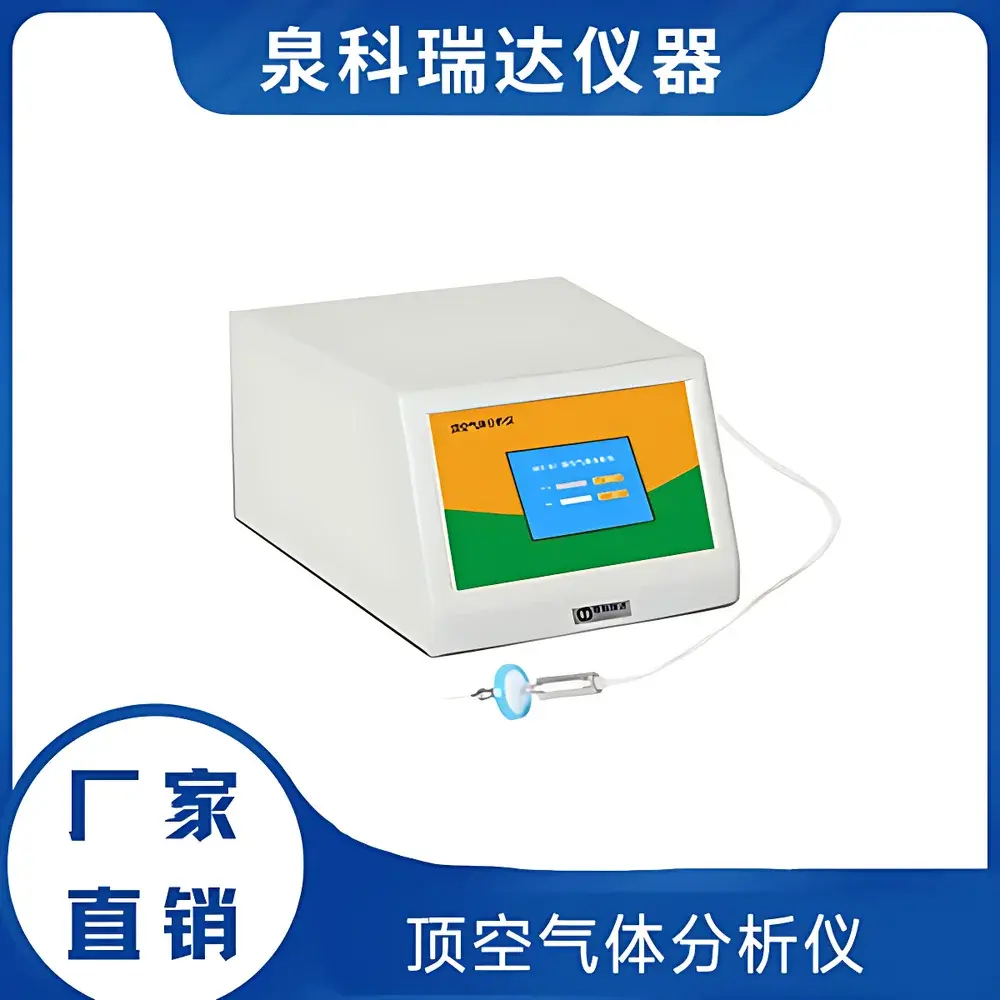
QKTester OGT-02 Benchtop Headspace Gas Analyzer for Residual Oxygen in Vials
| Brand | QKTester |
|---|---|
| Model | OGT-02 |
| Measurement Principle | Electrochemical (O₂), NDIR Infrared Absorption (CO₂, optional) |
| Gas Types | O₂ (standard), CO₂ (optional) |
| O₂ Range | 0–100% vol, Resolution: 0.01%, Accuracy: ±0.2% |
| CO₂ Range | 2–100% vol, Resolution: 0.01%, Accuracy: ±(0.03% + 5% of reading) |
| Sensor Lifetime | ~2 years (O₂), >15 years (CO₂) |
| Sample Volume | ≥6 mL (O₂), ≥20 mL (CO₂) |
| Power Supply | 220 VAC ±10%, 50 Hz |
| Dimensions | 350 × 310 × 220 mm |
| Weight | 3.2 kg |
| Compliance | Designed for GMP/GLP environments |
Overview
The QKTester OGT-02 Benchtop Headspace Gas Analyzer is an engineered solution for quantitative headspace gas analysis in sealed primary and secondary packaging—specifically optimized for residual oxygen (O₂) measurement in pharmaceutical vials (e.g., serum vials, lyophilized drug vials, and glass ampoules), as well as O₂ and carbon dioxide (CO₂) composition profiling in modified atmosphere packaging (MAP) used across food, dairy, nutraceutical, and biopharmaceutical supply chains. The instrument operates on dual-sensor principles: electrochemical detection for O₂ and non-dispersive infrared (NDIR) absorption spectroscopy for CO₂—enabling trace-level quantification with high specificity and minimal cross-sensitivity. Its benchtop architecture integrates a precision sampling pump, calibrated flow control, and real-time signal conditioning electronics to ensure consistent volumetric draw and stable sensor response under variable headspace pressures and temperature conditions. Unlike handheld or portable analyzers, the OGT-02 delivers laboratory-grade repeatability (RSD < 1.2% at 1% O₂) without requiring external calibration gases during routine operation—making it suitable for QC release testing, stability study monitoring, and process validation per ICH Q5C and USP <1207>.
Key Features
- Dual-sensor platform: Standard electrochemical O₂ sensor (2-year operational lifetime in ambient air) with optional factory-integrated NDIR CO₂ module (>15-year lifespan, no consumables)
- Benchtop form factor with integrated 5-inch capacitive touchscreen interface, supporting multi-level user authentication (four-tier access control: operator, supervisor, QA, administrator)
- Automated headspace extraction: Programmable vacuum-assisted sampling pump with adjustable draw volume (6–20 mL), pressure-compensated flow regulation, and real-time vacuum feedback
- GMP-ready data handling: Onboard memory stores ≥10,000 test records with timestamp, operator ID, sample ID, and environmental metadata; optional PC software enables full 21 CFR Part 11 compliance—including electronic signatures, audit trail logging, and role-based permissions
- Modular accessories: Quick-connect protective sleeve for sampling needle; submersible probe kit for liquid-immersed vial analysis; rigid-packaging puncture adapter for aluminum cans, PET bottles, and thermoformed trays
- Low TCO design: No carrier gases, zero reagents, and field-replaceable sensors reduce annual maintenance cost by >65% versus GC-based alternatives
Sample Compatibility & Compliance
The OGT-02 accommodates a broad spectrum of container geometries and closure systems—including Type I borosilicate glass vials (10–50 mL), rubber-stoppered ampoules, aluminum-sealed pouches, stand-up pouches with zip locks, metal cans, PET beverage bottles, and laminated foil sachets. It meets ASTM F2476–22 (Standard Test Method for Determining Headspace Oxygen in Flexible Packaging) and ISO 11607–2:2019 (Packaging for terminally sterilized medical devices) requirements for headspace gas verification. For pharmaceutical applications, the system aligns with Annex 1 (EU GMP) recommendations on container closure integrity assurance and supports validation protocols per PQ/IOQ frameworks. When configured with the GMP software suite, all analytical sessions generate ALCOA+ compliant data packages—including raw voltage traces, calibration history, and deviation flags—with export formats compatible with LIMS and ERP systems (CSV, PDF, XML).
Software & Data Management
The optional QKSoft-GMP application provides full lifecycle data governance: method creation with parameter locking (e.g., fixed draw volume, dwell time, sensor stabilization thresholds), batch-level reporting with statistical summaries (mean, SD, CPK), and automated pass/fail evaluation against configurable specification limits. All data entries are immutable post-acquisition; changes require documented justification and dual-signature approval. Audit trails record every action—including login/logout events, parameter edits, result deletions, and report exports—with cryptographic hashing to prevent tampering. The software supports FDA-recognized digital signature standards (PKI-based X.509 certificates) and integrates seamlessly with networked printers, barcode scanners, and electronic lab notebooks (ELNs). Raw sensor output files (.qkd) retain full analog waveform resolution for retrospective reprocessing.
Applications
- Pharmaceutical quality control: Residual O₂ quantification in lyophilized product vials pre- and post-capping; headspace mapping for stopper selection studies
- Food & beverage shelf-life optimization: O₂ ingress rate modeling in MAP coffee pouches; CO₂ loss tracking in carbonated dairy beverages
- Biologics storage assessment: Headspace gas evolution monitoring during accelerated stability studies (40°C/75% RH)
- Packaging material qualification: Barrier performance evaluation of multilayer films, metallized foils, and cold-form blister lidding
- Regulatory submission support: Generation of validated analytical reports for ANDA, BLA, and MAA dossiers
FAQ
What sample volumes are required for accurate O₂ and CO₂ measurements?
For O₂ analysis, a minimum of 6 mL of headspace gas (at standard atmospheric pressure) is drawn; for CO₂, ≥20 mL is recommended to ensure sufficient signal-to-noise ratio across the 2–100% range.
Can the OGT-02 analyze headspace gases in frozen or refrigerated samples?
Yes—provided the sample is equilibrated to ambient temperature prior to puncture; rapid condensation inside the sampling line may affect CO₂ readings if uncorrected, so optional thermal insulation kits are available.
Is sensor recalibration required between tests?
No—factory-calibrated sensors maintain accuracy over their specified lifetime; periodic verification using certified reference gas (e.g., 1.00% O₂ in N₂) is recommended every 6 months per ISO/IEC 17025.
Does the system support integration with MES or SCADA platforms?
Yes—the Ethernet-enabled version provides Modbus TCP and OPC UA interfaces for real-time data streaming to manufacturing execution systems.
How is data integrity ensured during power interruption?
All measurements are written to non-volatile flash memory before display; unsaved results are retained and recoverable after reboot.





