
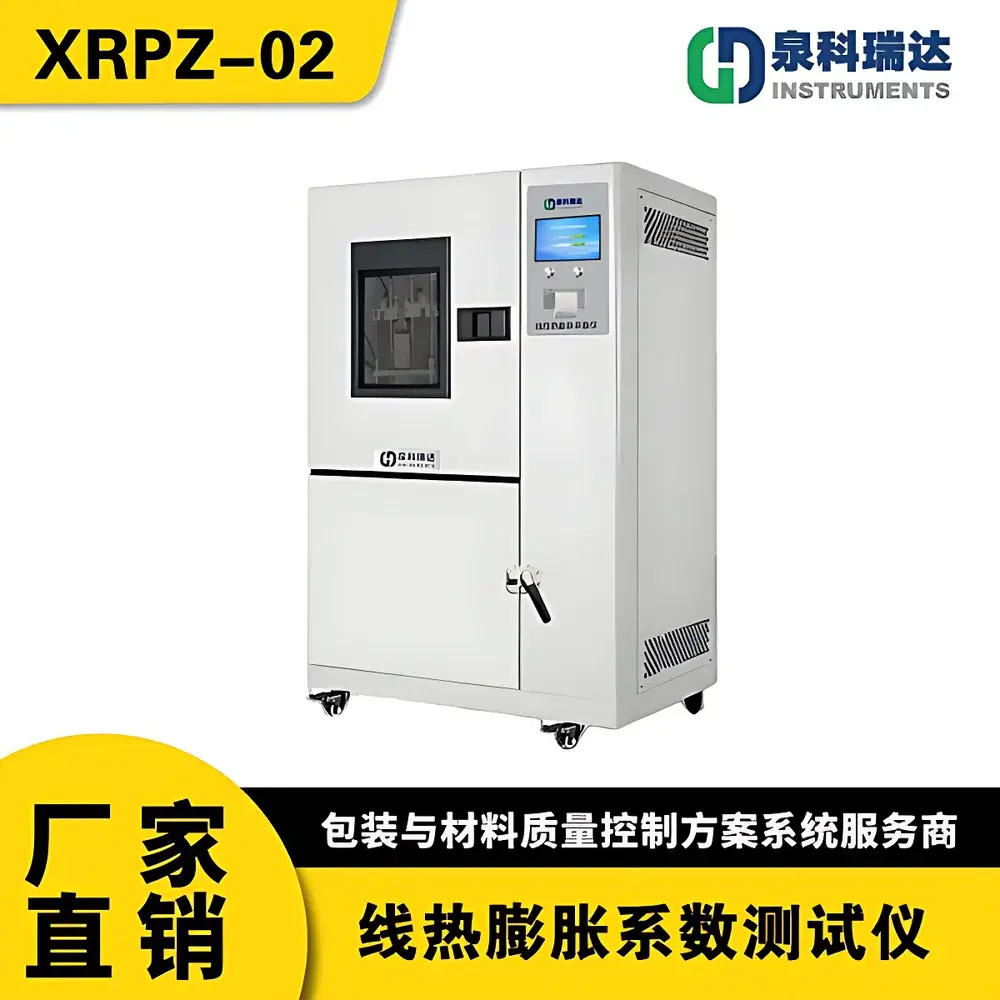
QKTester XRPZ-02 Linear Thermal Dilatometer for Glass Container Coefficient of Linear Expansion Measurement
| Brand | QKTester |
|---|---|
| Origin | Shandong, China |
| Manufacturer | QKTester |
| Model | XRPZ-02 |
| Temperature Range | Ambient to 400 °C |
| Heating Rate | 10 °C/min |
| Temperature Accuracy | ±1 °C |
| Sample Length | 150–200 mm |
| Displacement Range | 0–5 mm (±2.5 mm) |
| Resolution | 0.0001 mm |
| Power Supply | AC 220 V, 50 Hz |
| Power Consumption | 3 kW |
| Dimensions | 800 × 690 × 1700 mm |
| Weight | 29 kg |
Overview
The QKTester XRPZ-02 Linear Thermal Dilatometer is a precision instrument engineered for the quantitative determination of the coefficient of linear expansion (CLTE) of rigid solid materials—particularly glass containers, pharmaceutical vials, borosilicate tubing, and ceramic components—under controlled thermal conditions. It operates on the principle of contact-based displacement measurement: a high-resolution linear variable differential transformer (LVDT) or capacitive displacement sensor detects minute dimensional changes in a vertically oriented sample as it undergoes programmed thermal cycling from ambient temperature up to 400 °C. The system integrates a PID-controlled furnace with uniform axial heating profile, ensuring minimal thermal gradient across the sample length (150–200 mm). Data acquisition is synchronized with real-time temperature logging, enabling calculation of CLTE (αL) via the standard definition: αL = (1/L0)·(dL/dT), where L0 is the initial reference length at baseline temperature. Designed for routine QC laboratories and R&D environments in packaging, pharmaceuticals, and materials science, the XRPZ-02 delivers traceable, reproducible results aligned with regulatory expectations for thermal stability assessment.
Key Features
- PID-integrated intelligent temperature control system ensuring stable ramping (10 °C/min max) and holding accuracy of ±1 °C across the full 25–400 °C operating range
- High-resolution displacement sensing with 0.0001 mm resolution and ±2.5 mm full-scale range, optimized for low-magnitude expansion in brittle, low-CTE materials such as Type I borosilicate glass
- Dedicated software architecture comprising two core modules: (1) real-time furnace temperature regulation with programmable multi-step profiles, and (2) synchronized dimensional change acquisition with automatic zero-point compensation and thermal drift correction
- Automated post-processing algorithms compute linear expansion coefficient, cumulative expansion ΔL (mm), and relative expansion ΔL/L0 (%); all curves (temperature vs. displacement, temperature vs. αL) are exportable in CSV and PDF formats
- Robust mechanical design featuring corrosion-resistant stainless steel frame, insulated vertical sample chamber, and integrated electrical safety circuitry—including leakage current monitoring and over-temperature cutoff per IEC 61010-1
- Compliant with YBB00212003–2015 “Determination of Linear Expansion Coefficient of Pharmaceutical Packaging Glass Containers”, supporting audit-ready documentation for GLP/GMP-regulated facilities
Sample Compatibility & Compliance
The XRPZ-02 accommodates cylindrical or prismatic specimens with nominal lengths of 150–200 mm and diameters or cross-sections compatible with standard sample holders (e.g., glass vials, ampoules, tubing segments, and sintered ceramic rods). Its single-station configuration ensures consistent thermal boundary conditions and eliminates inter-channel variability. While primarily validated for glass substrates per Chinese Pharmacopoeia–aligned YBB00212003–2015, the instrument’s calibrated displacement and temperature response permit adaptation to ISO 11359-1 (Plastics — Thermomechanical Analysis), ASTM E228 (Linear Thermal Expansion of Solid Materials), and DIN 51045-1 (Thermal Expansion Testing) protocols—subject to user-defined calibration using NIST-traceable reference standards (e.g., fused quartz, Invar). All firmware and data logs maintain timestamp integrity via internal RTC (real-time clock) with battery-backed memory, satisfying basic ALCOA+ data integrity criteria for non-21 CFR Part 11 environments.
Software & Data Management
The proprietary Windows-based control software provides a deterministic, menu-driven interface with role-based access levels (Operator, Technician, Administrator). Experimental parameters—including start temperature, ramp rate, hold duration, and data sampling interval—are defined prior to run initiation. During operation, dual-channel real-time plots display temperature and displacement simultaneously, with dynamic threshold alerts for deviation >±0.5 °C or >±0.001 mm. Post-run, the software applies polynomial baseline correction to raw displacement data, computes point-wise αL values over user-selectable temperature intervals (e.g., 30–300 °C), and generates summary reports including mean αL, standard deviation, and confidence intervals (n ≥ 3 replicates). Raw datasets (.dat) and processed reports (.pdf/.xlsx) are stored with immutable metadata (operator ID, date/time, instrument serial number, calibration certificate ID), supporting retrospective review and internal audit requirements.
Applications
- Quality control of pharmaceutical glass packaging—verifying batch-to-batch consistency in thermal expansion behavior critical for sealing integrity and autoclave compatibility
- Development of low-expansion container systems for lyophilized biologics, where mismatched CLTE between stopper, vial, and aluminum seal induces stress-induced delamination
- Thermal stability screening of new borosilicate formulations during glass melting and annealing process optimization
- Validation of thermal cycling protocols used in accelerated aging studies per ICH Q1A(R2)
- Academic research on phase-transition-related expansion anomalies in crystalline ceramics and metallic alloys
FAQ
What is the maximum recommended sample length for accurate CLTE calculation?
The instrument is calibrated and validated for samples 150–200 mm in length; shorter specimens (<120 mm) may introduce boundary-effect errors due to non-uniform thermal conduction at clamping interfaces.
Does the XRPZ-02 support dual-sample testing?
The standard configuration is single-station; however, custom-engineered dual-furnace/dual-sensor variants are available upon request with extended lead time and validation documentation.
Is external calibration required before first use?
Yes—users must perform initial verification using certified reference materials (e.g., NIST SRM 735a fused silica rod) to confirm displacement linearity and temperature uniformity per ISO/IEC 17025 guidelines.
Can the software generate 21 CFR Part 11-compliant audit trails?
The base software does not include electronic signatures or biometric authentication; however, optional GxP-ready firmware upgrade packages with full Part 11 functionality (audit trail, role-based e-signature, data encryption) are available for regulated pharmaceutical labs.
What maintenance intervals are recommended for long-term accuracy?
LVDT calibration and furnace thermocouple verification should be performed every 6 months or after 200 operational cycles, whichever occurs first; optical alignment of the displacement sensor requires annual inspection by authorized service personnel.



