
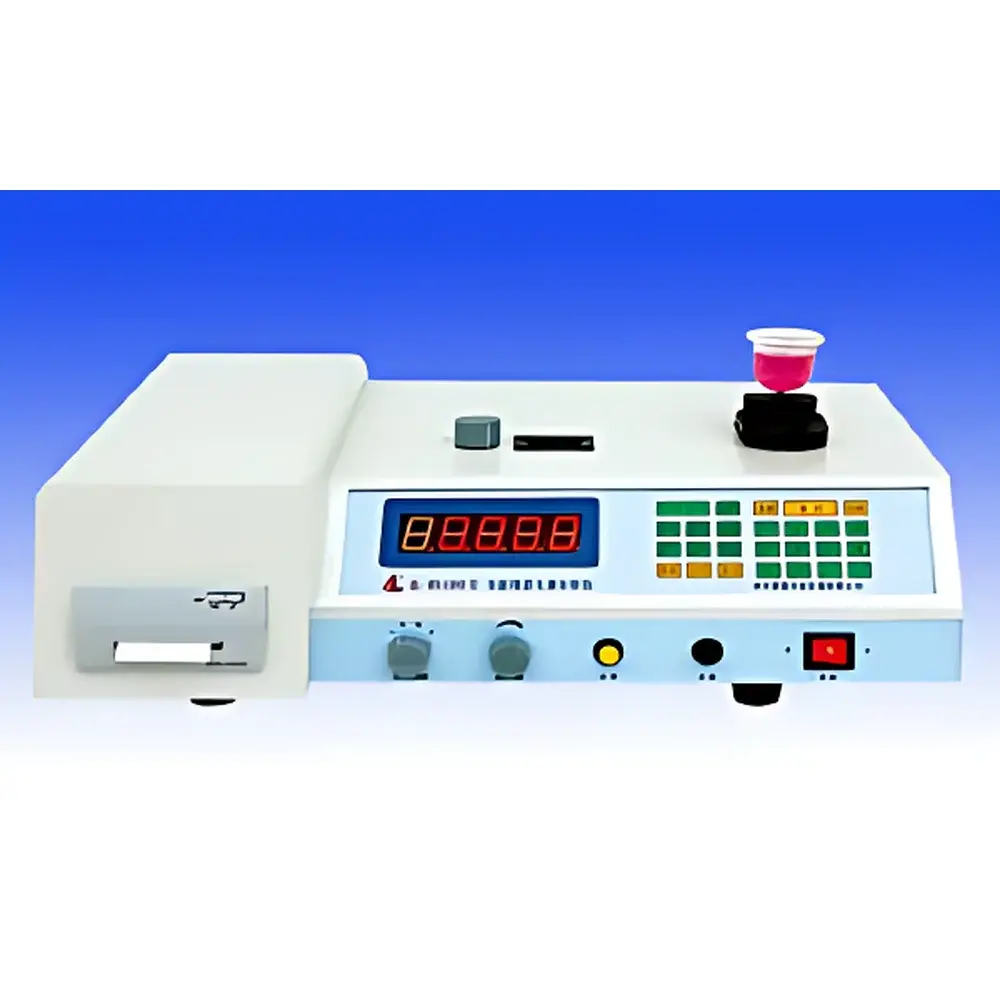
QL-BS1000 Qilin Portable Spectrophotometric Metal Elemental Analyzer
| Brand | Qilin (QL) |
|---|---|
| Model | QL-BS1000 |
| Origin | Jiangsu, China |
| Wavelength Range | 400–800 nm (continuously adjustable) |
| Absorbance Range | 0–1.999 A |
| Concentration Display Range | 0.000–99.99% (auto-ranging) |
| Wavelength Accuracy | ±3 nm |
| Data Storage | Onboard EEPROM (retains data for ≥10 years without power) |
| Power Supply | AC 220 V ±10%, 50 Hz ±5% |
| Power Consumption | ≤45 W |
| Net Weight | ≤15 kg |
| Display | 1-inch numeric LED display |
| Calibration | Auto-zero and full-scale calibration using cold light source and imported photodetectors |
| Curve Storage | Up to 9 pre-programmed calibration curves |
| Sample Handling | External dissolution |
| Optical System | Adjustable-wavelength monochromatic light source with microprocessor-controlled spectral selection |
Overview
The QL-BS1000 Qilin Portable Spectrophotometric Metal Elemental Analyzer is a benchtop optical emission-based elemental analyzer engineered for rapid, quantitative determination of major and minor metallic elements—including Si, Mn, P, Ni, Cr, and Cu—in aluminum alloys, ferrous metals, non-ferrous metals, and their derivatives. It operates on the principle of visible-range molecular absorption spectrophotometry: after chemical colorimetric development of analyte species (e.g., molybdenum blue for phosphorus, persulfate oxidation for manganese), the instrument measures absorbance at user-selectable wavelengths between 400 nm and 800 nm. This tunable-wavelength capability enables method-specific optimization—critical for minimizing interferences in complex alloy matrices—and distinguishes the QL-BS1000 from fixed-filter or broad-band photometers. Designed for foundry floor, QC lab, and incoming material inspection environments, it delivers reproducible results without requiring vacuum optics, high-voltage lamps, or inert gas purging. Its solid-state cold-light source and imported photodetectors ensure long-term photometric stability and eliminate warm-up drift.
Key Features
- Continuously adjustable wavelength selection (400–800 nm) with ±3 nm accuracy—enabling precise alignment to peak absorption maxima for each element-specific reaction system.
- Dual-range absorbance measurement (0–1.999 A) coupled with auto-ranging concentration display (0.000–99.99%), eliminating manual scale switching and reducing operator error.
- Onboard microcontroller (single-chip architecture) for automated reagent dosing control, timing sequence execution, and linear/nonlinear calibration curve fitting.
- Nine-user-configurable calibration curves stored in non-volatile EEPROM—retained for over 10 years without battery backup or external power.
- Cold-light source design with automatic zero and full-scale self-calibration before each measurement cycle—minimizing baseline drift and improving day-to-day repeatability.
- External sample dissolution workflow: all wet chemistry steps performed off-instrument, eliminating internal fluidic pathways, solenoid valves, and associated maintenance points such as clogging or elastomer degradation.
- Compact footprint and ≤15 kg mass—facilitating deployment at furnace-side locations, mobile QA carts, or space-constrained laboratory benches.
Sample Compatibility & Compliance
The QL-BS1000 supports analysis of solid metal samples following standardized acid digestion (e.g., HCl/HNO3/HF mixtures for Al-Si-Cu alloys) or fusion methods per ASTM E306, ISO 11575, and GB/T 20123. It is validated for use with common colorimetric chemistries defined in ASTM E1019 (for Si, Mn, P), ASTM E1251 (for Ni, Cr, Cu), and ISO 6429 (for low-alloy aluminum). While not certified for GLP/GMP-regulated release testing, its EEPROM-stored calibration history, manual audit trail via printed output, and deterministic microprocessor logic support internal quality system requirements under ISO/IEC 17025 Clause 7.7 (ensuring result traceability). No regulatory certification (e.g., FDA 21 CFR Part 11) is claimed; users implementing electronic records must validate software configuration independently.
Software & Data Management
The QL-BS1000 operates without PC dependency: all control, calculation, and display functions are executed onboard via embedded firmware. Quantitative results are shown on a 1-inch numeric LED display and may be printed via optional serial thermal printer (RS-232 interface). Calibration curves are entered manually or loaded from reference standard sets; no proprietary software installation or driver dependencies are required. Data integrity is maintained through write-protected EEPROM storage—immune to power loss, electromagnetic interference, or accidental overwrite. For laboratories integrating into LIMS, ASCII-formatted printouts provide machine-readable output compatible with OCR-based ingestion pipelines.
Applications
- Furnace-side composition verification during aluminum alloy melting and holding—enabling real-time adjustment of master alloy additions.
- Finished product certification per ASTM B209 (aluminum sheet) or EN 573 (wrought aluminum alloys), targeting key residuals such as Fe, Si, and Cu.
- Incoming raw material inspection of scrap aluminum, ingots, or master alloys against supplier specifications.
- Failure analysis support—quantifying segregation-related deviations in castings or extrusions.
- Process validation in heat treatment facilities where elemental homogeneity affects T6 temper response.
- Teaching laboratories conducting instrumental analysis modules on Beer-Lambert law applications in metallurgical chemistry.
FAQ
What sample preparation methods are recommended for aluminum alloys?
Acid digestion using a mixture of hydrochloric, nitric, and hydrofluoric acids—per ASTM E1019—is required to fully dissolve silicates and intermetallic phases. Fusion with lithium metaborate may be used for refractory-containing alloys.
Can the QL-BS1000 analyze trace elements below 0.01%?
No. Its optical design and colorimetric methodology are optimized for major and minor constituents (typically 0.02–30 wt%). Trace analysis (ppm-level) requires ICP-OES or spark-OES instrumentation.
Is wavelength calibration traceable to NIST standards?
The instrument does not include built-in NIST-traceable wavelength references; users must perform periodic verification using certified holmium oxide or didymium glass filters per ISO/IEC 17025 Section 6.4.
How often does the cold-light source require replacement?
Rated lifetime exceeds 10,000 hours under normal operation; no scheduled replacement interval is specified, but photometric stability should be verified monthly using blank and standard solutions.
Does the analyzer support ASTM E306-compliant reporting formats?
Raw data output complies with ASTM E306 Annex A1 requirements for tabular concentration reporting; however, full compliance—including uncertainty statements and analyst signatures—requires supplementary documentation outside the instrument’s native functionality.





