
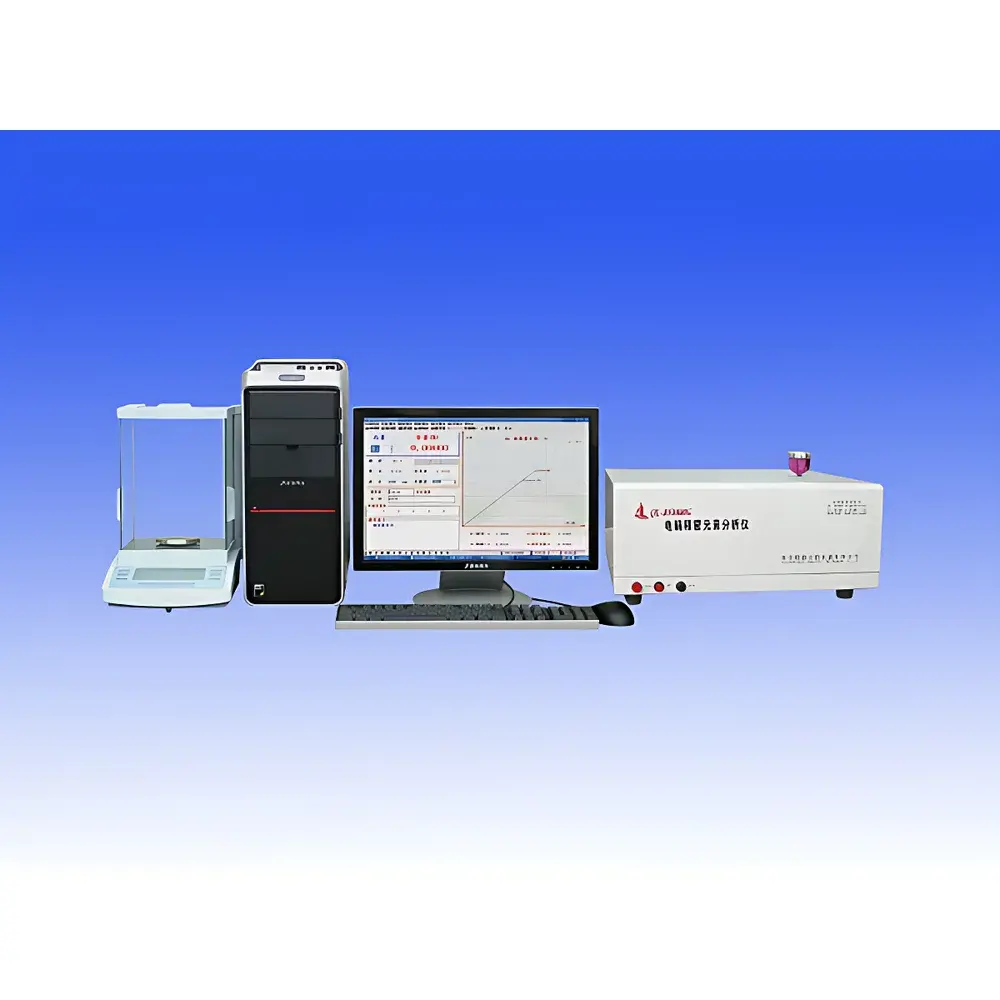
QL BS1000G Universal Precision Elemental Analyzer
| Brand | QL |
|---|---|
| Origin | Jiangsu, China |
| Manufacturer Type | Authorized Distributor |
| Country of Manufacture | China |
| Model | BS1000G |
| Price | USD 3,650 (FOB) |
| Wavelength Range | 400–800 nm (motorized continuous adjustment) |
| Absorbance Range | 0–1.999 A |
| Concentration Display Range | 0.000–99.99% (auto-ranging) |
| Measurement Time | ~120 s per sample |
| Analytical Accuracy | Compliant with GB/T 223.3–223.5–1988 and equivalent ISO/ASTM practices for photometric elemental analysis |
| Detection Elements | Si, Mn, P, Cr, Ni, Mo, Cu, Ti, V, Mg, Al, W, Rare Earths (Ce, La), Fe, etc. |
| Calibration Curves | 99 programmable polynomial regression curves per element |
| Sample Introduction | Off-line acid digestion (external dissolution) followed by photometric measurement |
| Light Source | Stabilized cold LED array with auto-zero and full-scale calibration |
| Data Interface | RS-232/USB to Windows PC |
| Power Supply | AC 220 V ±10%, 50 Hz ±5% |
| Max. Power Consumption | ≤350 W |
Overview
The QL BS1000G Universal Precision Elemental Analyzer is a benchtop photometric multi-element analyzer engineered for rapid, high-reproducibility quantitative analysis of metallic and alloyed materials in industrial quality control laboratories. It operates on the principle of **off-line acid digestion followed by visible-range spectrophotometric detection (400–800 nm)**, utilizing a motorized, continuously adjustable optical system to select optimal analytical wavelengths for each target element. Unlike fixed-filter or discrete-wavelength instruments, the BS1000G employs a precision stepper-motor-driven monochromator assembly, achieving wavelength resolution within ±3 nm—significantly tighter than conventional photometers (±20 nm). This enhanced spectral fidelity enables robust discrimination between overlapping absorption bands, particularly critical when analyzing complex matrices such as high-alloy steels, cast irons, and nickel-based superalloys. The system integrates seamlessly with standard laboratory balances via RS-232 or USB, enabling automatic mass input for gravimetric normalization. All operations—including wavelength selection, reagent dosing, absorbance reading, curve fitting, and result calculation—are coordinated through embedded firmware and a dedicated Windows-based application, ensuring traceability and procedural consistency.
Key Features
- Motorized continuous wavelength adjustment (400–800 nm) with ±3 nm repeatability, eliminating manual filter changes and enabling method flexibility across >15 elements
- 99 programmable calibration curves per element, built using polynomial regression algorithms for non-linear concentration-absorbance relationships
- Cold LED light source with automated zero-point and full-scale self-calibration before each measurement cycle, minimizing drift and lamp aging effects
- Computer-controlled reagent dispensing with volumetric accuracy better than ±0.5%, reducing analyst intervention and improving inter-batch reproducibility
- Off-line sample dissolution architecture—no internal fluidic valves or tubing—eliminates corrosion, clogging, and maintenance downtime associated with wet-chemistry autosamplers
- Direct integration with analytical balances: weight data auto-imported or manually entered, supporting both fixed- and variable-mass sampling protocols
- Comprehensive data management: timestamped results stored locally with user-defined metadata fields; export formats include CSV, XLSX, and PDF for LIMS compatibility
Sample Compatibility & Compliance
The BS1000G is validated for use with solid metallic samples requiring acid digestion (e.g., HCl/HNO₃/HF mixtures), including carbon steels, low- and high-alloy steels, austenitic and ferritic stainless grades, gray and ductile cast irons, aluminum alloys, and copper-based materials. It meets the performance criteria defined in Chinese national standards GB/T 223.3 (silicon), GB/T 223.5 (manganese), GB/T 223.11 (chromium), and GB/T 223.63 (phosphorus), which align with ISO 4940, ASTM E1019, and EN 10316 methodologies for photometric metal analysis. While not FDA 21 CFR Part 11–certified out-of-the-box, the software supports optional audit-trail logging and electronic signature configuration to meet GLP/GMP documentation requirements upon customer-specific validation.
Software & Data Management
The proprietary QL-Analyze™ software runs on Windows 10/11 and provides a fully localized English interface with intuitive menu navigation. It manages instrument control, calibration curve generation, real-time absorbance monitoring, statistical reporting (mean, SD, RSD%), and compliance reporting templates. All measurement events—including operator ID, sample ID, digestion batch, wavelength setting, raw absorbance, calculated concentration, and curve selection—are logged with immutable timestamps. Data export is configurable to match laboratory information management system (LIMS) ingestion protocols, including column mapping for CSV and structured XML. Optional modules support IQ/OQ documentation packages and electronic signature workflows compliant with ISO/IEC 17025 Clause 7.7.
Applications
- Rapid furnace-side composition verification for melt shop process control (e.g., Si/Mn/P in carbon steel heats)
- Finished product certification in metallurgical manufacturing (e.g., Cr/Ni/Mo in stainless grades per ASTM A240)
- Raw material incoming inspection for foundries and forging facilities (e.g., Ti/V in titanium-alloy feedstock)
- Quality assurance in mechanical component production (e.g., Cu/Al in bearing alloys per SAE J429)
- Research-grade elemental screening in university metallurgy labs where cost-effective, high-throughput photometry is preferred over ICP-OES
FAQ
What sample preparation method does the BS1000G require?
It requires off-line acid digestion (e.g., HCl-HNO₃ for steels, HF-containing mixtures for silicates), followed by dilution to known volume. No on-board digestion or nebulization is performed.
Can the instrument analyze non-metallic elements such as sulfur or nitrogen?
No. The BS1000G is optimized for metals and metalloids detectable by visible-region photometry (e.g., Si, Mn, Cr, Ni, Cu, Ti). S and N require combustion infrared or chemiluminescence detection.
Is method validation support provided for ISO/IEC 17025 accreditation?
Yes—QL provides documented test reports, linearity studies, LOD/LOQ assessments, and uncertainty budgets aligned with EURACHEM/CITAC guidelines. Full validation kits are available upon request.
How is wavelength calibration verified during routine operation?
The system performs automatic dark-current and reference-blank correction prior to each measurement; certified holmium oxide or didymium glass filters may be used for periodic wavelength verification per ISO 6326-1.
Does the software support network deployment or multi-user access?
Yes—the application supports concurrent local users via shared database mode; remote desktop access is permitted, though centralized server hosting requires additional IT infrastructure planning.





