
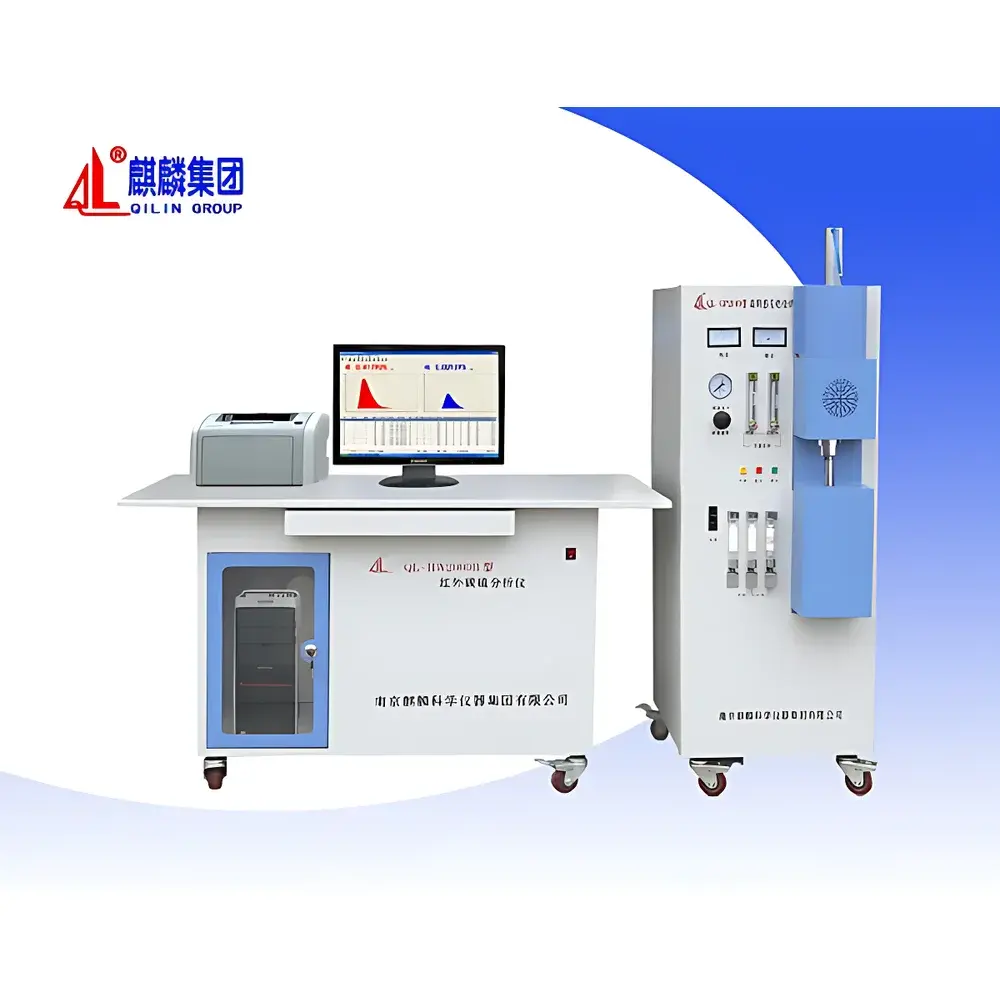
QL HW2000B High-Frequency Infrared Carbon-Sulfur Analyzer
| Brand | QL |
|---|---|
| Origin | Jiangsu, China |
| Manufacturer Type | Authorized Distributor |
| Origin Category | Domestic (China) |
| Model | HW2000B |
| Price | USD 13,800 (FOB Nanjing) |
| Measurement Principle | Non-Dispersive Infrared (NDIR) Absorption |
| Heating System | 2.5 kVA High-Frequency Induction Furnace (18–20 MHz) |
| Carbon Range | 0.00001–10.0000 wt% (extendable to 99.999 wt%) |
| Sulfur Range | 0.00001–0.5000 wt% (extendable to 99.999 wt%) |
| Sensitivity | 0.1 ppm (minimum display resolution) |
| Precision | Carbon RSD ≤ 0.5% |
| Analysis Time | 25–60 s (user-adjustable) |
| Compliance | GB/T 20123–2006, ISO 15350:2000 |
| Weighing Accuracy | 0.0001 g (external analytical balance required) |
| Optical Detection | High-stability pyroelectric IR detectors with narrow-band interference filters |
| Gas Handling | Precision mass flow control |
| Mechanical Drive | Aerospace-grade synchronous motor in IR absorption cell (MTBF > 100,000 h) |
| Compensation | Real-time temperature, pressure, and flow compensation algorithms |
Overview
The QL HW2000B High-Frequency Infrared Carbon-Sulfur Analyzer is a laboratory-grade elemental analyzer engineered for precise, routine quantification of total carbon (C) and total sulfur (S) in solid inorganic and metallurgical samples. It operates on the principle of non-dispersive infrared (NDIR) spectroscopy: sample combustion in a high-frequency induction furnace generates CO₂ and SO₂ gases, which are swept through dedicated optical cells where their characteristic infrared absorption bands (4.26 µm for CO₂, 7.35 µm for SO₂) are measured by thermally stable pyroelectric detectors. The instrument’s dual-channel detection architecture—paired with narrow-band interference filters—eliminates spectral cross-talk between carbon and sulfur signals, enabling reliable analysis even in high-carbon matrices (e.g., cast irons, ferroalloys) without chemical suppression or dilution. Designed for integration into QC/QA workflows in foundries, steel mills, and third-party testing labs, the HW2000B delivers trace-level sensitivity (0.1 ppm), wide dynamic range, and robust repeatability under variable ambient conditions.
Key Features
- 2.5 kVA high-frequency induction furnace (18–20 MHz) with RF-controlled thermal ramping ensures uniform, reproducible combustion across diverse sample types—including refractory alloys and low-conductivity ceramics—minimizing incomplete oxidation artifacts.
- Dual independent NDIR optical paths with thermoelectrically stabilized pyroelectric detectors and certified narrow-band interference filters (FWHM < 10 nm) provide long-term signal stability and eliminate inter-element interference, particularly critical for sulfur measurement in high-carbon steels.
- Real-time multi-parameter compensation engine corrects for ambient temperature drift, barometric pressure fluctuations, and carrier gas flow variance—ensuring consistent calibration transfer across shifts and laboratories.
- Modular electronic architecture with isolated analog signal conditioning, galvanically decoupled power supplies, and EMI-hardened PCB layout guarantees immunity to electrical noise from arc furnaces, rolling mills, or adjacent instrumentation.
- Gas handling system employs Airtac (Taiwan) solenoid valves rated for >100,000 actuation cycles and precision laminar-flow mass controllers (±0.5% FS accuracy), supporting unattended operation over extended validation runs.
- Optical absorption cell driven by aerospace-grade synchronous motor (rated >100,000 h MTBF) ensures zero mechanical backlash and positional repeatability critical for absorbance baseline stability.
Sample Compatibility & Compliance
The HW2000B accepts solid samples weighing 0.1–1.0 g (recommended), including ferrous and non-ferrous metals (e.g., stainless steels, aluminum alloys, titanium grades), mineral ores (iron ore, manganese nodules), cementitious materials, coal and coke, catalyst supports (Al₂O₃, SiO₂), and ceramic precursors. Sample preparation requires only homogenization and weighing on an external analytical balance (0.0001 g resolution). The system complies with ISO 15350:2000 and GB/T 20123–2006 for combustion-infrared determination of C and S in metallic materials. While not pre-certified for FDA 21 CFR Part 11, its audit-ready data logging structure—including operator ID, timestamped method parameters, raw detector voltages, and post-compensation integrals—supports GLP/GMP-aligned validation protocols when paired with compliant LIMS or ELN systems.
Software & Data Management
The embedded Windows-based control software provides full method configuration (combustion power ramp profiles, gas flow setpoints, integration windows), real-time spectral visualization, and automated baseline correction. All measurement data—including raw absorbance traces, calculated concentrations, RSD values per run, and system diagnostic logs—are stored in encrypted SQLite databases with immutable timestamps. Export options include CSV (for Excel/Statistica), XML (for LIMS ingestion), and PDF analytical reports with digital signature fields. Audit trails record all user actions (method edits, calibration updates, result overrides) with IP address and workstation ID—enabling retrospective forensic review per ALCOA+ principles.
Applications
- Metallurgical QC: Rapid verification of C/S specification compliance in incoming raw materials (scrap, ferroalloys) and finished products (billets, coils, forgings).
- Research & Development: Quantitative mapping of segregation effects in directional solidification experiments or diffusion couple studies.
- Mining & Geochemistry: Determination of organic carbon content in sedimentary rocks and total sulfur in sulfide-rich ores for resource grade modeling.
- Energy Sector: Monitoring sulfur accumulation in coal-fired boiler ash and desulfurization by-products per ASTM D3177.
- Catalyst Manufacturing: Validation of residual carbon/sulfur in supported noble-metal catalysts where ppm-level contamination deactivates active sites.
FAQ
What sample forms are compatible with the HW2000B?
Solid, non-volatile, and thermally stable samples—including metals, ores, cements, coals, and ceramics—are suitable. Liquids, volatile organics, or explosive compounds require prior conversion to solid residue (e.g., ashing) and are not recommended for direct analysis.
Does the instrument require daily recalibration?
No. The HW2000B uses stable reference gases and internal dark-current compensation; calibration verification with certified reference materials (CRMs) is recommended before each analytical batch per ISO/IEC 17025 requirements.
Can the system analyze sulfur in high-carbon steels without interference?
Yes. The narrow-band optical filtering and dual-wavelength referencing algorithm suppress CO₂ spectral overlap at the SO₂ detection band, validated per ISO 15350 Annex B for carbon contents up to 6.5 wt%.
Is external gas supply required?
Yes. Ultra-high-purity oxygen (99.995%, dew point < –70°C) is mandatory for complete combustion; argon or helium may be used as carrier/purge gases depending on application.
What maintenance intervals are specified for critical components?
The high-frequency oscillator tube requires replacement every 2,000–3,000 hours; IR detectors and filters are rated for ≥5 years under normal lab use; ceramic combustion tubes should be inspected after every 500 analyses and replaced if cracked or glazed.





