
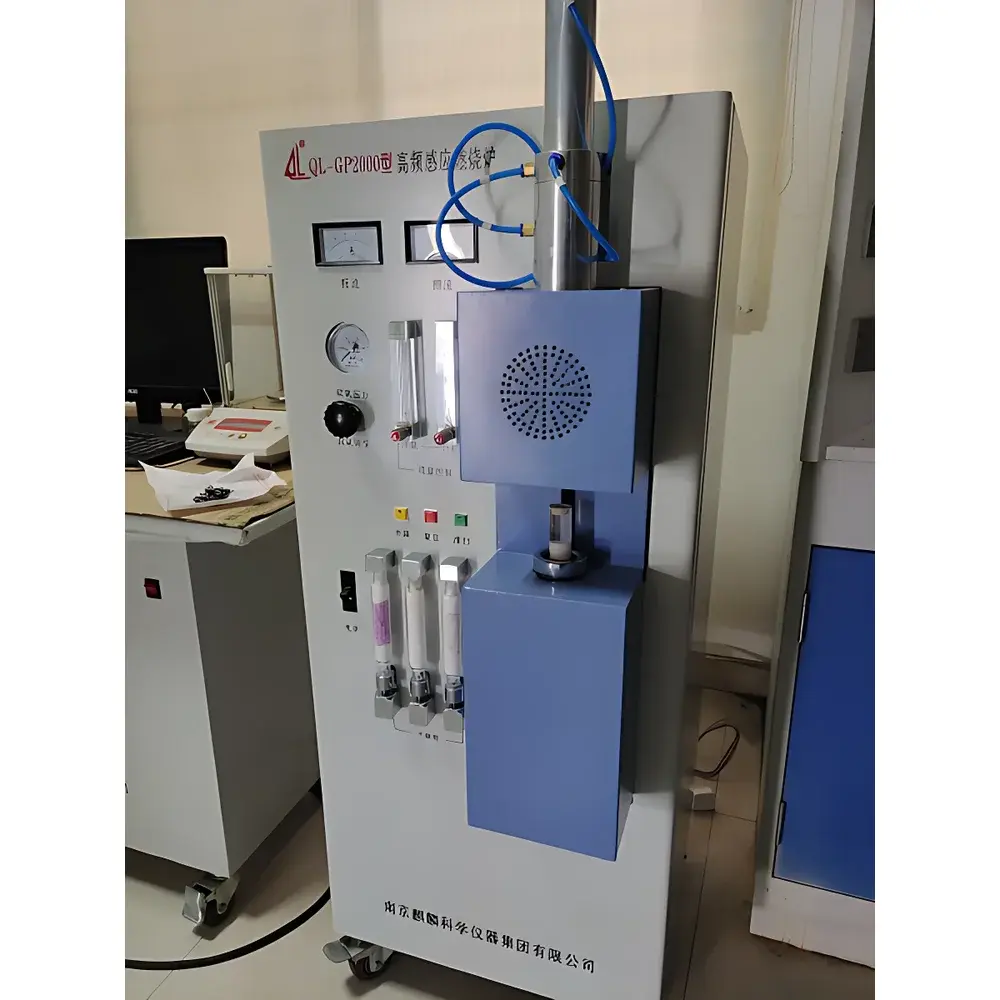
QL-HW2000B High-Frequency Infrared Carbon-Sulfur Analyzer
| Brand | Qilin (QL) |
|---|---|
| Origin | Jiangsu, China |
| Model | QL-HW2000B |
| Measurement Principle | Infrared Absorption Spectroscopy |
| Heating System | 2.5 kVA High-Frequency Induction Furnace (18–20 MHz) |
| Carbon Range | 0.00001–10.0000 wt% (extendable to 99.999 wt%) |
| Sulfur Range | 0.00001–0.5000 wt% (extendable to 99.999 wt%) |
| Sensitivity | 0.1 ppm (minimum display resolution) |
| Precision | Carbon RSD ≤ 0.5%, Sulfur RSD ≤ 1.0% |
| Analysis Time | 25–60 s (user-adjustable) |
| Compliance | GB/T 20123–2006, ISO 15350:2000 |
| Sample Weighing Accuracy | 0.0001 g |
| Detector Type | High-Stability Pyroelectric Infrared Detector with Narrow-Band Interference Filters |
| Gas Control | Precision Mass Flow Controllers + Airtac (Taiwan) Solenoid Valves (rated for ≥100,000 cycles) |
| Optical Drive | Aerospace-Grade Synchronous Motor (MTBF > 100,000 h) |
Overview
The QL-HW2000B High-Frequency Infrared Carbon-Sulfur Analyzer is a dedicated elemental combustion analyzer engineered for quantitative determination of total carbon (C) and sulfur (S) in solid inorganic and organic materials. It operates on the principle of high-temperature combustion followed by non-dispersive infrared (NDIR) absorption spectroscopy. Solid samples are precisely weighed (to 0.0001 g) and introduced into a sealed quartz combustion tube, where they undergo complete oxidation in an oxygen-rich atmosphere at temperatures exceeding 1,700 °C—generated by a 2.5 kVA high-frequency induction furnace operating at 18–20 MHz. The resulting CO₂ and SO₂ gases are carried through a dust- and moisture-removal system into dual independent NDIR cells. Each cell employs thermally stabilized pyroelectric detectors and narrow-band interference filters centered at 4.26 µm (CO₂) and 7.35 µm (SO₂), minimizing spectral overlap and cross-sensitivity. Real-time signal processing, coupled with temperature-, pressure-, and flow-compensated algorithms, ensures trace-level accuracy and long-term baseline stability.
Key Features
- High-frequency induction furnace with RF-controlled thermal ramping, delivering reproducible combustion efficiency across heterogeneous matrices—including refractory carbides, catalysts, and low-conductivity minerals.
- Dual-channel NDIR detection architecture with individually optimized optical paths, enabling simultaneous quantification of carbon and sulfur without inter-element interference—even in ultra-low-sulfur steels or high-carbon ceramics.
- Narrow-band interference filters (FWHM < 10 nm) and low-noise pyroelectric detectors achieve 0.1 ppm sensitivity and support extended dynamic ranges: C from 0.00001 to 99.999 wt%, S from 0.00001 to 99.999 wt% (with optional calibration extension).
- Robust gas handling system featuring mass flow controllers (±0.5% full scale) and industrial-grade solenoid valves (Airtac, Taiwan; rated for ≥100,000 actuations), ensuring leak-tight integrity and repeatable carrier gas delivery over extended operation.
- Modular motherboard design with embedded environmental compensation (T/P/flow), enabling consistent performance under variable laboratory conditions—critical for GLP-compliant routine QC labs.
- Quartz combustion tube assembly with integrated ceramic insulation and rapid cool-down protocol, reducing turnaround time between analyses while maintaining furnace longevity.
Sample Compatibility & Compliance
The QL-HW2000B accommodates a broad spectrum of sample types relevant to metallurgy, geology, energy, and catalysis: ferrous and non-ferrous alloys, graphite electrodes, silicon carbide, coal and coke, limestone and iron ore concentrates, petroleum coke, polymer fillers, and heterogeneous catalyst supports. Sample mass typically ranges from 0.1 to 1.0 g, depending on expected C/S concentration and matrix volatility. All measurements adhere to internationally recognized standards: carbon and sulfur determinations comply fully with GB/T 20123–2006 (identical to ISO 15350:2000) for solid metallic materials. The system supports audit-ready data generation aligned with ISO/IEC 17025 requirements, including electronic signature capability, full audit trail logging, and user-access-level controls—facilitating integration into GMP or FDA 21 CFR Part 11–governed environments when paired with validated LIMS interfaces.
Software & Data Management
The instrument is operated via Windows-based QL-Analyzer software, supporting method-driven workflows with configurable analysis parameters (e.g., pre-burn duration, oxygen flow rate, integration time). Raw detector signals, baseline-corrected absorbance values, and final %C/%S results are stored in encrypted binary format with timestamp, operator ID, sample ID, and calibration reference metadata. Export options include CSV, XML, and PDF reports compliant with internal QA templates. Software includes statistical modules for RSD calculation, drift monitoring, and control chart generation (X-bar/R), enabling real-time assessment of measurement consistency per ASTM E29–23 guidelines. Data backup and restore functions support automated network synchronization, and optional OPC UA connectivity allows seamless integration with enterprise MES or SAP QM modules.
Applications
This analyzer serves as a primary QC tool in high-precision manufacturing sectors where carbon and sulfur content directly govern mechanical properties and corrosion resistance. Key use cases include: verification of carbon specification in high-speed steel and bearing alloys; sulfur quantification in rail-grade austenitic stainless steels to prevent hot shortness; compositional screening of lithium-ion battery cathode precursors (e.g., Ni-rich NMC); sulfur speciation support in coal quality assurance (ASTM D3177); and trace carbon analysis in high-purity quartz crucibles used in semiconductor crystal growth. Its ability to handle challenging matrices—such as borosilicate glass frits and spent automotive catalysts—has been validated in third-party interlaboratory studies coordinated by CNAS-accredited testing centers.
FAQ
What sample preparation is required prior to analysis?
Solid samples must be homogenized and dried (if hygroscopic), then weighed to ±0.0001 g using an analytical balance calibrated per ISO/IEC 17025. No acid digestion or solvent extraction is needed—direct solid combustion is employed.
Can the instrument analyze liquid or powder suspensions?
No—the QL-HW2000B is designed exclusively for solid samples. Liquids, gels, or slurries require prior evaporation and residue ashing under controlled conditions, which is outside the scope of standard operation.
How frequently must the calibration be verified?
Daily verification using certified reference materials (CRMs) traceable to NIST or IRMM is recommended for regulated environments; weekly verification suffices for routine industrial QC when system stability metrics remain within control limits.
Is helium required as a carrier gas?
No—high-purity oxygen (≥99.995%) is the sole required gas. Helium or argon are not used in this configuration.
Does the system support remote diagnostics or firmware updates?
Yes—via secure TLS-encrypted Ethernet connection, authorized service engineers can perform real-time diagnostic logging, parameter optimization, and version-controlled firmware upgrades without onsite intervention.



