
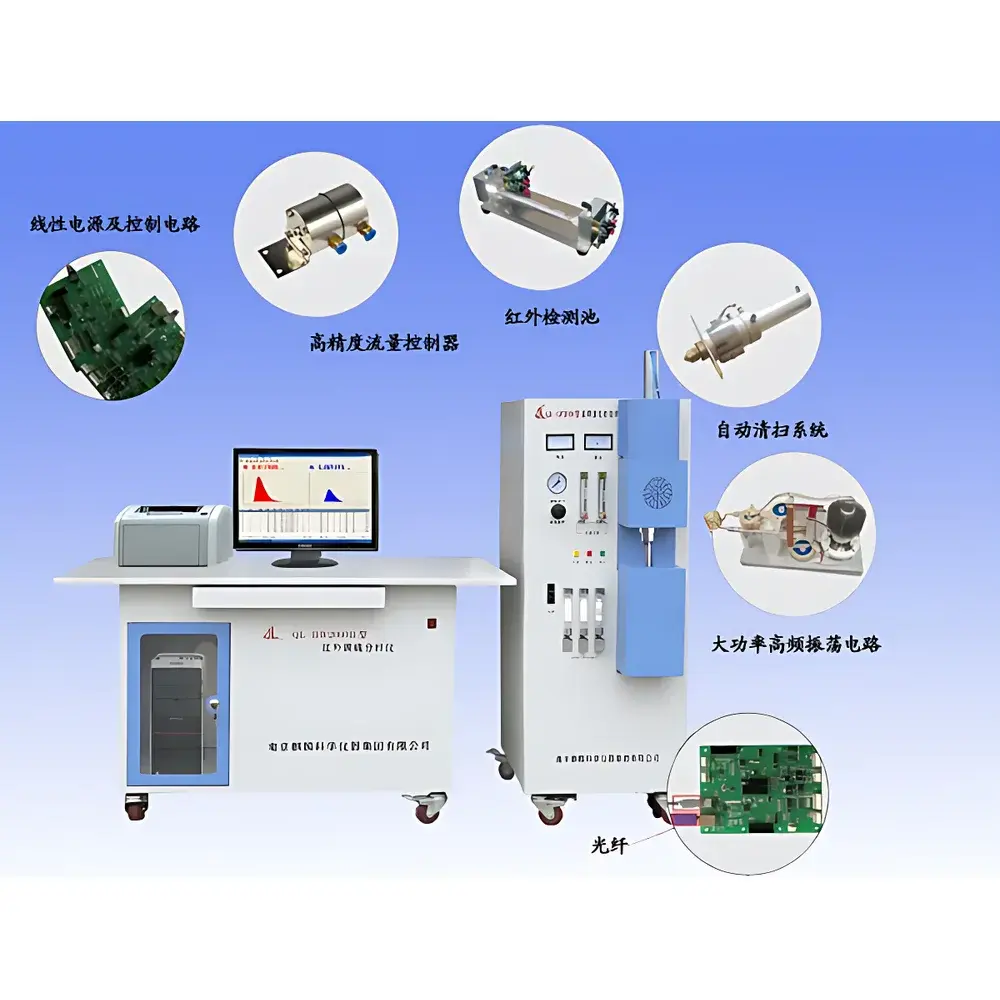
QL-HW2000B High-Frequency Infrared Carbon-Sulfur Analyzer for Coal and Solid Fuels
| Brand | QL |
|---|---|
| Origin | Jiangsu, China |
| Model | HW2000B |
| Detection Principle | Non-Dispersive Infrared (NDIR) Spectroscopy |
| Measurement Range | C: 0.0001–99.999 wt% |
| S | 0.0001–99.999 wt% |
| Precision | C RSD ≤0.5% |
| Sensitivity | 0.1 ppm |
| Analysis Time | 25–60 s (typ. 35 s) |
| Compliance | GB/T 20123–2006 & ISO 15350:2000 |
| Sample Weighing | 0–120 g, readability 0.0001 g |
| High-Frequency Furnace | 2.5 kVA, 18–20 MHz |
| Optical Path | Platinum IR source, gold-plated gas cell, aviation-grade modulation motor, narrow-band interference filters (CO₂ @ 4.26 µm |
Overview
The QL-HW2000B High-Frequency Infrared Carbon-Sulfur Analyzer is a dedicated elemental combustion analyzer engineered for precise quantification of total carbon (C) and total sulfur (S) in solid fuel matrices—including coal, coke, char, lignite, anthracite, and associated mineral feedstocks. It operates on the fundamental principle of non-dispersive infrared (NDIR) absorption spectroscopy: following high-frequency induction combustion (18–20 MHz), evolved CO₂ and SO₂ gases are swept through a temperature- and pressure-stabilized optical path. Each gas exhibits characteristic vibrational-rotational absorption at discrete mid-infrared wavelengths—4.26 µm for CO₂ and 7.4 µm for SO₂. A dual-channel, thermally stabilized detection system employs narrow-band interference filters and high-sensitivity pyroelectric detectors to isolate and quantify absorbance signals with minimal cross-interference. The instrument integrates real-time flow, temperature, and pressure compensation algorithms to ensure metrological traceability across heterogeneous sample types and matrix compositions.
Key Features
- Dual-CPU architecture with industrial-grade modular power supply, delivering electromagnetic compatibility (EMC) robustness in laboratory and plant-floor environments.
- Platinum-coated infrared source operating at 800 °C, coupled with gold-plated absorption cells to minimize wall adsorption and maximize signal-to-noise ratio.
- Aerospace-grade synchronous motor for optical chopper modulation (64 Hz), rated for >100,000 hours of continuous operation without performance drift.
- Automatically switched dual-carbon infrared detection cells enable extended dynamic range coverage—from ultra-trace (0.1 ppm) to near-pure carbon materials (up to 99.999 wt%).
- High-reproducibility high-frequency furnace (2.5 kVA) with RF-controlled thermal ramping, ensuring consistent combustion efficiency and minimizing incomplete oxidation artifacts.
- Integrated gravimetric subsystem: analytical balance (0–120 g, 0.1 mg resolution) compliant with ISO/IEC 17025 mass calibration requirements.
Sample Compatibility & Compliance
The QL-HW2000B is validated for use with coal and related carbonaceous solids per national and international standard methods. It conforms fully to GB/T 20123–2006 (equivalent to ISO 15350:2000), which specifies procedures for determination of total carbon and total sulfur in steels and irons—and is widely adopted by coal testing laboratories for method transfer validation. The system accommodates heterogeneous particulates (≤1 mm particle size), pressed pellets, and ash-free organic matrices without chemical pretreatment. Optional oxygen flow optimization and ceramic crucible configurations support ASTM D3176 (ultimate analysis) and ISO 19579 (sulfur in solid biofuels) workflows. All firmware and data handling modules comply with GLP documentation requirements, including full audit trail logging for balance readings, furnace parameters, gas flow profiles, and raw spectral integrals.
Software & Data Management
The embedded Windows-based control software provides ISO/IEC 17025-aligned data acquisition, calibration management, and report generation. Calibration curves are generated using certified reference materials (CRMs) traceable to NIST SRM 1632e (coal), BCS-CRM 383 (coke), and LECO® standards. Software supports multi-point linear and quadratic regression, drift correction via internal reference gas pulses, and automatic blank subtraction. Raw detector voltage waveforms (64 Hz AC-coupled output), integrated absorbance values, and final %C/%S results are stored in vendor-neutral CSV and XML formats. Audit trails record operator ID, timestamp, method version, calibration status, and instrument configuration changes—meeting baseline requirements for FDA 21 CFR Part 11 compliance when deployed with networked domain authentication and electronic signature protocols.
Applications
This analyzer serves as a primary tool in coal quality assurance, power plant fuel procurement, coking plant process control, and environmental emissions monitoring. Typical use cases include: determination of total sulfur content for SOₓ emission forecasting and compliance with EU Industrial Emissions Directive (IED) limits; carbon content verification for calorific value estimation (ASTM D5865); assessment of desulfurization efficiency in flue gas cleaning systems; characterization of activated carbons and biomass-derived chars for adsorption capacity modeling; and QC screening of coal blends prior to pulverized coal injection (PCI) in blast furnaces. Its broad dynamic range also supports research applications in geochemical carbon sequestration studies and low-sulfur coal deposit mapping.
FAQ
What combustion technique does the QL-HW2000B employ?
It uses high-frequency induction heating (18–20 MHz) within a ceramic crucible under controlled oxygen atmosphere to achieve complete oxidation of carbon and sulfur into CO₂ and SO₂.
Is the instrument capable of measuring other elements besides C and S?
No—the QL-HW2000B is a dedicated carbon-sulfur analyzer. Multi-element capability (e.g., Mn, Si, P) requires integration with a separate spectrometer (e.g., QL-BS1000G), as referenced in system integration documentation.
How is interference between CO₂ and SO₂ absorption minimized?
Through wavelength-specific narrow-band interference filters (4.26 µm and 7.4 µm), combined with sequential gas-phase filtering and real-time baseline correction algorithms.
What maintenance intervals are recommended for the infrared source and detector?
The platinum IR source and pyroelectric detector require no scheduled replacement under normal operation; preventive inspection is advised every 12 months or after 5,000 analyses.
Can the system be validated for ISO/IEC 17025 accreditation?
Yes—full metrological documentation, CRM traceability statements, uncertainty budgets, and interlaboratory comparison reports are provided upon request to support accreditation audits.






