
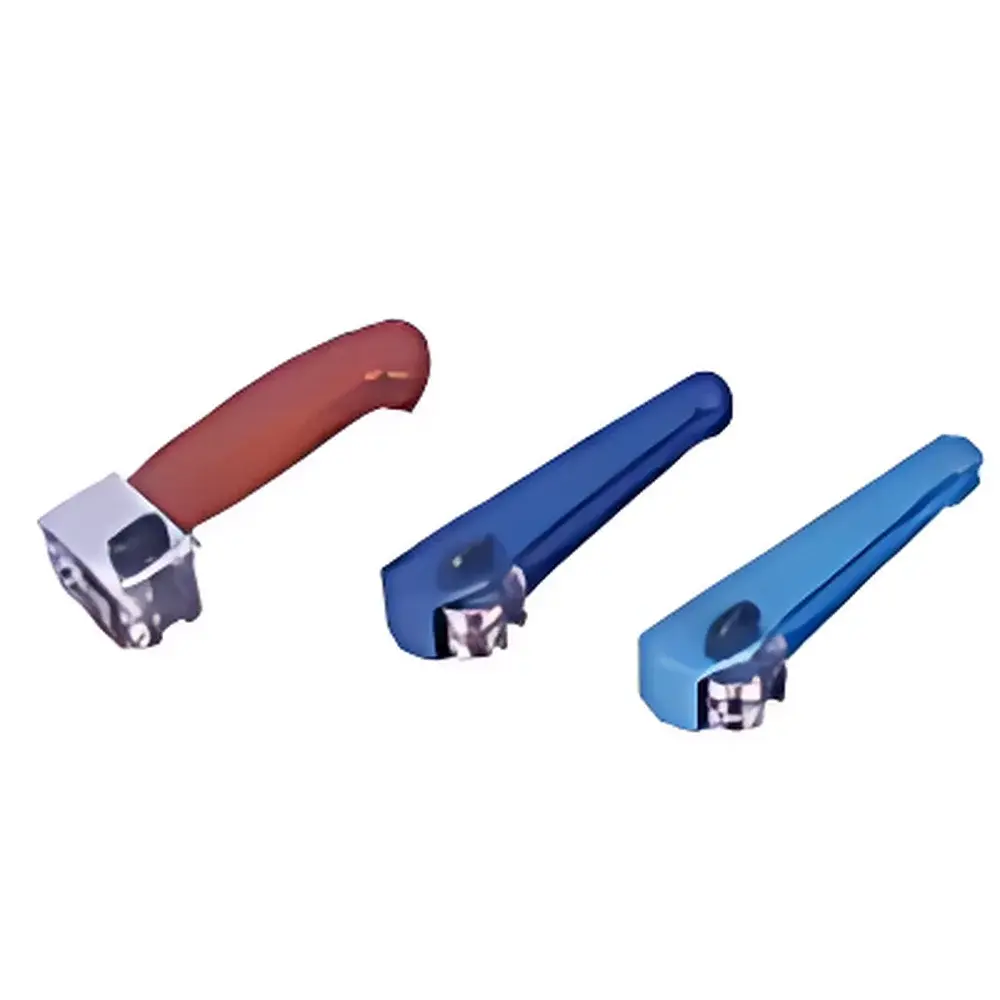
Qnix GW Cross-Cut Adhesion Tester
| Origin | Shanghai, China |
|---|---|
| Manufacturer Type | Authorized Distributor |
| Origin Category | Domestic (China) |
| Model | GW |
| Pricing | Available Upon Request |
| Compliance | ISO 2409:1974, GB/T 9286–1998 |
| Blade Spacing Options | 1 mm and 2 mm |
| Recommended Film Thickness Range | ≤60 µm (1 mm blade), 60–100 µm (2 mm blade) |
| Test Environment | 23 °C ± 2 °C, 50 % RH ± 5 % |
| Blade Configuration | Quadruple-edge replaceable cutting head with ship-shaped nut and thrust screw adjustment |
Overview
The Qnix GW Cross-Cut Adhesion Tester is a precision-engineered manual instrument designed for the standardized evaluation of coating adhesion to rigid substrates using the cross-cut method. It operates on the principle of controlled mechanical incision—employing a hardened multi-blade cutting head to produce a defined grid pattern (typically 6 × 6 or 11 × 11 squares) perpendicular to the substrate surface. This geometrically reproducible lattice enables quantitative assessment of interfacial bond integrity through subsequent tape application and visual classification per ISO 2409:1974 and GB/T 9286–1998. Unlike automated or motorized systems, the GW model prioritizes mechanical simplicity, operator control, and field-deployable robustness—making it suitable for both accredited laboratory environments and uncontrolled industrial sites where portability, minimal power dependency, and rapid setup are critical.
Key Features
- Interchangeable dual-spacing cutting heads: 1 mm and 2 mm blade pitch, each optimized for specific dry film thickness (DFT) ranges—1 mm for coatings ≤60 µm and 2 mm for 60–100 µm DFT—ensuring compliance with test standard requirements for grid density and stress distribution.
- Quadruple-edge hardened steel cutting head with precision-ground blades; four usable edges per insert reduce consumable replacement frequency and support extended calibration stability.
- Tool-free blade rotation mechanism: A ship-shaped locking nut and top-mounted thrust screw allow rapid 90° indexing of the cutting head without disassembly—enabling immediate edge renewal when micro-chipping or dulling occurs during repetitive use.
- Ergonomic aluminum alloy body with non-slip rubberized grip and integrated depth stop, ensuring consistent downward pressure and vertical blade alignment across variable operator skill levels.
- No external power source required; fully manual operation ensures uninterrupted functionality in remote locations, cleanrooms, or hazardous zones where electrical equipment is restricted.
Sample Compatibility & Compliance
The GW Cross-Cut Adhesion Tester is validated for use on flat, rigid substrates including cold-rolled steel, aluminum panels, glass, and rigid plastics—provided surface curvature radius exceeds 100 mm and substrate hardness is ≥HV 150. It is not intended for flexible films, elastomeric coatings, or substrates with surface roughness exceeding Ra 3.2 µm unless pre-qualified per ASTM D3359 Annex A2. The instrument meets the dimensional, blade geometry, and force application specifications outlined in ISO 2409:1974 (identical to EN ISO 2409) and its Chinese national adoption GB/T 9286–1998. Test reporting must reference the applicable standard edition and include environmental monitoring logs (temperature and relative humidity) as mandated by ISO/IEC 17025 for accredited testing laboratories.
Software & Data Management
As a purely mechanical test device, the GW Cross-Cut Adhesion Tester does not incorporate embedded electronics, firmware, or digital connectivity. All measurements are performed manually, and result documentation follows standardized visual rating protocols (e.g., ISO 2409 classification scale: 0B–5B). For laboratories operating under GLP or GMP frameworks, users are advised to record test parameters—including blade type, substrate ID, environmental conditions, tape type (e.g., 3M™ 600 or TESA® 7475), peel angle, and observer-assigned rating—in a validated electronic lab notebook (ELN) or LIMS. While no proprietary software is bundled, the instrument’s output is fully compatible with audit-trail-enabled systems compliant with FDA 21 CFR Part 11 when paired with appropriate data capture workflows.
Applications
- Quality control of coil-coated and pre-painted metal sheets in OEM manufacturing lines.
- On-site verification of protective coating adhesion after blast cleaning and application on structural steel bridges or offshore platforms.
- R&D screening of primer-topcoat systems for automotive refinish and aerospace maintenance depots.
- Third-party certification testing for architectural coating products seeking CE marking or CCC certification.
- Failure analysis investigations where delamination onset correlates with grid-pattern failure morphology (e.g., cohesive vs. adhesive failure modes).
FAQ
What standards does the GW Cross-Cut Adhesion Tester comply with?
ISO 2409:1974 and GB/T 9286–1998. It is not certified to ASTM D3359, though comparative use may be justified under method validation per ISO/IEC 17025 Clause 7.2.2.
Can the GW tester be used on curved surfaces?
Only on gently curved substrates with radius ≥100 mm; concave or highly contoured geometries require alternative methods such as pull-off adhesion testers (ASTM D4541) or modified dolly fixtures.
How often should the cutting blades be replaced?
Blade life depends on substrate hardness and cumulative cuts; typical service interval is 200–500 grids per edge under standard steel panel testing. Visual inspection for burring or inconsistent incision depth is the primary replacement criterion.
Is calibration required before each test?
No formal calibration is specified in ISO 2409; however, daily verification of blade sharpness, spacing accuracy (using calibrated optical comparator or gauge block), and perpendicular alignment is recommended as part of a laboratory’s internal quality control procedure.
Does the GW model support traceable metrology documentation?
Yes—each unit ships with a manufacturer’s declaration of conformance to ISO 2409 geometry tolerances. Optional third-party metrological verification (e.g., NIST-traceable blade pitch measurement) can be arranged through authorized calibration service providers.



